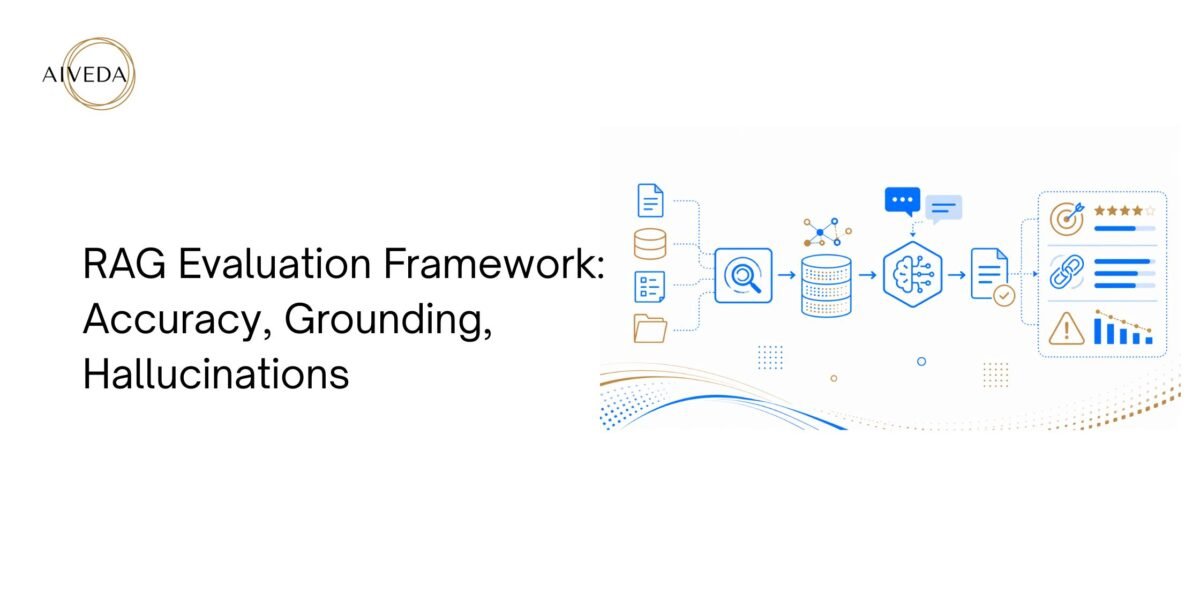
Retrieval-augmented generation-powered AI systems are revolutionising the way companies access and utilise data. However, these algorithms may produce erroneous or deceptive results without a robust framework for rag evaluation. Evaluation becomes crucial at that point.
A well-thought-out rag evaluation strategy ensures that your system delivers dependable, accurate, and grounded responses. It reduces risks like hallucinations and false information while assisting organisations in deploying AI with confidence. Retrieval augmented generation evaluation also provides quantifiable information about system performance.
This blog will teach you how to create a successful assessment plan, comprehend important metrics for evaluating rag systems, and investigate best practices for assessing rag systems in practical settings.
What is a RAG Evaluation Framework?
An organised method for guarding the performance of a retrieval-augmented generation system is a rag assessment framework. It is crucial for end-to-end retrieval augmented generation evaluation as it assesses both retrieval quality and response generation.
Rag systems evaluation, in contrast to typical LLM evaluation, necessitates examining two components:
- The significance of the documents that were retrieved
- The precision of the responses produced
A rag evaluation framework is made more complex by this dual-layer complexity. It guarantees that results are not just coherent but also factually accurate and based on data solutions that have been retrieved.
A rag evaluation framework’s main objectives are as follows:
- Assessing the correctness of responses
- Making sure the supply is grounded
- Recognising hallucinations
- Monitoring performance over time
To preserve uniformity and enhance system performance, organisations depend on clearly established rag model evaluation metrics. Scaling and trusting AI systems in industrial settings becomes challenging without a systematic strategy.
Why Evaluating RAG Systems is Critical
Even sophisticated AI models may fail in crucial situations if rag systems are not properly evaluated. Poor judgements might result from inaccurate outputs, particularly in sectors like healthcare, banking, or legal services.
A strong rag evaluation framework helps reduce these risks by ensuring every response is backed by reliable data. It also improves transparency, making AI systems more trustworthy.
Retrieval enhanced generation evaluation is important for the following reasons:
- Prevents false information: Lessens false or inaccurate answers
- Increases user trust: Ensure dependable and consistent results
- Encourages compliance: Essential for industries under regulation
- Improves performance: Find gaps in creation and retrieval
Furthermore, rag model evaluation metrics offer quantifiable standards for advancement. Based on actual data insights, businesses may continuously improve their systems.
For example, businesses like AIVeda incorporate structured rag evaluation framework techniques to ensure that enterprise AI systems fulfil strict security and accuracy requirements.
How to Evaluate RAG Models?
A systematic method that assesses both generation accuracy and retrieval quality is necessary for evaluating RAG models. The effectiveness of the system’s retrieval of pertinent data and its accuracy in using that data to produce responses are key components to evaluate.
Start by evaluating retrieval performance using metrics such as Precision@K and Recall@K. These aid in determining whether the system is retrieving the documents that are most pertinent to a certain query. Next, as part of the retrieval augmented generation evaluation, assess the generated responses for accuracy, lucidity, and pertinence.
Measuring grounding to determine whether the result is directly supported by retrieved sources is also crucial. The evaluation phase is essential since it guarantees dependability and transparency. Additionally, keep an eye out for hallucinations by spotting answers that contain false or unsupported information.
For optimal outcomes, combine human inspection with automatic rag model evaluation measures. Metrics offer scalability, but human evaluation catches subtlety and context. Lastly, use real-world data to continuously analyse and enhance your system’s performance over time.
Core Pillars of a RAG Evaluation Framework
Three key elements form the foundation of a strong rag evaluation framework: accuracy, grounding, and hallucinations. These pillars determine the performance of a system in practical applications.
Accuracy
Accuracy assesses how accurate and pertinent the generated response is. This entails determining whether the result is consistent with true data in retrieval augmented generation evaluation.
Key aspects include:
- Appropriate questions interpretation
- Relevance of the data retrieved
- Generate accurate responses
Grounding
Grounding guarantees that answers are backed up by the sources that were collected. Traceability and source alignment are given top priority in a robust rag evaluation framework.
Benefits include:
- Enhanced dependability
- Improved explainability
- decreased possibility of fraudulent claims
Hallucinations
When the model produces information that isn’t in the data, hallucinations happen. Finding hallucinations is important while assessing rag systems.
Common causes:
- Inadequate retrieval mechanisms
- Inadequate rapid design
- An excessive dependence on model memory
The framework guarantees reliable and high-quality results by concentrating on these aspects.
Key RAG Model Evaluation Metrics You Must Track
Tracking the appropriate metrics is crucial to developing a trustworthy rag evaluation system. The evaluation metrics help measure system performance and pinpoint areas for improvement.
Here is a quick overview:
| Metrics | Purpose |
|---|---|
| Recall@K, Precision@K | Measure relevant retrieved documents |
| BLEU, ROUGE | Evaluate text quality and similarity |
| Faithfulness score | Ensure alignment with source data |
| Fact-checking scores | Datect unsupported claims |
| Latency, response time | Measure system efficiency |
A comprehensive view can be obtained in retrieval augmented generation evaluation by integrating several measures. For example:
- High recall guarantees the retrieval of pertinent facts.
- High fidelity guarantees grounded outputs.
One metric is enough, it balances approach while guaranteeing accuracy and dependability.
Quantitative vs Qualitative Evaluation in RAG
| Aspect | Quantitative Evaluation | Qualitative Evaluation |
|---|---|---|
| Definition | Uses numerical data and rag model evaluation metrics to measure system performance | Relies on human judgment to assess response quality and usability |
| Purpose | Provides objective insights | Evaluates real-world effectiveness when evaluating rag systems |
| Key Methods | Recall@K, Precision@K, BLEU, ROUGE, latency tracking | Manual review, user feedback, expert analysis |
| Advantages | Scalable, fast, and consistent across large datasets | Captures context, nuance, and user experience |
| Limitation | May miss contextual errors or subtle hallucinations | Time-consuming and less scalable |
| Role in RAG | Essential for automated retrieval augmented generation evaluation | Critical for validating accuracy and clarity in outputs |
| Best Use Case | Benchmarking and continuous monitoring | Final validation and improving user trust |
A balanced rag evaluation strategy that accounts for both technical accuracy and user experience is ensured by combining the two approaches.
Step-by-Step Guide to Evaluating RAG Systems
A methodical approach is necessary to provide a robust foundation. This is a useful, step-by-step method for efficiently assessing rag systems.
Step 1: Describe Evaluation
Determine what success looks like first. Align your evaluation of retrieval augmented generation with business objectives including compliance, speed, and accuracy.
Step 2: Create Benchmark Datasets
Make carefully chosen datasets that represent enquiries from the real world scenario. Consistent rag model evaluation metrics depend on these datasets.
Step 3: Assess Retrieval Efficiency
Use metrics such as Recall@K to gauge how well your system finds relevant material.
Step 4: Assess the Quality of Generation
Evaluate the generated quality response. Pay attention to completeness, accuracy, and clarity.
Step 5: Look for Hallucinations
To find unsupported outputs, use both automated techniques and human assessment.
Step 6: Ongoing Observation
It takes time to establish a rag evaluation mechanism. For better outcomes, keep an eye on your system and make any adjustments.
Get in touch with AIVeda today and transform your RAG systems into dependable, high-performing AI solutions.
Common Challenges in RAG Evaluation (The Solution to Them)
A framework for rag evaluation is necessary, but putting it into practice is difficult. Understanding these helps in enhancing retrieval augmented generation evaluation techniques.
Common mistakes:
- Absence of uniform measures
- Accurately assessing grounding is difficult.
- Exorbitant human evaluation costs
- Over time, data drift
- Difficulty of scaling and assessing
For example, because grounding necessitates confirming source alignment, it is frequently difficult to quantify. In a similar vein, detecting hallucinations may be arbitrary.
The Solution:
- Employ hybrid assessment techniques
- Update datasets frequently.
- Automate whenever you can.
A well-designed RAG system consistent performance.
Tools and Frameworks for RAG Evaluation
The task of assessing rag systems and putting in place a strong rag evaluation framework can be made simpler by a number of tools.
Well-liked choices consist of:
- RAGAS: Prioritises fidelity and pertinent responses
- TruLens: Offers comprehensive assessment insights
- LangSmith: Assists with LLM application monitoring and debugging
By automating crucial procedures and monitoring performance indicators, these technologies facilitate the evaluation of retrieval augmented generation.
Advantages of tool use:
- Quicker cycles of evaluation
- Improved system performance visibility
- Scalable testing environments
Businesses can enhance their rag model evaluation metrics and more effectively optimise system performance by integrating these solutions.
Best Practices for an Effective RAG Evaluation Framework
It is crucial to adhere to best practices to construct a successful rag evaluation system. These guarantee scalable and dependable retrieval boosted generation assessment.
Important best practices:
- For balanced insights, use a variety of rag model evaluation measures.
- Integrate human and automated assessment
- Update datasets frequently.
- Concentrate on lowering hallucinations
- Align assessment with practical applications
Additionally, to guarantee robustness, test rag systems with a variety of questions.
In addition to increasing accuracy, a robust framework for rag evaluation also boosts user confidence and system dependability.
Future of Retrieval Augmented Generation Evaluation
Retrieval enhanced generation evaluation is rapidly changing in the future. The necessity for a strong framework will increase as AI systems develop.
Among the new trends are:
- AI-powered assessment tools
- Systems for real-time monitoring
- Standardised standards
- A rise in the use of artificial datasets
Rag system evaluation will become more effective and scalable as a result of these developments.
Investing in a robust rag evaluation framework would give businesses a competitive edge in the upcoming years by enabling them to provide more dependable AI solutions.
In conclusion
Building dependable and trustworthy AI systems requires a well-organised framework for rag evaluation. Businesses may greatly increase performance by concentrating on precision, anchoring, and hallucination control.
We covered important metrics, realistic rag system evaluation procedures, and retrieval enhanced generation evaluation methodologies throughout this book.
The conclusion is obvious: evaluation is essential and not optional. Businesses that place a high priority on a robust framework evaluation will be better able to scale AI responsibly and provide steady value.
Investing in a strong evaluation strategy is important if you are developing or refining a RAG system.
FAQs
What is a framework for RAG evaluation?
Using predetermined metrics and evaluation techniques, it’s an organised method for assessing accuracy, grounding, and dependability in retrieval-augmented generation systems.
What is the significance of retrieval augmented generation evaluation?
By ensuring that outputs are precise and based on actual data and retrieval augmented generation evaluation. It lowers hallucinations and increases confidence in AI-generated solutions.
How do you properly assess RAG systems?
Both automated metrics and human evaluation techniques are used to assess retrieval relevance, response accuracy, grounding, and hallucinations in rag systems.
What are typical metrics used to evaluate RAG models?
Recall@K, Precision@K, BLEU, ROUGE, fidelity ratings, and hallucination detection metrics are examples of common rag model evaluation criteria.
How may hallucinations in RAG systems be minimised?
Improve retrieval quality, employ grounding strategies, hone prompts, and implement a robust rag evaluation structure with ongoing monitoring to lessen hallucinations.