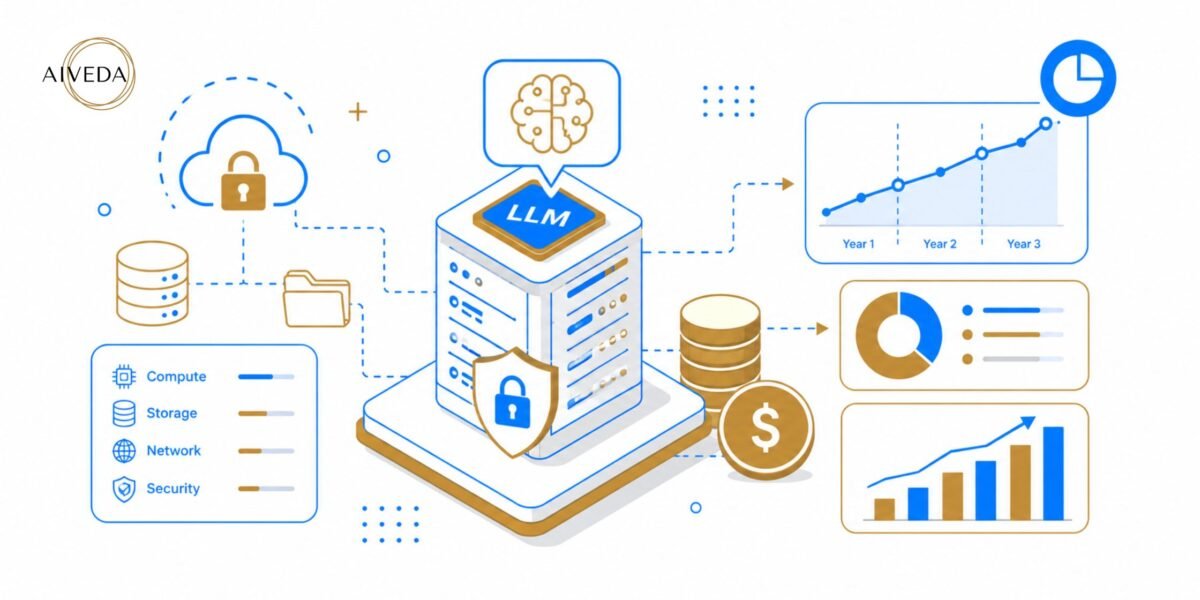
Businesses are operationalizing AI instead of just experimenting with it. One concern is increasingly unavoidable as large language models (LLMs) progress from pilot projects to mission-critical systems: what is the true private LLM cost over time?
According to recent industry estimates, up to 30-40% of all digital transformation funds may go toward AI infrastructure and model implementation expenses. However, a lot of businesses continue to assess AI investments solely based on immediate costs, neglecting the higher private LLM total cost of ownership.
Understanding the entire cost of a private LLM is crucial for both budgeting and making more intelligent strategic choices. Over a three-year period, the optimization potential, hidden expenses, and true ROI of private AI systems may all be observed.
What Is Private LLM Total Cost of Ownership (TCO)?
The entire lifespan cost of implementing, operating, and maintaining a private large language model over a predetermined time frame. Usually three years in enterprise settings is referred to as the private LLM total cost of ownership.
Private LLM costs cover everything from infrastructure and development to maintenance and scaling, in contrast to upfront pricing. Because of this, it is far more complicated than conventional software cost models.
Licensing and API pricing are only two aspects of a comprehensive business LLM cost study.
It takes into consideration:
- Capital costs (hardware, setup)
- Operational expenses (energy, storage, and computation)
- Human resources (DevOps, ML engineers)
- Retraining and ongoing enhancements
Organizations can avoid underestimating the full cost of private AI by adopting this more comprehensive perspective.
The Total Cost of Ownership (TCO): A 3-Year Enterprise Breakdown
An example 3-year TCO model for a mid-market GTM team on the business plan with weekly enrichment, daily competition monitoring, and monthly outbound content creation is provided below. The team size, credit burn, agreed-upon rates, and external data security will all affect the final numbers. Before agreeing to a contract, teams should conduct a 30-day pilot to verify these assumptions against actual usage.
1 Year Setup and Implementation:
The first year typically accounts for the highest private LLM cost. Enterprises invest heavily in infrastructure, development, and deployment.
- Subscription to a business plan: $499 per month, or $5,988 annually
- Estimated credit overage (30% over floor, directional): extra fees based on the agreed-upon overage rate
- Internal implementation time: 40-80 hours of operations or RevOps work
- External data sources (if applicable): vary the provider and volume.
- Training: 20-40 hours of team onboarding and workflow setup
2 Year Optimization and Scaling:
In the second year, costs begin to stabilize. Organizations optimize infrastructure usage and improve model efficiency.
- Subscription and credit charges may rise as the number of seats or workflow volume increases.
- When process architecture is improved and automations become more sophisticated, credit burn usually stabilizes.
- At renewal, the annual renewal uplift (5-10% default or negotiated cap) is applicable.
- An estimated 100-200 hours are spent on ongoing internal maintenance annually.
The marginal private LLM cost decreases as systems scale and processes become more efficient.
3 Year Maturity and ROI Realization:
By the third year, businesses begin to see noticeable results. As operational efficiency increases, the cost per production significantly decreases.
3-year costs, including subscription, overage, and internal time, may be between $80,000 and $130,000 for a small team on a single Business subscription with moderate credit usage and no external data feeds. Three-year expenditures can rise significantly for a larger team with increased credit burn and external data requirements. Before committing, teams should model their unique workflow volume and verify the overage price.
At this stage, the private LLM total cost of ownership aligns more closely with business value, making the initial investment cost worthwhile.
Cost Comparison Between On-Prem LLM vs Cloud
The debate around on-prem LLM cost vs cloud goes beyond infrastructure. It directly shapes long-term ROI and operational efficiency.
Self-hosting is not a decision that is made in a vacuum. It must be compared to the well-established and incredibly adaptable alternative of renting GPU capability from cloud providers. Every strategy has a unique financial profile and set of trade-offs.
Cost Benefits and Trade-Offs of On-Prem Deployment
Long-term cost-effectiveness at scale is the main advantage of an on-premise deployment. The marginal cost of executing additional queries on the model, which usually includes power, is very low after the initial capital expenditure.
The pay-per-token approach of APIs, in which charges increase linearly with usage, stands in stark contrast to this. Control is the other significant benefit. Sensitive corporate data never leaves the company’s safety perimeter when deployed on-premise or in a private cloud, which is essential for regulated industries.
This control also enables extensive fine-tuning of proprietary datasets, resulting in a specialized model with a distinct competitive advantage. However, there are severe trade-offs, including a very large initial capital investment and the high overhead of personnel and operations needed to maintain the infrastructure.
Learn more about On-Prem.
Cloud-based Substitutes and Cost Model
Renting H100 GPUs from cloud providers is an attractive option for businesses unable to make a significant upfront investment. H100 instances are available for on-demand, hourly access through major providers including AWS, Google Cloud, and Azure as well as specialist GPU clouds.
A single H100 can cost anything from $2 to $3 per hour from a specialized provider, more than $7 to $11 per hour from a large hyperscaler. The conversion of a significant capital expenditure into a predictable operational expenditure (OpEx) with no upfront hardware costs and no maintenance overhead is the main advantage.
This gives you a great deal of freedom to scale resources up or down as needed. Because data must be sent to the cloud provider’s servers, the main disadvantages are increased long-term expenses for high-utilization workloads and possible data privacy issues.
Real-World Enterprise Use Cases
Private LLMs are quickly gaining popularity in sectors where control, personalization, and data sensitivity are crucial. Financial sector companies use it for automated report preparation, risk analysis, and fraud detection. Large amounts of sensitive data can be processed safely by these models while adhering to stringent rules.
Private LLMs are revolutionizing patient data analysis and clinical recording in the healthcare industry. Healthcare industries use this to expedite administrative processes, help with diagnosis, and summarize medical records while maintaining data privacy.
Law companies use Private LLMs to automate case summaries, contract analysis, and legal research. This increases accuracy and turnaround time while simultaneously lowering manual labor.
Businesses also use Private LLMs in a variety of industries for customer support automation and corporate knowledge management. These use cases demonstrate how businesses can increase productivity and lessen reliance on outside resources, from responding to employee inquiries to powering intelligent chat platforms.
These implementations highlight how a thoughtful enterprise LLM cost analysis can unlock significant value. While preserving control, security, and scalability in their AI deployments with the correct approach.
The Future Trends in Private LLM Cost
As enterprise adoption and technology advance, the private LLM cost landscape is changing quickly. One of the most significant changes is the emergence of more compact, effective models that perform well without demanding large amounts of processing power. This directly lowers training and infrastructure costs, increasing the accessibility of private AI.
Another important factor is the development of hardware. As more powerful and energy-efficient GPUs and AI accelerators become available, businesses will eventually be able to reduce their operating expenses. Simultaneously, open-source LLMs are rapidly advancing, providing businesses with superior substitutes for costly proprietary models.
The rise of hybrid deployment tactics, in which companies combine on-premises and cloud deployments, is another significant trend. This preserves flexibility while enabling improved cost control.
The total cost of private AI is anticipated to drop as optimization methods advance, making private LLMs a more sensible and scalable long-term investment for businesses.
Conclusion
Understanding the full private LLM total cost of ownership is critical for long-term success. The actual financial and strategic impact of private AI investments can be seen over a three-year period.
Businesses may optimize their private LLM cost and increase ROI by closely examining infrastructure, deployment, and operational costs.
Understanding economics is now crucial in a world where AI is turning into a competitive requirement.
FAQs
1. What is included in private LLM cost?
Everything required to create and operate your own AI model is included in the cost of a private LLM. This includes development and fine-tuning, deployment, infrastructure like GPUs and storage, and continuing maintenance like upgrades, monitoring, and retraining.
2. How does the private LLM total cost of ownership compare to cloud AI?
Due to setup and infrastructure costs, the initial total cost of ownership for private LLMs is typically greater. But if you use it frequently and heavily, it may eventually prove to be more affordable than cloud AI.
3. Is on-prem LLM cost vs cloud cheaper in the long run?
Yes, in a lot of situations. Although cloud solutions are simpler to begin with, their usage-based cost can increase rapidly. Because you can better control costs and avoid recurrent usage fees, on-premise setups frequently become more economical over time.
4. What factors affect enterprise LLM cost analysis?
Enterprise LLM cost analysis is influenced by a number of elements, such as the model’s size. They often use infrastructure type and any industry-specific compliance needs. The total cost increases with the complexity of your requirements.
5. How can businesses reduce the cost of private AI?
Companies can lower cost by implementing strategies like fine-tuning rather than training from the start, utilizing fewer or optimized models, and increasing infrastructure efficiency. Long-term cost control is also aided by prudent scaling and utilization planning.