The EU AI Act is no longer in the future. The process has already started. Rules banning certain AI practices have been in place since 2024. New requirements for general-purpose AI started in August 2025. Now, the biggest deadline is coming soon.
On 2 August 2026, three months from now. The full rules for high-risk AI systems will take effect. This is when enforcement becomes much stricter. The penalties are also very high.
For Heads of AI, this creates a difficult balancing act: maintain innovation speed while building operational compliance across increasingly complex AI environments.
The good news is that EU AI Act readiness does not have to become a multi-year transformation project. With the right governance structure, infrastructure visibility, and deployment controls, enterprises can build a practical compliance foundation in as little as 90 days.
What EU AI Act Compliance Enterprise Leaders Must Understand First
The EU AI Act is fundamentally changing how enterprises approach AI governance. Unlike earlier regulations that focused mainly on data privacy, this framework evaluates the entire lifecycle of AI systems from development and deployment to monitoring and human oversight.
For enterprise leaders, understanding the law at a strategic level is the first step toward meaningful compliance.
The Core Objectives of the EU AI Act
The regulation follows a risk-based model. AI systems are categorized according to their potential impact on safety, rights, and societal outcomes. The higher the potential risk, the stricter the compliance obligations become.
The Act primarily focuses on:
- Transparency in AI-generated decisions
- Accountability across deployment workflows
- Human oversight mechanisms
- Technical robustness and cybersecurity
- Continuous risk monitoring
This matters because regulators are no longer evaluating AI only as software. They are evaluating it as an operational infrastructure that is capable of influencing critical business decisions.
The legislation also applies extraterritorially. That means even US-based enterprises offering AI-powered services within Europe may still fall under compliance obligations.
Breaking Down AI Act High-Risk Systems
One of the most important concepts enterprise teams must understand is the classification of AI Act high-risk systems.
These typically include AI deployments used in:
- Recruitment and workforce management
- Credit scoring and financial services
- Healthcare diagnostics
- Critical infrastructure
- Law enforcement and border control
- Educational assessment systems
Under the regulation, high-risk systems require:
- Detailed technical documentation
- Risk management processes
- Human review capabilities
- Audit trails and logging
- Bias testing and monitoring
For many enterprises, the real issue is not intentional non-compliance. It is the lack of centralized visibility into where AI is already being used across departments.
This becomes especially problematic when organizations adopt AI tools rapidly without governance standards, documentation policies, or deployment inventories.
How the EU AI Act AI Deployment is Different From Existing Regulations
Many organizations initially approached the Act like another GDPR-style compliance exercise. That assumption is creating major operational gaps.
GDPR primarily governs how organizations collect and process personal data. The EU AI Act, however, governs how AI systems behave, make decisions, and impact users.
That means compliance is no longer limited to legal teams alone.
Engineering, MLOps, security, procurement, compliance, and executive leadership now all share responsibility for AI governance. In practice, this turns EU AI Act AI deployment into a cross-functional operational initiative rather than a standalone legal review.
The shift is significant because enterprises now need:
- AI inventories
- Model risk classification workflows
- Monitoring systems
- Governance committees
- Audit-ready documentation pipelines
Organizations that delay these foundations may eventually struggle to scale AI deployment safely once enforcement intensifies in 2026.
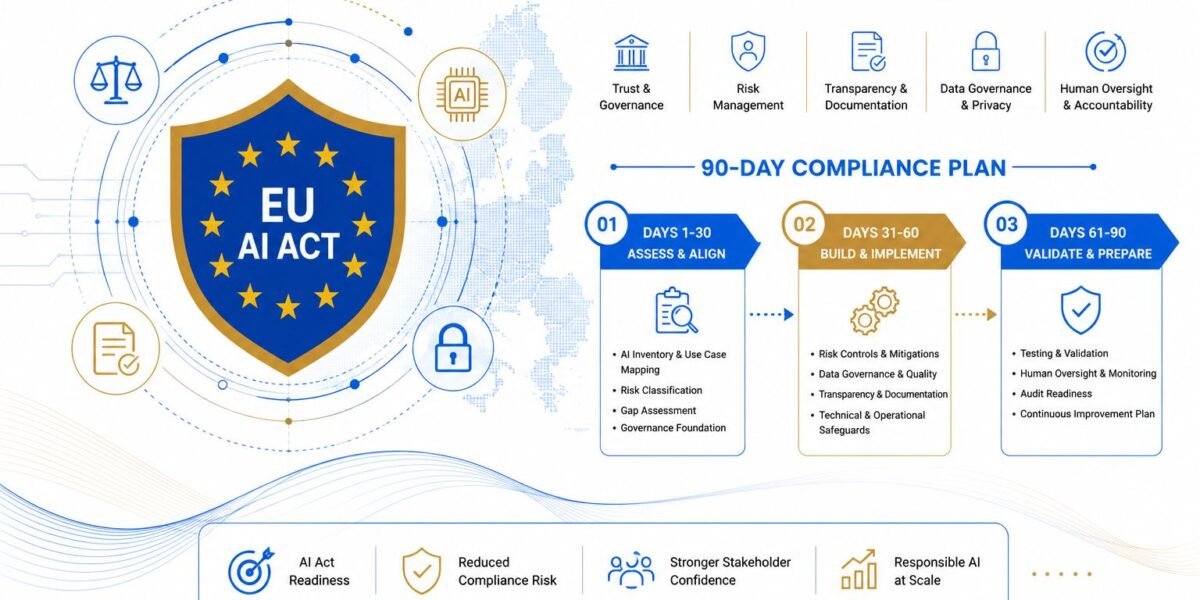
EU AI Act Compliance Enterprise Roadmap: The 90-Day Strategy
It may seem overwhelming for enterprise teams to be prepared for the EU AI Act, but inaction is the true risk. Instead of treating compliance as a long-term transformation, leading organizations are adopting structured, time-bound approaches.
A 90-day roadmap helps shift AI governance from reactive to proactive. The goal isn’t to achieve full compliance instantly, but to build a strong operational foundation for EU AI Act compliance enterprise initiatives. Businesses can establish governance, validate systems, and increase visibility without impeding innovation by following the proper order.
Days 1-30: AI System Audit and Risk Classification
The first 30 days focus on gaining visibility into your AI landscape. Most enterprises already use AI across multiple functions, but few have a centralized view of where and how it operates. This lack of visibility is often the biggest compliance risk.
At this stage, organizations should identify all AI systems in use, internal models, third-party tools, and even experimental deployments. What emerges is typically a fragmented ecosystem, shaped by decentralized adoption across teams.
Once identified, systems must be evaluated against EU AI Act criteria. The objective is to determine which systems may fall under AI Act high-risk systems, particularly those impacting hiring, finance, or critical decision-making.
This phase is less about perfection and more about clarity. By the end of it, enterprises should understand where AI is being used, which systems carry regulatory risk, and where immediate attention is needed. This clarity becomes the foundation for everything that follows.
Days 31-60: Governance, Documentation, and Controls
With visibility established, the next step is creating structure. Many organizations struggle here and not because they lack technical capability, but because ownership and processes are unclear.
This phase focuses on embedding governance into how AI is managed. Instead of siloed efforts, enterprises need cross-functional alignment between legal, engineering, and risk teams. Compliance becomes an operational discipline, not just a legal requirement.
Documentation is a critical component. The EU AI Act requires detailed records, especially for high-risk systems, including model behavior, data usage, and risk assessments. However, the challenge lies in maintaining these records as systems evolve.
At the same time, organizations must introduce control mechanisms. These ensure that AI systems are deployed, updated, and monitored within defined boundaries. Without such controls, compliance efforts remain theoretical.
Days 61-90: Testing, Monitoring, and Deployment Readiness
The final phase focuses on validating whether systems meet regulatory expectations in practice. At this point, enterprises have visibility and governance but they still need to ensure systems are reliable and compliant in real-world scenarios.
This is where EU AI Act AI deployment requirements become operational. Organizations must test bias models, evaluate performance under edge cases, and confirm that outputs align with intended outcomes. For high-risk systems, this step is especially critical.
Beyond testing, continuous monitoring becomes essential. The EU AI Act emphasizes ongoing oversight, meaning enterprises must track system behavior, detect anomalies, and enable human intervention when necessary.
What separates mature organizations is their ability to operationalize monitoring as an ongoing process. Systems are continuously evaluated and refined.
By the end of 90 days, enterprises are not fully compliant but they are structured, accountable, and prepared. They transition from reactive fixes to a scalable compliance model that supports long-term AI growth.
Key Challenges in Achieving EU AI Act Compliance Enterprise-Wide
Even with a clear roadmap, most enterprises encounter friction when translating compliance plans into execution. The issue is rarely a lack of intent. It’s the complexity of aligning people, systems, and processes across the organization.
Understanding these challenges early helps Heads of AI avoid delays and build a more realistic path toward EU AI Act compliance and enterprise readiness.
Fragmented AI Deployment Across Departments
In many enterprises, AI adoption has grown organically rather than strategically. Different teams experiment with tools, integrate third-party models, or build internal AI often without centralized oversight.
This leads to fragmented AI deployment, where no single team has full visibility into how AI is being used across the organization. As a result, compliance efforts become reactive. High-risk systems may go unnoticed, and governance policies fail to cover shadow AI initiatives.
The challenge here is not just technical but it’s organizational. Without a unified inventory and cross-functional alignment, even well-designed compliance frameworks struggle to scale.
Managing High-Risk Systems Without Slowing Innovation
One of the biggest concerns for enterprise leaders is whether compliance will slow down AI innovation. This tension is especially visible when dealing with AI Act high-risk systems, which require stricter controls, documentation, and monitoring.
Without the right approach, compliance can introduce bottlenecks. Approval cycles become longer, experimentation slows, and teams may hesitate to deploy new models.
However, the real challenge lies in designing processes that balance control with agility. Enterprises need governance frameworks that enable safe innovation rather than restrict it. When done correctly, compliance becomes an enabler of trust.
Documentation and Audit Complexity
Documentation is one of the most underestimated aspects of the EU AI Act. While creating initial records is manageable, maintaining them over time is far more demanding.
AI systems evolve constantly, models are retrained, datasets change, and deployment conditions shift. Keeping documentation aligned with these changes requires continuous effort.
For many enterprises, this becomes a scalability issue. Manual documentation processes quickly break down, increasing the risk of inconsistencies and audit failures.
The challenge is not just volume, but accuracy and timelines. Organizations need systems that can support real-time documentation and audit readiness without overburdening teams.
How to Accelerate EU AI Act Compliance Enterprise Initiatives with the Right Infrastructure
By this stage, one thing becomes clear that EU AI Act readiness is not just about policies or documentation. It’s about whether your underlying AI infrastructure can support governance, monitoring, and auditability at scale.
For many enterprises, existing AI environments were not designed with compliance in mind. As a result, even well-defined strategies struggle during execution. The fastest way to move forward is not adding more manual processes, but enabling infrastructure that supports EU AI Act compliance enterprise requirements by design.
The Role of Private, Controlled AI Environments
A major challenge in compliance is the lack of control over how AI systems are deployed and accessed. Public or loosely governed environments make it difficult to track usage, enforce policies, or maintain audit trails.
This is where private or controlled AI environments become critical. By centralizing AI deployment within a secure infrastructure, enterprises gain better visibility into model behavior, data flow, and system interactions.
More importantly, controlled environments allow organizations to enforce governance consistently. Instead of chasing compliance gaps across scattered systems, enterprises can build standardized processes that apply across all deployments.
This shift not only reduces risk. It also creates a foundation where compliance becomes part of the system.
Automating Compliance for EU AI Act AI Deployment
Manual compliance processes may work in early stages, but they quickly become unsustainable as AI adoption scales. Documentation, monitoring, and reporting require continuous updates, which can overwhelm teams if handled manually.
Automation changes this dynamic. By embedding monitoring, logging, and reporting directly into AI systems, enterprises can ensure that compliance requirements are met in real time.
This means:
- Automatic tracking of model performance and outputs
- Continuous logging for audit trails
- Real-time alerts for anomalies or risks
The benefit is double. Teams spend less time on repetitive compliance tasks, and organizations gain greater confidence in their ability to meet regulatory expectations consistently.
Where AIVeda Fits in Your Compliance Journey
This is where platforms like AIVeda play a strategic role. Instead of treating compliance as an external layer. We allow enterprises to build AI systems within environments designed for governance, security, and auditability.
From centralized model management to built-in monitoring and compliance-ready infrastructure. Our team of professionals helps reduce the operational burden associated with EU AI Act readiness. It allows teams to move faster while maintaining control over high-risk systems and sensitive deployments.
For enterprise leaders, the advantage is clear: compliance no longer slows innovation. With the right infrastructure in place, organizations can scale AI confidently, knowing that governance and regulatory alignment are built into every stage of deployment.
Contact us to build AI systems that are compliant, auditable, and enterprise-ready.
Best Practices for Long-Term EU AI Act Compliance Enterprise Strategy
Sustaining EU AI Act compliance enterprise efforts requires more than initial readiness. As AI systems evolve, compliance must become an embedded, repeatable capability.
Here are the key practices enterprises should focus on:
Shift compliance earlier in the AI lifecycle
Instead of treating governance as a final checkpoint, integrate risk assessment, documentation, and validation directly into model development. This reduces rework and ensures systems are compliant by design.
Define cross-functional ownership
AI compliance cannot sit within a single team. Align legal, engineering, risk, and business stakeholders to ensure decisions are balanced, informed, and scalable across the organization.
Standardize governance frameworks across all AI systems
Avoid fragmented policies by creating consistent processes for model approval, deployment, and monitoring. Standardization improves efficiency and reduces compliance gaps over time.
Invest in continuous monitoring and audit readiness
Compliance is ongoing. Businesses need to keep logs, monitor system activity, and make sure documentation is updated as models change, particularly for high-risk installations.
Design for regulatory change, not just current requirements
Organizations should build flexible systems that can adapt to new rules without major rework as the enforcement of the EU AI Act 2026.
Treat compliance as a strategic advantage
Enterprises that proactively build trustworthy AI systems gain more than regulatory alignment. They build customer trust, improve transparency, and strengthen long-term market positioning.
Conclusion
The EU AI Act is reshaping how enterprises approach AI not as isolated tools, but as regulated systems that require accountability at every stage.
For Heads of AI, the path forward is clear. A structured 90-day roadmap provides the foundation, but long-term success depends on embedding governance into everyday operations. Organizations that act early will not only reduce regulatory risk but also build more reliable, scalable AI systems. Enterprises can innovate with confidence, knowing their AI systems are built for both performance and trust.
They are not, however, out of time. Before August, significant readiness can be attained with a disciplined 90-day sprint that prioritizes the highest-risk systems and builds a governance architecture that makes continuous compliance operational rather than episodic. Organizations that have not yet begun will be subject to enforcement measures.