There has never been more pressure on the US healthcare system to increase patient outcomes and clinical productivity. By automating clinical summaries, administrative operations, and documentation, generative AI provides a solution to the burnout epidemic.
A single data leak containing Protected Health Information (PHI), however, can result in millions of dollars in fines and an irreversible loss of patient confidence, making the stakes existential.
To navigate this, healthcare organizations are moving away from public, multi-tenant AI interfaces. The focus has shifted toward strong, private architectures where data sovereignty is absolute.
This guide explores the technical and strategic framework required for a successful HIPAA compliant LLM healthcare, healthcare private AI architecture, and HIPAA AI deployment.
Navigating the Legal Landscape of HIPAA Compliant LLM Healthcare
Compliance is an ongoing architectural state rather than a checkbox in AI. Any technology that handles PHI must follow the privacy, security, and breach notification regulations set forth by the Health Insurance Portability and Accountability Act (HIPAA). When dealing with LLMs, this introduces unique challenges regarding how data is read and remembered by the model.
A Business Associate Agreement (BAA) is the baseline requirement. However, a BAA with a public cloud provider often lacks the granular control needed for high-stakes medical LLM compliance. True HIPAA compliant LLM healthcare integration demands that data remain within a boundary that the provider controls, ensuring that the AI provider has no secondary access to the raw inputs for training or evaluation purposes.
The HIPAA-Compliant AI Architecture Framework
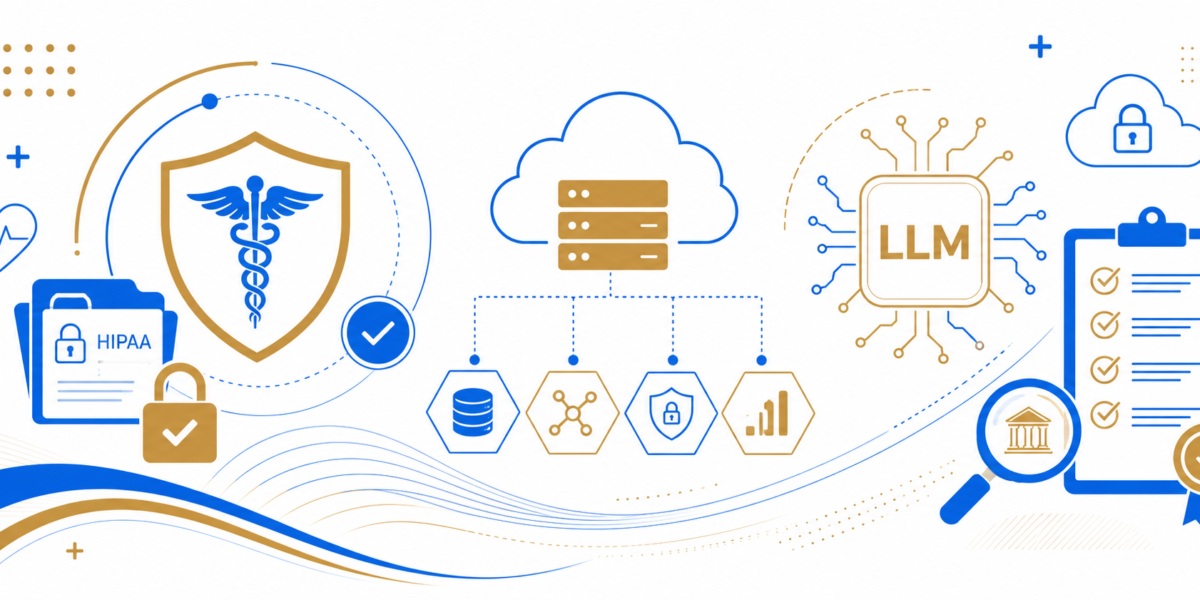
The security of all electronic Protected Health Information (ePHI) processed by AI agents and machine learning models is guaranteed by a healthcare private AI architecture framework. It requires a foundational Business Associate Agreement (BAA) combined with stringent technical safeguards: zero-data retention, end-to-end encryption, and rigorous access control.
A strong, enterprise-grade AI framework integrates these core pillars to achieve full medical LLM compliance:
1. Data Ingestion & Sanitization
PII/PHI De-Identification: Before raw data reaches an external Large Language Model (LLM), it must be scrubbed using Named Entity Recognition (NER) models or rule-based tokenization to strip names, dates, and medical record numbers.
Minimum Necessary Principle: Only query the exact data needed for the AI’s specific task, aligning with HIPAA’s minimum necessary standard.
2. Processing & Inference
Zero-Trust Architecture: Enforce strict network segmentation to ensure the AI and model training servers can only communicate with authorized resources.
Zero-Data Retention Models: The AI processes inputs and generates outputs, but it never stores patient data for model training. Models should remain entirely agnostic to the raw patient data unless explicitly authorized.
3. Encryption & Storage
Data-in-Transit: Encrypt all API calls and data streams using secure protocols like TLS 1.2 or higher.
Data-at-Rest: All databases and training environments must utilize AES-256 encryption.
4. Access Control & Governance
RBAC & ABAC: Implement Role-Based Access Control (RBAC) and Attribute-Based Access Control (ABAC) to ensure users only interact with AI-driven workflows they are authorized to access.
Identity Management: Enforce Multi-Factor Authentication (MFA) across all endpoints and user interfaces.
5. Auditing & Logging
Immutable Audit Trails: Maintain tamper-proof, time-stamped logs of every prompt, response, and database access for a minimum of six years to comply with HIPAA retention rules.
Anomaly Detection: Utilize Security Information and Event Management (SIEM) tools to immediately flag unusual query volumes or unauthorized access attempts.
Private AI vs Public APIs: The Infrastructure Divide
Public APIs are convenient but fundamentally high-risk. In a public model, your data travels over the open internet to a server managed by a third party. Even with zero-retention promises, the metadata and surrounding context can be vulnerable.
Private AI deployment involves hosting the model weights within your own data center or a dedicated, isolated cloud instance. This eliminates the transit risk and ensures that all processing happens within your security perimeter.
The Anatomy of a Secure Medical RAG (Retrieval-Augmented Generation)
Retrieval-Augmented Generation (RAG) is the gold standard for reducing hallucinations in medicine. It allows the LLM to look up facts from your own EHR/EMR systems before answering. To keep this HIPAA-aligned:
- Data Ingestion: Use FHIR-compliant pipelines to sanitize or control the flow of data into the vector database.
- Vector Isolation: Ensure that the database storing your clinical embeddings is encrypted at rest and in transit, with keys managed by your internal security team.
- Identity Governance: Implement Role-Based Access Control (RBAC). A nurse shouldn’t see the same AI-generated insights as a financial officer.
Do Not Make These Architectural Mistakes (How to Avoid Them)
The same failing patterns appear in all of our interactions. They are worth naming specifically so you may compare your own design to them.
Mistake 1: “ChatGPT works fine if we remove names.”
A BAA is not included with ChatGPT’s free tier. The majority of “stripping” carried out on an as-needed basis by clinical personnel does not satisfy the HIPAA Privacy Rule Safe Harbor de-identification criterion. This calls for the elimination of 18 unique identifiers.
Even in those cases, OpenAI is not authorized to get the data due to the lack of a BAA. Policy and tools are the solution: provide an enterprise-tier or BAA-eligible substitute, block consumer endpoints at the network edge, and educate employees on the distinction.
Mistake 2: “HIPAA-eligible and HIPAA-compliant are the same.”
Substrates that qualify include HIPAA-compliant cloud hosts, AWS Bedrock, and Azure OpenAI. Your IAM policy, encryption setup, logging configuration, and operational procedures will determine if your HIPAA AI deployment on top of them complies. A barrier is eliminated by the eligibility designation. It doesn’t result in compliance.
Mistake 3: “BAA logistics for the downstream subprocessors are missing.”
That downstream relationship is covered when the AI system makes calls to a third-party tool, embedding service, or evaluation service. Verify that each subprocessor in the data flow has BAA coverage, then record the chain.
Mistake 4: “The LLM gateway does not provide audit logging.”
You cannot recreate an incident, demonstrate that the system was operating as intended, or satisfy the security rule’s audit control requirement. If your gateway does not record who prompted what, when, and what the model responded. From the beginning, build the gateway with logging. After deployment, retrofitting logging is difficult and leaves gaps in the evidence.
Mistake 5: “No prompt-level PHI scanning before requests cross the boundary.”
Sending more PHI than required increases exposure, even in cloud configurations that are HIPAA-eligible. A defensive measure worth investing in is a prompt-level scanner that finds and redacts extraneous identifiers before the request exits your environment.
Selection Criteria for Your HIPAA Compliant LLM Healthcare Partner
Selecting a vendor is a decision that will impact your clinical operations for the next decade. Beyond a signed BAA, look for the following criteria:
- Clinical Accuracy: Does the vendor test using USMLE-style datasets or other medical LLM compliance benchmarks? The subtlety needed for clinical notes pertaining to a particular discipline is frequently absent from general-purpose models.
- Auditability: Is it possible for the system to generate comprehensive logs of each prompt and response for compliance audits? Transparency cannot be compromised.
- Scalability: Is the architecture able to manage thousands of clinicians at once without experiencing latency problems that could affect patient care?
Why AIVeda is Redefining Private AI for Modern Health Systems
AIVeda stands at the intersection of clinical excellence and computational security. Unlike generalized AI platforms, AIVeda was engineered specifically for the healthcare sector. Our platform provides an environment where providers can leverage the world’s most powerful LLMs without the data ever leaving their secure virtual private cloud (VPC).
Our team guarantees that your company maintains complete control of its data, logs, and optimized weights by giving healthcare private AI architecture a priority. This effectively future-proofs your compliance posture against changing OCR rules.
Contact us today for a comprehensive AI Readiness Audit.
Implementation Strategy: From Pilot to Production
Successful medical LLM compliance requires a phased approach. Start with low-stakes administrative tasks such as insurance appeal letter generation or clinical documentation summarization. To validate the security of the pipeline.
Once the HIPAA compliant LLM healthcare framework is proven, scale to more complex use cases like clinical decision support and personalized patient education. Throughout this journey, constant red teaming and bias monitoring are essential to ensure the AI remains a safe and effective tool for your staff.
Frequently Asked Questions
Is ChatGPT HIPAA compliant for medical use cases?
Standard versions are not. Compliance requires a signed BAA, zero-retention policies, and strict data isolation. Even then, private AI architectures are often preferred to ensure PHI never leaves your infrastructure.
What is a Business Associate Agreement (BAA) in AI?
A BAA is a legal contract where an AI vendor assumes liability for protecting PHI. It is a mandatory requirement for any HIPAA compliant LLM healthcare provider handling sensitive US healthcare data.
How does Private AI differ from standard Cloud AI?
Private AI runs the entire model and database within your controlled environment (VPC or on-prem), ensuring data sovereignty and eliminating the risks associated with third-party data processing.
Can LLMs be used for clinical decision support safely?
Yes, provided they use Retrieval-Augmented Generation (RAG) to ground responses in verified medical literature and are deployed within a secure, auditable framework that includes human-in-the-loop verification.