Enterprise AI teams are racing to deploy a secure Retrieval-Augmented Generation (RAG) systems that deliver accurate, context-aware responses while keeping sensitive data secure.
But as organizations move from prototypes to production, a critical question emerges: what’s the right vector database for a private RAG architecture? The answer hinges on balancing performance, security, scalability, and operational complexity.
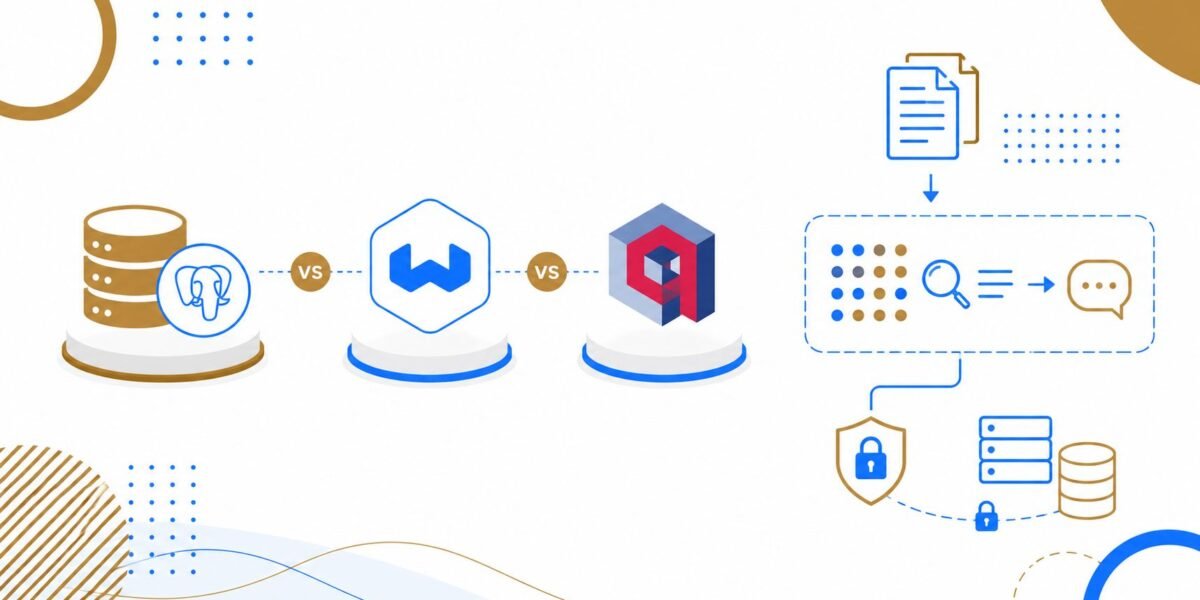
We will compare three leading options pgvector, Weaviate, and Qdrant. Focusing on their fit for enterprise RAG vector database deployments.
This blog will give you a clear decision criteria, reference architecture patterns, and actionable deployment tips that your AI engineering team can apply immediately.
Lets clear our basics about pgvector vs Weaviate vs Qdrant.
pgvector:
The Postgres extension pgvector enhances ordinary Postgres with vector data types, similarity operators, and index support. With the same database, operational tools, and backup plan, pgvector provides the simplest route to vector capabilities for enterprises already running Postgres at scale (Supabase, Neon, RDS, Cloud SQL, self-hosted). Purpose-built alternatives are typically superior for dedicated vector workloads larger than moderate.
Advantages
- Vector functionality is introduced to the current Postgres implementation with no additional infrastructure.
- Postgres backups, replication, and monitoring are all part of the standard operating paradigm.
- Strong hybrid search that combines Postgres full-text search (tsvector) with vector similarity
- Open source (PostgreSQL License) and widely available under management (Supabase, Neon, RDS, Cloud SQL)
Disadvantages
- The practical maximum is tens of millions of vectors per instance, which is a smaller scale ceiling than specifically designed vector databases.
- Compared to dedicated alternatives, query performance at scale is less optimized (HNSW improvements ameliorate this).
- When transactional and vector workloads compete on the same instance, operational complexity increases.
Weaviate:
Weaviate is the most feature-rich open-source vector database in 2026. The hybrid search quality is on par with Pinecone, the schema model provides extensive object structures (rather than just vector + information), and modular vectorization connects with several embedding suppliers. Weaviate is the top solution for businesses looking for managed-cloud open-source vector infrastructure.
Advantages
- Weaviate Cloud Services deployment is both self-hosted and managed, and it is open source (BSD-3).
- Rich schema model that is more akin to a vector-native graph database and has cross-references between things
- Strong hybrid search that combines vector similarity with BM25 keyword search
- Integrated vectorization modules for local models, OpenAI, Cohere, and HuggingFace
Disadvantages
- Self-hosted operational complexity higher than Pinecone managed or Qdrant
- Schema-driven design adds upfront modeling effort vs simpler key-value vector storage
- Memory footprint for large indexes can exceed alternatives at comparable scale
Qdrant:
The top-performing open-source vector database is Qdrant. The self-hosted operational paradigm is more straightforward than Weaviate. The Rust-based design generates significantly better latency and throughput than Python-based alternatives at equivalent size. The Qdrant Cloud managed solution offers a way for teams who would rather not handle infrastructure. Qdrant is becoming the standard for production teams that prioritize performance and have options about managed vs self-hosted.
Advantages
- For self-hosted vector databases, Rust-based design yields best-in-class latency and throughput.
- Simple self-hosted operational model and open source (Apache 2.0)
- For companies that require both, Qdrant Cloud offers both managed deployment and open source.
- Strong hybrid search for multi-embedding scenarios using named vectors and sparse + dense vectors
Disadvantages
- Smaller ecology and community than Weaviate or Pinecone now
- Some sophisticated capabilities (fine-grained access control, multi-tenant isolation) are not as developed as Pinecone.
- Weaviate and Pinecone provide deeper documentation for production deployment techniques.
Side-byside Metrics to Observe
Measure query latency at reasonable concurrency levels while benchmarking your enterprise RAG vector database; instead of focusing only on averages, consider P50, P95, and P99 percentiles.
Throughput is important as well; monitor the number of requests per second under continuous load to see how your system responds to high usage. How rapidly you can onboard fresh data is revealed by the index creation time for datasets at 1 million, 10 million, and 100 million vectors.
Another important statistic is storage overhead. To determine the total cost of ownership, compute vectors, metadata, and index size. For disaster recovery planning, backup and restore time are frequently neglected until it’s too late. To ensure that recovery time goals are realistically attainable, teams should test entire cluster restoration from backups.
pgvector vs Weaviate Enterprise: When To Pick Each
The debate between pgvector vs Weaviate enterprise deployments comes down to your existing stack, scale requirements, and feature needs. There’s no universally superior choice only the right choice for your specific context.
Choose pgvector when your organization already runs Postgres
If you already operate Postgres at scale and your vector workload is small-to-moderate, pgvector lets you move quickly without introducing new infrastructure. Teams with Postgres expertise can leverage existing monitoring, backup, and access control mechanisms. The learning curve is minimal since engineers use familiar SQL syntax for vector queries.
pgvector works well for internal knowledge bases where enterprise teams search company documentation, product catalogs with relational metadata where product attributes live in Postgres tables, and analyst workflows where Postgres serves as the system of record. Budget constraints also favor pgvector since there are no additional licensing costs beyond what you’re already paying for Postgres.
However, pgvector faces limitations at very large scale. Beyond approximately 10 million vectors per node, you’ll need to implement read replicas, careful HNSW tuning, or consider sharding strategies. Advanced approximate nearest neighbor features require manual configuration, and hybrid search combining keyword and vector search needs custom plumbing since pgvector doesn’t include built-in BM25 support.
Choose Weaviate when you need enterprise features and flexibility
Weaviate shines when your use case demands built-in hybrid search without custom engineering, multimodal data supporting text plus image plus video embeddings, enterprise features like role-based access control and module plugins, or customer-facing search portals with complex metadata filtering requirements.
Typical use cases include enterprise search hubs with rich faceted filtering where users narrow results by multiple metadata dimensions, media-rich RAG applications handling legal documents with embedded images or technical manuals with diagrams, and multi-tenant SaaS RAG systems requiring per-tenant isolation for data security.
Weaviate’s flexibility comes at a cost. The operational footprint is medium-to-high, requiring careful capacity planning for large clusters. You’ll need dedicated DevOps attention for Kubernetes orchestration, monitoring setup, and cluster scaling. Licensing costs are higher than pgvector, though Weaviate offers both open-source and enterprise tiers.
Security, Governance, and Compliance for Enterprise RAG Vector Database
When deploying an on-prem vector database, security is not just an option. Enterprise AI teams must address multiple layers of security to meet compliance requirements and protect sensitive data throughout the RAG pipeline.
Data residency and encryption requirements
Encryption at rest requires AES-256 for vector stores and backups to protect data even if physical storage is compromised. Encryption in transit mandates TLS 1.3 for all client-server communication to prevent man-in-the-middle attacks. Key management should integrate with enterprise KMS solutions like AWS KMS or HashiCorp Vault rather than managing keys manually. Air-gapped deployments become necessary for highly classified data in defense or healthcare sectors where any network connection poses unacceptable risk.
Access control and auditability for compliance
Role-based access control per collection or namespace ensures users only access data they’re authorized to see. API gateways enforce rate limiting and authentication, preventing abuse and unauthorized access. Query auditing logs all retrieval queries for compliance, creating an audit trail that satisfies regulators. PII redaction strips sensitive data before embedding, ensuring personally identifiable information never reaches the vector database in the first place.
Model and prompt handling to prevent data leakage
Private LLM hosting on-prem AI using solutions like vLLM or Text Generation Inference avoids sending prompts to external APIs, eliminating data leakage through third-party services. Prompt sanitization filters injected prompts to prevent prompt injection attacks where malicious users try to extract training data or bypass security controls. Context minimization retrieves only necessary chunks rather than entire documents, reducing exposure of sensitive information.
Cost, Performance Tuning, and Operational Tips for Private RAG
Balancing cost and performance is critical for sustainable private RAG architecture. Enterprise teams often underestimate total cost of ownership until production scaling reveals hidden expenses.
Cost components requiring careful planning
Storage costs scale with vector size times dimensionality times number of vectors. A 768-dimensional vector stored as float32 takes 3KB, so 100 million vectors require nearly 300GB just for raw vectors. Compute costs include indexing which is CPU-intensive and query latency which may require GPU acceleration for large datasets. Data pipeline costs encompass embedding generation measured in GPU hours and ETL job infrastructure. Monitoring costs cover logging, alerting, and observability stack infrastructure.
Performance tuning checklist for production systems
Select the right index type for your workload. HNSW works best for latency-critical applications while IVF favors storage efficiency. Shard sizing should target 10 to 50 million vectors per shard for optimal performance without excessive overhead. Dimensionality reduction using PCA or quantization from 768 to 256 dimensions can reduce storage and improve speed if accuracy loss is acceptable. Caching layers like Redis for frequent query results can achieve cache hit rates above 60%, dramatically reducing database load.
Monitoring and service level objectives
Track query latency at P95 and P99 percentiles with targets under 100ms for user-facing applications. Success rate should exceed 99.9% to ensure reliable user experience. Index rebuild time should stay under 2 hours for 10 million vectors to enable practical data refresh cycles. Memory and CPU utilization should average below 70% to maintain headroom for traffic spikes.
AIVeda offers performance tuning services to optimize your enterprise RAG vector database for production workloads, helping you achieve these targets without excessive infrastructure costs.
How AIVeda Helps Enterprise AI Teams Deploy Private RAG Systems
Building production-grade RAG is hard. AIVeda specializes in helping enterprise AI teams design, deploy, and scale secure private RAG architecture with pgvector, Weaviate, or Qdrant, based on your specific requirements rather than pushing a one-size-fits-all solution.
Architecture design and proof of concept work lets you rapidly prototype and validate vector database choice before committing to full implementation. Secure on-prem deployments support air-gapped environments and compliance requirements for regulated industries. Integration with data pipelines covers change data capture, ETL workflows, and and OpenAI APIs. Tuning and SRE handoff includes performance optimization, monitoring setup, and comprehensive runbooks for your operations team.
Contact us for a consultation on your enterprise RAG vector database strategy and get a customized architecture design for your use case.
Conclusion
Choosing the right enterprise RAG vector database is a strategic decision that impacts security, performance, and long-term maintainability. This decision affects your team for years, so invest time in proper evaluation upfront. pgvector excels for Postgres shops and cost-conscious teams who value simplicity. Weaviate delivers enterprise features and hybrid search for complex use cases. Qdrant dominates in latency-critical, high-throughput scenarios where performance is paramount.
The key is matching the vector database to your specific use case rather than chasing shiny objects or following trends. Your optimal choice depends on your existing infrastructure, team expertise, scale requirements, and compliance needs.
FAQs
Q1: What is the best on-prem vector database for enterprise RAG?
A: On-prem vector database depends on your needs pgvector for Postgres integration and cost efficiency. Weaviate for rich metadata filtering and enterprise features. Qdrant for low-latency high-throughput retrieval. Match the choice to your specific use case and operational constraints.
Q2: Can pgvector handle enterprise-scale search at 100 million vectors?
A: Yes for many cases, but it may need read replicas, careful sharding, or hybridizing with specialized ANN engines like Qdrant at very large scale beyond 10 million vectors per node.
Q3: Is Weaviate suitable for private, on-prem deployments in regulated industries?
A: Yes, Weaviate supports on-prem and enterprise licensing with modules for hybrid search. Also for role-based access control and plugin integrations designed for private compliant deployments.
Q4: How does Qdrant compare on latency and throughput versus competitors?
A: Qdrant typically delivers lower latency and higher throughput for vector search. Particularly where optimized approximate nearest neighbor indexing and Rust-based performance matter for production workloads.