
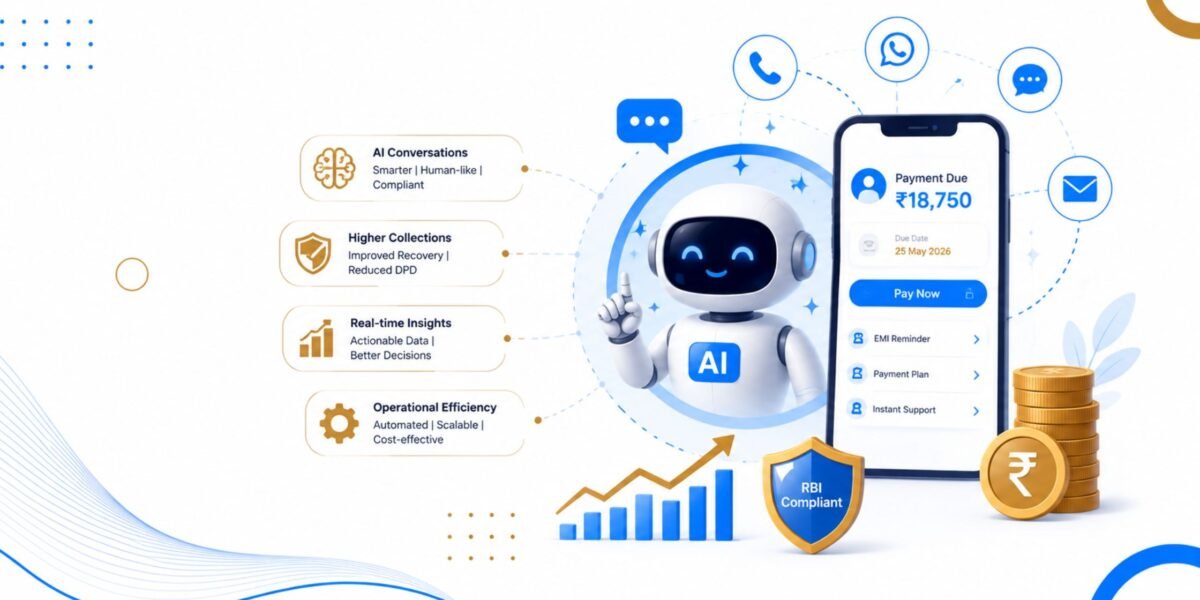
Let’s be honest: digital lending has gotten incredibly fast. Today, a recipient can download an app, apply for a loan, pass an alternate credit check, and see funds hit their bank account in minutes. It is a massive win for financial inclusion and a masterclass in user experience.
But there’s a flip side to this speed that nobody likes to talk about. While front-end loan distribution has leaped into the future, back-end debt recovery is still largely stuck in the past.
When you are managing high-volume, small-ticket portfolios, the traditional way of chasing missed payments completely falls apart. Relying entirely on massive human call centers means dealing with constant staff turnover, ballooning overhead costs, and the nagging worry that a stressed-out agent might say something that violates compliance laws. To top it all off, collection yields are dropping because, quite frankly, people just don’t answer calls from unrecognized numbers anymore.
To protect your margins and keep non-performing assets (NPAs) under control, you can’t just throw more people at the problem. It requires a fundamental shift in how we approach recovery. Transitioning to modern, intelligent debt collection software that replaces confrontational calls with smooth, automated, and empathetic conversations isn’t just a tech upgrade anymore.
Why Traditional Debt Recovery Software Fails
Historically, an institution’s standard debt recovery software operated essentially as a specialized customer relationship management (CRM) database. Debt collection software logged historical defaults, maintained transaction logs, and bucketed delinquent accounts into chronological tranches (DPD or Days Past Due: 1-30, 31-60, 61-90). While these platforms functioned adequately as passive record-keepers, they failed as active resolution engines.
The Operational Pitfalls of Legacy Infrastructure:
- Static Rigid Rule Engines: Traditional collections software triggers automated workflows using unyielding, linear “if-then” configurations. Every customer who slips into DPD 1 receives the exact same automated reminder sequence, regardless of their individual credit history, psychographic profile, or current reason for financial distress. This rigid approach actively damages the long-term customer relationship.
- Severe Lack of Behavioral Intelligence: Legacy infrastructure evaluates risk purely based on transactional history and formal credit scores. It completely misses real-time behavioral signals, such as interaction trends, tone of voice, preferred communication channels, or changes in digital engagement.
- Prohibitive Human Call-Center Overheads: Relying on large human call centers introduces persistent operational bottlenecks. Human operations are exceptionally difficult to scale quickly during market downturns, suffer from high annual agent turnover rates, and introduce significant compliance vulnerabilities when agents deviate from strict regulatory scripts under pressure.
The Hidden Costs of Human Call-Center Scenarios
Consider a growing digital lender managing N = 500,000 active, small-ticket loans. If their default rate hovers around 8%, the collection team must address $40,000 delinquent accounts monthly. Attempting to manage this sheer volume exclusively via human agents demands massive staff overheads, high training budgets, and continuous management vigilance. All while yielding steadily diminishing returns as customers increasingly reject unrecognized phone calls
Enter AI-Driven Conversational Workflows: The Next Paradigm
The modern era of smart recovery utilizes specialized, cognitive systems designed to transform confrontational collection conversations into smooth, cooperative financial resolutions. Today’s advanced credit collection software does not rely on simple, rigid templates. Instead, it leverages custom, domain-specific Large Language Models (LLMs) that are deeply integrated directly into core banking architectures.
This is precisely where advanced platforms like Lira by AIVeda are completely redefining the economics of retail credit management. Moving far beyond generic, uncalibrated conversational API wrappers, Lira is built on top of a highly optimized, enterprise-ready proprietary LLM infrastructure. It functions as a fully context-aware digital collection specialist that interacts across voice, chat, and instant messaging interfaces with human-like precision and empathy. Rather than merely broadcasting static, generic warnings, Lira actively listens to borrowers, evaluates their financial context, and helps design realistic, personalized payment pathways in real time.
| Operational Metric | Legacy Collections Systems | AI-Powered Platforms (e.g., Lira) |
|---|---|---|
| Scale & Capacity | Constrained by human headcount and staff schedules. | 🚀 Infinitely scalable; handles thousands of concurrent calls and chats. |
| Context Retention | Fragmented across agent notes and disjointed CRMs. | 🧠 Continuous multi-turn context tracking with instant backend updates. |
| Regulatory Compliance | High risk due to unmonitored human emotional responses. | 🛡️ Deterministic compliance guardrails built natively into the AI. |
| Deployment Setup Time | Months of complex, manual system mapping and integration. | ⚡ Rapid integration powered by automated Auto ETL Intent Engines. |
Architectural Understanding: How Modern Credit Collection Software Operates
To successfully drive repayments without introducing regulatory risks, an AI collection assistant requires a sophisticated multi-layered technology stack. The platform must dynamically process natural human language, understand explicit and underlying borrower intent, and confidently execute live operational actions directly within the lender’s core systems.
Dynamic Multi-Turn Context Tracking
Human dialogue is naturally fluid and non-linear. During a high-stress conversation like a collection call, a borrower rarely responds in simple, predictable affirmations. A customer might begin with an excuse, transition into an angry complaint, request a multi-week postponement, and then ask for an updated payoff statement all in a single conversation. Advanced implementations like Lira manage these complex shifts using sophisticated Context Management modules. The engine continuously monitors the interaction history, ensuring the AI never loses track of the primary objective: settling the overdue balance. While respectfully adapting to any shifting statements the borrower makes during the conversation.
Natively Integrated Intent-Driven Actions (CRUD)
An intelligence engine is only as valuable as its ability to execute concrete business solutions. Most conversational chatbots on the market function simply as information access nodes. They can answer static questions but cannot perform actual tasks. Next-generation debt collection software bridges this gap through real-time CRUD (Create, Read, Update, Delete) operations executed via secure enterprise APIs.
When an overdue customer communicates a specific, viable commitment such as “I cannot pay the full amount today, but I can pay $150 this Friday and the remaining balance on the 30th”. The AI does not simply flag a human worker. Software like Lira securely verifies the user’s identity, queries the core transaction database, calculates the eligibility of the requested split-payment structure, creates the updated promise-to-pay schedule, and locks in the new configuration instantly inside the lender’s systems. This level of automation drastically reduces manual intervention across the operational cycle.
Quantifiable Strategic Value: How AI Scalably Helps Digital Lenders
Transitioning to an intelligent conversational platform delivers immediate, verifiable improvements across every core financial and operational metric within a lending portfolio:
- Substantial Compression of Operational Expenses (OpEx): By shifting up to 70% of early-stage (DPD 0 to DPD 30) outreach workflows to conversational AI, companies significantly lower their reliance on expensive third-party collection agencies and high-overhead internal call centers.
- Measurable Elevation in Resolution and Recovery Rates: AI systems operate completely free of human bias or emotional fatigue. They consistently deliver polite, structured, and legally compliant payment solutions across every single touchpoint, resulting in higher overall recovery yields.
- Seamless Multilingual Optimization: Modern retail credit portfolios cover diverse geographical regions. AI platforms seamlessly translate and communicate across dozens of regional languages and dialects, breaking down communication barriers and building trust with borrowers.
- Accelerated Setup via Automated Data Onboarding: Traditional automated systems typically demand extensive engineering time to map out every single target conversational path. Platforms equipped with advanced automation such as AIVeda’s Auto ETL Intent Creation engine can ingest raw historical collection logs and automatically structure their own intent frameworks, cutting deployment timelines down to days
Ensuring Bulletproof Regulatory Compliance and Data Security
In the modern financial services industry, regulatory compliance is just as critical as recovery performance. Regulatory bodies are intensely focused on borrower data protection and preventing aggressive or deceptive collection practices by lenders and third-party contractors.
Deploying automated debt recovery software solves this regulatory challenge by establishing absolute process control. Because software like Lira operates on tightly calibrated, specialized model architectures rather than unmonitored public frameworks, its behavior is completely deterministic. It never loses patience, never threatens a customer, and strictly adheres to predefined legal communication hours and approved data disclosure rules. Furthermore, enterprise-grade authentication guarantees that sensitive financial information is only revealed after robust, multi-factor user validation, significantly reducing data liability risks for the institution.
Implementation Blueprint: Transitioning to Cognitive Collections
Successfully transitioning from an outdated, passive recovery system to an active, AI-powered system should follow a highly structured, phased roadmap:
- Target Data Integration: Safely connect your core banking systems, loan origination databases, and existing communication APIs with your intelligent collections software platform.
- Intent and Script Definition: Utilize automated tools like Auto ETL engines to analyze historical communication logs, mapping out core user intents, common excuses, and optimal resolution paths.
- Pilot Deployment (The Champion-Challenger Framework): Direct a small percentage of early-stage delinquent accounts (e.g., 10% of DPD 1-15) through the conversational AI system. Carefully benchmark its resolution efficiency against your traditional human call center strategies.
- Enterprise Optimization and Scaling: As the AI consistently proves its performance, gradually expand its operational scope to handle multilingual outreach, complex payment restructurings, and mid-stage delinquencies.
Conclusion
The intersection of artificial intelligence and financial operations has fundamentally redefined what is possible in credit management. Continuing to rely on rigid legacy infrastructure or volatile human-driven collections models is no longer a viable strategy for maintaining margin.
By implementing a highly specialized, context-aware intelligence engine that handles everything from dialogue processing to real-time database execution, financial institutions can systematically lower overhead costs, enforce absolute compliance, and drastically optimize recovery yields.
Deploying an advanced debt collection software like Lira bridges the gap between collections efficiency and borrower empathy. Moving forward, the lenders that dominate the market won’t just be those that disburse credit the fastest, but those that protect their portfolios with smart, automated recovery ecosystems.