The enterprise rush to integrate generative artificial intelligence into core operations has collided head-on with the strict realities of data sovereignty, compliance frameworks like HIPAA and GDPR, and escalating compute expenditures. The core challenge has shifted from simply proving LLM capabilities to deploying them at scale across multiple corporate entities, departments, or external clients.
Building a robust multi-tenant private AI architecture is fundamentally different from designing standard SaaS multi-tenancy. Traditional applications isolate database rows via logical barriers like Row-Level Security (RLS). However, Large Language Models (LLMs) introduce massive, stateful GPU memory footprints, complex prompt context windows, and non-deterministic execution paths that break traditional computing boundaries. When multiple enterprise units utilize a shared hardware layer, engineering teams face significant architectural hurdles in balancing security risks against infrastructural overhead.
To scale GenAI sustainably, platform teams must design an optimal strategy around enterprise AI tenant isolation. Choosing the right architectural pattern requires evaluating the complex trade-offs between absolute security boundaries and cloud compute cost efficiency. This whitepaper analyzes the core isolation patterns for a multi-tenant private AI architecture and examines how innovative platforms like AIVeda allow organizations to achieve maximum isolation without inflating their hardware footprint.
Why LLM Infrastructure Breaks Traditional SaaS Multi-Tenancy
Traditional SaaS architectures rely heavily on shared, stateless application servers operating on top of logically partitioned relational databases. In this classic paradigm, tenant isolation is enforced at the software API or query layer. This model falls short when handling modern foundation models due to the structural characteristics of deep learning infrastructure:
- Compute vs. Storage Coupling: In standard applications, data sits passively until queried. In an LLM pipeline, model weights must be actively held in High Bandwidth Memory (HBM) or VRAM to run real-time inference, creating a continuous, expensive state.
- The VRAM Fragmentation Bottleneck: Modern LLMs require tens of gigabytes of VRAM. Dedicating full hardware clusters per tenant to guarantee isolation leaves massive compute resources idle, leading to severe resource underutilization.
- Semantic Vector Leakage: Shared Vector Databases store high-dimensional embeddings that capture deep semantic associations. If index partitioning or metadata filtering fails at the application layer, cross-tenant data leakage can happen easily.
Core Isolation Patterns for a Multi-Tenant Private AI Architecture
When implementing a multi-tenant private AI architecture, platform engineering teams typically deploy one of three architectural patterns, each offering distinct security and financial profiles.
Pattern 1: The Silo Model (Hard Infrastructure Isolation)
The Silo Model provides maximum safety by assigning completely separate infrastructure stacks to every single tenant. Each tenant runs inside its own isolated Virtual Private Cloud (VPC), utilizing dedicated Kubernetes nodes and physical GPU instances.
This design delivers complete enterprise AI tenant isolation. Because no memory or network paths are shared, there is zero risk of cross-tenant information exposure or side-channel attacks. However, this model scales poorly from a financial standpoint. Maintaining dedicated GPU clusters for dozens of enterprise tenants results in massive cloud spend, with organizations paying for continuous idle capacity during off-peak hours.
Pattern 2: The Pool Model (Logical Application Isolation)
The Pool Model focuses entirely on resource optimization by running a unified, shared multi-tenant LLM gateway layer. All incoming requests from various tenants route into a single, high-throughput GPU cluster running base model instances. Tenant separation occurs logically through software namespaces, token tracking, and fine-grained access control lists.
This approach maximizes GPU utilization and brings down the total cost of ownership (TCO). Rather than duplicating base weights across separate instances, the system leverages parameter-sharing techniques like
Low-Rank Adaptation (LoRA) dynamically loads tenant-specific adapters into memory on demand. The primary trade-off is architectural complexity; engineering teams must build sophisticated guardrails to handle noisy neighbor problems and ensure that one tenant’s heavy prompt volume does not degrade token delivery for others.
Pattern 3: The Bridge Model (Hybrid Architectural Isolation)
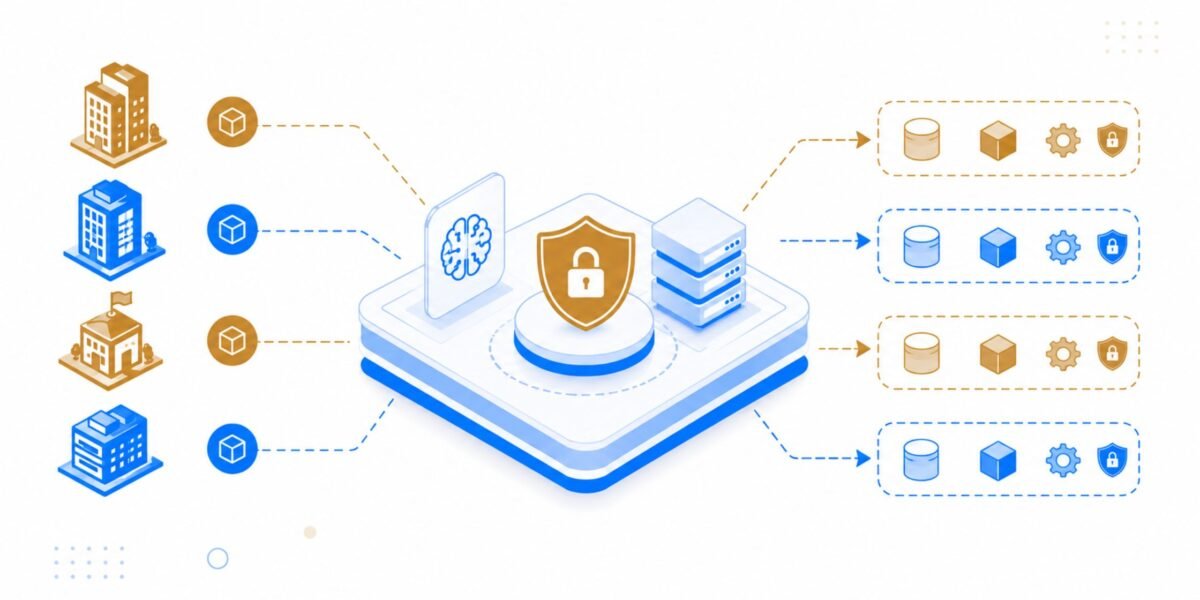
The Bridge Model acts as a pragmatic middle ground for modern enterprises. It uses a shared, highly optimized compute orchestra layer for model inference, but maintains strictly isolated storage systems, encryption keys, and distinct vector database indices for each tenant. This hybrid approach ensures that sensitive enterprise data never mixes at rest, while allowing processing pipelines to benefit from shared hardware efficiency during active operations.
The Technical Trade-Off Matrix: Security, Latency, and Cost
Selecting an isolation model requires analyzing the engineering trade-offs between three competing vectors: compliance posture, runtime performance, and infrastructure costs.
In highly regulated spaces such as banking or clinical healthcare, security frequently supersedes cost considerations, pushing infrastructure designs toward the Silo pattern.
Conversely, platform teams building a commercial SaaS AI multi-tenant product often rely on the Pool or Bridge models to maintain viable gross margins. The primary technical hurdle in a shared compute pool involves managing the Time to First Token (TTFT) when switching tenant-specific fine-tuning weights into active VRAM.
Implementation Blueprints for a Multi-Tenant Private AI Architecture
To deploy a secure, high-performance multi-tenant private AI architecture without relying on costly infrastructure duplication, platform teams must implement specific core components:
Dynamic LoRA Adapter Routing
Instead of deploying complete, separate model instances for each customer, engineers maintain a singular base model (such as Llama-3 or Mistral) in memory. Tenant-specific fine-tuning adjustments are saved as lightweight LoRA weights. Utilizing inference frameworks like vLLM or Hugging Face TGI, the application gateway intercepts incoming tenant metadata, fetches the appropriate LoRA matrix from storage, and applies it to the core base weights in real time. This ensures specialized outputs without multiplying the core VRAM footprint.
Multi-Tenant KV Cache Management
The Key-Value (KV) cache preserves past context tokens during ongoing chat sessions to speed up subsequent generations. In a high-throughput multi-tenant LLM setup, letting tenant caches commingle in raw memory presents a severe security risk. Engineers must enforce cryptographic or strict physical segmentations within the GPU memory manager to prevent context leakage across active request streams.
Token Bucket Rate Limiting & Quotas
To eliminate the noisy neighbor effect inherent to the Pool model, platform layers must integrate advanced request scheduling. By utilizing custom token bucket algorithms at the API gateway layer, the system can throttle or queue overflowing request volumes from individual tenants, ensuring consistent hardware access and stable response latency across all corporate users.
The Build vs Buy Dilemma for Platform Engineering Teams
Developing an internal enterprise-grade routing, orchestration, and isolation layer requires substantial engineering investments. Teams frequently find themselves spending months writing custom Kubernetes operators, fine-tuning low-level CUDA memory allocation wrappers, and building complex tracking frameworks to monitor consumption for internal cost accounting.
This operational overhead diverts specialized machine learning and platform engineers away from building core product differentiators. Moreover, custom-built solutions often struggle to adapt smoothly when foundational open-source models update their underlying tensor structures, leading to ongoing code maintenance debt and potential deployment delays.
Standardizing Isolation and Infrastructure Efficiency via AIVeda
For organizations seeking to bypass the risks of custom engineering, we provide a production-ready, enterprise platform built to handle complex AI multi-tenancy. AIVeda bridges the gap between infrastructure efficiency and absolute data sovereignty, allowing engineering teams to run high-throughput operations confidently.
By decoupling the execution layer from the underlying storage systems, our team achieves the rigorous security boundaries of the Silo model alongside the outstanding cost benefits of a Pool model. Its advanced semantic gateway handles multi-tenant isolation out of the box, employing hardware-level cryptographic isolation alongside automated tenant guardrails to protect fine-tuning layers and vector pipelines.
Furthermore, AIVeda streamlines standard SaaS AI multi-tenant operational workflows. It provides built-in tools for dynamic weight loading, real-time token tracking, and detailed GPU resource accounting, giving platform teams complete visibility into exact per-tenant usage costs.
Contact us to schedule a technical architecture review.
Conclusion
Platform engineers and infrastructure leaders no longer have to compromise on security to maintain reasonable infrastructure budgets. Scaling a modern multi-tenant private AI architecture requires moving past traditional application design paradigms and adopting smart, model-aware routing layers that protect enterprise data boundaries at every step.
Frequently Asked Questions
Q1: What is the primary difference between traditional multi-tenancy and a multi-tenant private AI architecture?
Traditional multi-tenancy isolates structured text fields within relational databases. A modern private AI architecture must securely partition high-dimensional vector embeddings, dynamic prompt caches, and shared GPU memory blocks.
Q2: How does AIVeda enforce enterprise AI tenant isolation without drastically increasing our cloud compute spend?
AIVeda utilizes smart semantic routing and shared base model weights combined with isolated, dynamically swapped tenant adapters, maximizing GPU utilization while guaranteeing strict, cryptographic data boundaries.
Q3: Can a SaaS AI multi-tenant framework effectively prevent the “noisy neighbor” effect on shared GPUs?
Yes. By implementing token-bucket rate limiting, customized request scheduling queues, and isolated KV cache allocations per user, platforms maintain predictable, stable latency across all concurrent tenants.
Q4: Is a hybrid multi-tenant LLM approach compliant with strict regulatory frameworks like HIPAA or GDPR?
Absolutely. A hybrid approach ensures that sensitive tenant data and vector storage remain in isolated compliance zones, while utilizing shared, de-identified compute clusters for model inference execution.