The enterprise AI landscape is undergoing a massive structural shift. While massive, trillion-parameter foundational models dominate headlines, machine learning engineers and AI researchers in production environments are leaning heavily into Small Language Models (SLMs). Models ranging from 3B to 14B parameters are proving that when properly adapted, they can match or exceed larger models on specific domain tasks at a fraction of the operational cost.
However, the core engineering challenge lies in the adaptation phase. How do you inject domain expertise, enterprise guardrails, and specialized task handling into an SLM without blowing past your cloud budget or destroying the model’s emergent capabilities?
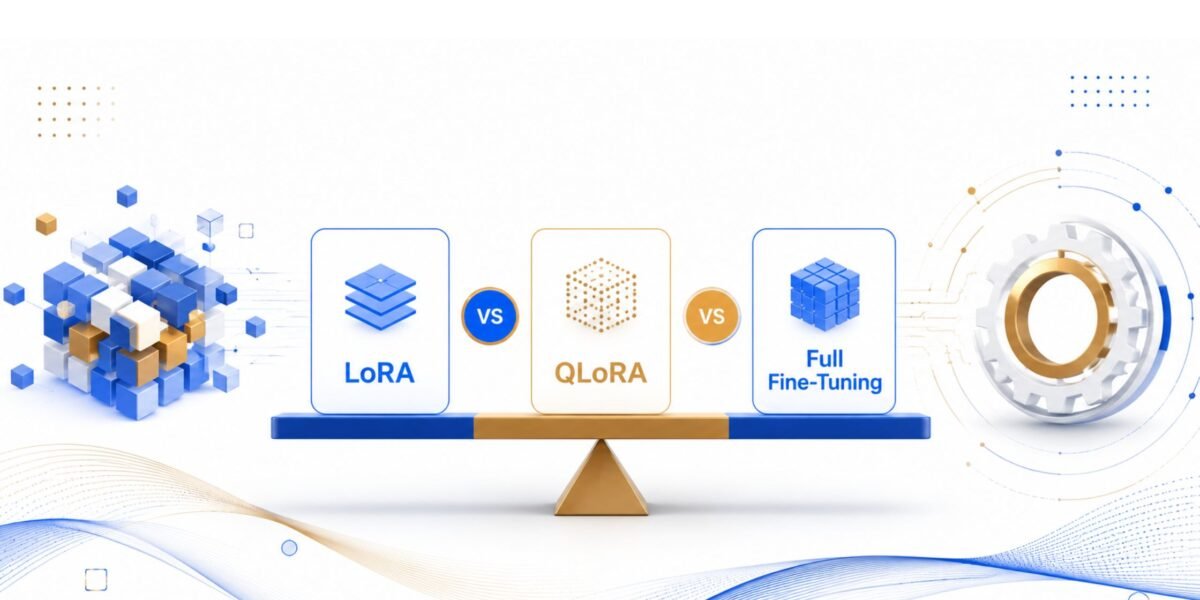
Choosing the right strategy requires a deep look at fine-tuning methods enterprise teams can reliably deploy. Today, three main approaches dominate the landscape: Full Fine-Tuning, Low-Rank Adaptation (LoRA), and Quantized LoRA (QLoRA). Navigating this LLM adaptation comparison requires balancing available hardware, training wall-clock time, and final inference latency.
Let’s dive deep into the mechanics of each method so you can make an informed architectural decision for your enterprise workloads.
FFT: Full Fine-Tuning
The easiest way to modify a pre-trained model for a new job or dataset is by full fine-tuning. During training, all of the model’s parameters including the weights in the layers are changed.
To improve its performance on the new data or task, the model first undergoes additional training using a pre-trained set of weights.
The capacity to fully optimize a model for a particular job is the main benefit of full fine-tuning. The model might acquire intricate, task-specific patterns that are absent from the pre-trained model because all parameters are updated during fine-tuning.
Nevertheless, there are certain disadvantages to this approach. First, a substantial amount of processing power is needed for complete fine-tuning, particularly for big models. For many developers, the requirement for high memory capacities and long training times can be a hindrance. Furthermore, overfitting may result from fine-tuning every parameter, especially if the dataset is tiny or lacking in variety.
LoRA: Low-Rank Adaptation
A more effective substitute for complete fine-tuning is Low-Rank Adaptation (LoRA). By adding low-rank matrices to the model’s layers, LoRA modifies a smaller portion of the model’s weights rather than changing all of the model’s parameters.
In particular, LoRA breaks down the weight updates into two smaller, lower-rank matrices that are significantly easier to train computationally.
LoRA is based on the idea that many deep learning models, particularly big ones, can increase task-specific performance without requiring complete parameter updates.
Rather, a low-rank approximation of the weight updates is adequate. LoRA lowers the number of parameters that must be updated, resulting in a significant decrease in memory use and computational cost, by freezing the original model parameters and just training the low-rank matrices.
One drawback is that, for more complicated jobs, LoRA might not always perform as well as full fine-tuning since the low-rank approximation might not capture all the essential subtleties of the data.
QLoRA: Quantized LoRA for Maximum Resource Savings
A variation of LoRA called Quantized Low-Rank Adaptation (qLoRA) adds quantization to the low-rank adaptation procedure.
The process of lowering the accuracy of the model’s parameters, such as changing floating-point values to lower-precision forms (e.g., 8-bit integers instead of 32-bit floats), is known as quantization.
Large models can be fine-tuned on even more limited hardware thanks to this approach, which further lowers the memory footprint and computing needs.
The advantages of quantization’s memory efficiency and LoRA’s low-rank adaptability are combined in qLoRA. qLoRA lowers the total computational load of the fine-tuning procedure by quantizing both the low-rank adaptation matrices and the pre-trained model weights.
This approach is especially helpful in settings with constrained memory, storage, and processing capability, like edge devices or scenarios needing quick model deployment.
The fundamental benefit of qLoRA is its capacity to keep LoRA’s efficiency while shrinking the model’s size, enabling even quicker training and inference.
Quantization has the drawback of potentially reducing model precision, which could have an impact on performance. With even less memory and computational overhead, qLoRA’s performance is frequently on par with LoRA.
The Comparison Table
Memory Footprint vs. Training Speed
In a head-to-head LoRA vs QLoRA fine-tuning setup, memory savings are the primary differentiator. Standard LoRA requires loading the base model in 16-bit or 32-bit precision. For an 8B model, the base weights alone consume roughly 16 GB of VRAM before accounting for gradients and activations.
QLoRA compresses that base model footprint down to roughly 5.5 GB. However, this memory relief comes at a cost to compute throughput. Because the base model must be continually dequantized from 4-bit NF4 to 16-bit floating point during training execution, QLoRA typically exhibits a 15% to 25% slower training speed (tokens processed per second) compared to unquantized LoRA.
Accuracy Retention
A common concern among AI researchers is whether the aggressive 4-bit quantization of QLoRA degrades performance. Empirical benchmarks across a wide variety of academic and industrial datasets show that the NF4 quantization scheme preserves virtually 100% of the accuracy found in standard 16-bit LoRA variants. The low-rank adapters effectively compensate for any information loss induced by the quantization process.
Architectural Trade-Offs in LoRA vs QLoRA Fine-Tuning for SLMs
When implementing LoRA vs QLoRA fine-tuning for specialized SLMs, choosing hyperparameters requires careful consideration of the network architecture.
Rank Selection (r) and Alpha (α)
The choice of rank (r) dictates the capacity of your adapter. While a lower rank (r=8 or r=16) is ideal for simple classification or specific stylistic adaptations, higher ranks (r=64 or r=128) are frequently deployed in complex LLM adaptation comparison tests to give the adapter more expressive power.
When configuring these settings, the scaling factor α acts as a learning rate for the adapter. In standard LoRA, performance scales linearly with changes to these dimensions. In QLoRA enterprise configurations, however, scaling the rank too high can occasionally lead to gradient instability if the base model’s precision boundary is pushed too hard across multiple attention heads.
Compute-Bound vs Memory-Bound Workloads
- Standard LoRA is memory-bound. Your main blocker is fitting the batch size and context length into your VRAM allocations without triggering out-of-memory (OOM) errors.
- QLoRA shifts the bottleneck toward being compute-bound. It saves you from OOM errors, but your GPUs will spend substantial clock cycles performing quantization math. If you have an abundance of high-bandwidth VRAM (like H100 or H200 clusters), standard LoRA or full tuning is often preferred for pure speed. If you are operating on tighter hardware constraints (like A10G or L4 clusters), QLoRA becomes the clear choice.
Choosing Between LoRA vs QLoRA Fine-Tuning and Full Tuning
Enterprise engineering teams must avoid defaulting to the most complex or the most highly compressed strategy without considering the underlying data characteristics.
Scenario A: The Data Shift is Radical
If your SLM needs to learn highly specialized internal enterprise knowledge. Such as proprietary software codebases written in an internal language, or highly complex, non-standard tabular data structures. LoRA vs QLoRA fine-tuning applied across all linear layers is necessary. The model requires deep, systemic weight shifts to alter its structural behavior.
Scenario B: Strict Hardware and Budget Caps
When your priority is maximizing your existing hardware footprint or reducing cloud bills, a QLoRA enterprise pipeline is the definitive answer. It enables your team to run parallel training experiments of highly capable 14B or 32B models on accessible, lower-cost GPU clusters without risking sudden out-of-memory errors during long context window jobs.
Scenario C: Multi-Tenant and Edge Deployments
If you are deploying software where different corporate clients require completely customized models, storing separate full-weight instances for each customer is financially restrictive. Here, standard LoRA excels. You can keep a single golden base model in VRAM and dynamically swap out tiny, customer-specific adapter files (weighing only a few megabytes) at runtime based on incoming API routing keys.
Streamlining LoRA vs QLoRA Fine-Tuning Infrastructure with AIVeda
While the theoretical concepts behind these fine-tuning methods enterprise frameworks are well-understood, setting up the actual infrastructure to execute them is notoriously brittle. Balancing deep library dependencies, managing CUDA compilation mismatches, tracking gradient convergence, and avoiding precision loss during weight merging can derail engineering roadmaps.
Contact us and discover how we can optimize your enterprise AI pipelines
Conclusion
There is no one-size-fits-all answer in the LLM adaptation comparison matrix. Full fine-tuning remains the ultimate choice for fundamental, ground-up domain shifts. Standard LoRA provides an ideal blend of speed and modular flexibility for multi-tenant applications. QLoRA stands out as the ultimate option for resource-constrained environments, unlocking high-quality training on cost-effective hardware.
Frequently Asked Questions
Q1: Does QLoRA lose model accuracy compared to standard LoRA?
A: No. Empirical benchmarks show that using the 4-bit NormalFloat (NF4) data type allows QLoRA to match standard 16-bit LoRA performance without degrading downstream accuracy.
Q2: Can I merge QLoRA adapters directly back into a 16-bit base model?
A: Yes. You dequantize the base model back to 16-bit or 32-bit precision before adding the adapter weights, completely eliminating any inference latency overhead during deployment.
Q3: When should enterprise teams completely avoid parameter-efficient fine-tuning (PEFT)?
A: Avoid PEFT if your SLM must learn a completely new language, entirely distinct syntax, or deeply complex, foundational formatting rules that drastically diverge from its base pre-training.