Most people have encountered a voice bot that felt genuinely human. One that caught exactly what they said, remembered what came two exchanges earlier, and responded in a way that moved the conversation forward.
And most people have also hit the opposite: a rigid phone system that misheard every third word, reset the conversation each time they paused, and made them repeat themselves to a machine that clearly wasn’t listening.
That gap isn’t about better text-to-speech. It’s about architecture such as how a system understands language, holds context across a conversation, responds at a speed that feels natural, and does all of that in more than one language.
This piece breaks down how a conversational AI voice bot actually works under the hood, what makes human-like delivery hard to build right, and what the 10+ language capability genuinely requires beyond what most marketing materials bother to explain.
What a Conversational AI Voice Bot Actually Is
More Than a Voice Layer on Top of a Chatbot
A conversational AI voice bot is not simply a text chatbot with a microphone bolted on. The voice interface changes the interaction model in fundamental ways. There’s no cursor, no backspace, no ability to re-read a message. The system has to understand what was said correctly, in real time, and respond in a way that sounds like a conversation rather than a transaction. That requires a different architecture from the ground up, not a wrapper. AIVeda’s Conversational Agent Platform is one example of how this layer gets purpose-built for enterprise deployment rather than adapted from a general-purpose chatbot.
Where a Voice AI Chatbot Fits in the Broader AI Stack
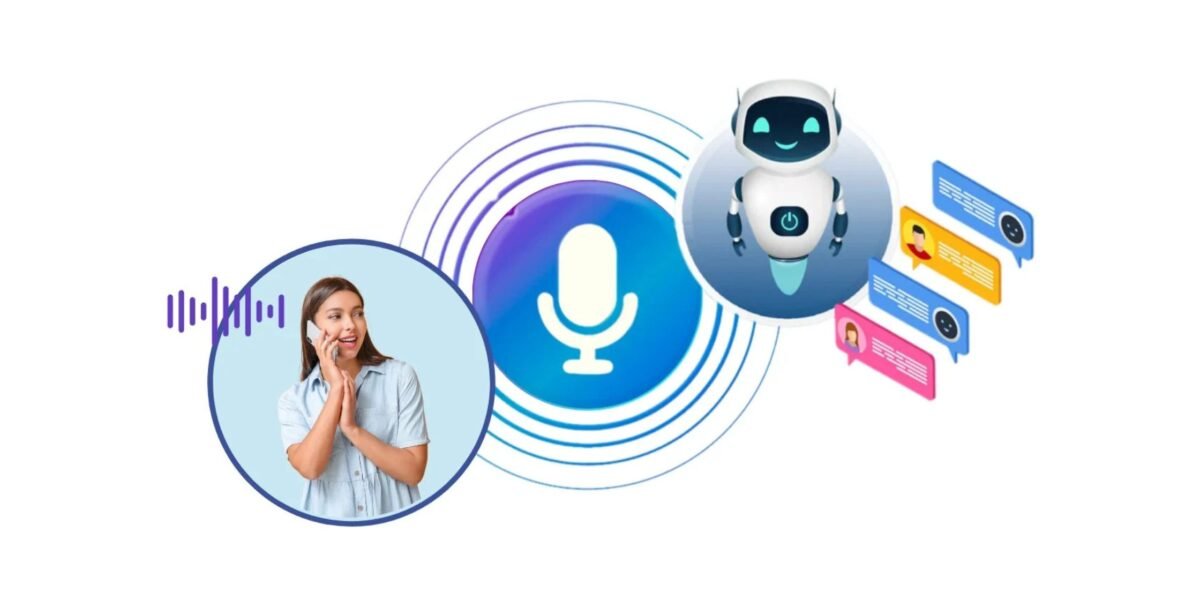
A voice AI chatbot sits at the intersection of two distinct technology areas: speech technology (the ASR and TTS components that handle audio) and conversational intelligence (the NLU, dialogue management, and knowledge retrieval that handle meaning).
Most consumer products combine these in ways that obscure the seam. Enterprise deployments need to understand each component because that’s where the customization, security, and compliance decisions actually get made.
What Makes a Chatbot With Voice Recognition Different From a Voice Recorder
The distinction worth making early: a chatbot with voice recognition isn’t transcription software that happens to talk back. Transcription, converting audio to text is the entry point, not the intelligence.
What comes after the transcription is where the system either handles the caller well or falls apart. Intent interpretation, entity extraction, context management, and appropriate response generation are all separate layers stacked on top of that initial audio-to-text conversion.
With that foundation in place, it’s worth walking through exactly how this technology takes a spoken sentence and turns it into a useful, relevant response.
How a Conversational AI Voice Bot Processes Speech (Step by Step)
Step 1: Automatic Speech Recognition (ASR)
The first thing the system does is convert raw audio into text. Modern ASR models are trained on large, diverse corpora of speech data. It is what lets them handle regional accents, natural pacing, background noise, and the way people actually talk rather than the way they’d dictate to a court reporter.
Accuracy at this stage directly determines everything downstream. Poor ASR means the NLU layer is working from bad input, and no amount of sophisticated language modeling can fix a misheard sentence.
Step 2: Natural Language Understanding (NLU)
Once the audio is text, NLU takes over. It extracts the intent of what the caller actually wants and entities. The specific information they provided (my account ending in 4821, next Tuesday, the order from last week). This is the layer where a chatbot with voice recognition separates itself from a keyword-matching system.
It handles paraphrasing, partial sentences, implied requests, and corrections, rather than requiring a caller to use exact pre-programmed phrasing to trigger a response. For enterprise deployments, the language model underlying this NLU layer increasingly matters. A generic third-party API handles general conversational intent well, but it struggles with domain-specific vocabulary, regulatory language, and company-specific product terminology.
Private LLM development, where the model is fine-tuned on a company’s own data and domain knowledge. It is what closes that gap for production-grade enterprise voice systems.
Step 3: Dialogue Management & Knowledge Retrieval
The system maintains conversation state: what’s been said, what’s been resolved, what the caller is still waiting on. For fact-based queries like account balance, order status, and appointment availability.
This is where a knowledge retrieval layer matters as much as the language model. A caller asking what the status of my last order is expects a specific answer from real data, not a plausible-sounding generated response.
Secure RAG systems layer retrieval-augmented generation on top of LLM reasoning to ground responses in live, accurate, access-controlled information, which is what makes an enterprise voice bot trustworthy rather than confident-sounding.
Step 4: Text-to-Speech (TTS) & Response Delivery
The generated response gets converted back into speech. Modern neural TTS varies pitch, pace, emphasis, and tone in ways that older concatenative systems couldn’t. The output sounds present in the conversation rather than like a pre-recorded announcement read in sequence.
In regulated industries, it’s worth noting that every exchange across all four steps needs to be logged and auditable, not just stored. AI governance and compliance architecture built into the platform from day one is what makes that feasible without a compliance retrofit later.
The architecture explains how the system works. What makes a conversational AI voice bot feel human is a separate and harder problem.
Why Human-Like Delivery Is Harder Than It Sounds
Context Retention Across a Multi-Turn Conversation
Human conversations build on themselves. A caller who provides their account number in the first exchange shouldn’t have to give it again in the third. A customer who explained their problem shouldn’t have to re-explain it after a brief digression. Maintaining full conversation context across every turn without discarding earlier exchanges to manage processing overhead. It is one of the most technically demanding parts of building a voice system that actually feels natural. It’s also where most off-the-shelf tools fall short, resetting context silently between turns in ways the caller experiences as the bot not listening.
Handling Interruptions, Corrections & Tangents
Real speech is not clean. People change direction mid-sentence, correct a detail they gave thirty seconds ago, or ask a quick tangential question before getting back to their main request. A voice AI chatbot built for production use needs to handle all three gracefully. Tracking when a speaker is self-correcting versus introducing new information, and maintaining the underlying task state through the noise. This is a dialogue management problem, not a transcription problem, and it requires intentional design rather than just a capable language model.
Latency: The Hidden Killer of Naturalness
The time between a caller finishing a sentence and the response beginning is where the human feeling lives or dies. Latency of even two seconds breaks the conversational rhythm in a way that immediately signals this is a machine.
Every step in the processing pipeline contributes to that delay, such as ASR, NLU inference, dialogue management, knowledge retrieval, and TTS synthesis. All of which need to complete fast enough that the gap feels like a natural thinking pause rather than a system loading spinner.
This is one of the main architectural constraints that makes enterprise voice AI hard to build well, even when all the individual components work in isolation. All of that complexity doubles when you add the requirement to work naturally across 10 or more languages.
What 10+ Language Support Actually Requires
Language Models vs Translation Layers
There are two ways to build multilingual voice AI. The first is to use a separate language-specific model for each supported language. Accurate and well-controlled, but expensive to maintain and difficult to scale.
The second is to use a multilingual model that handles cross-language inference natively, including regional phrasing, idiomatic expressions, and cultural context, rather than just literal translation of words. The latter scales better but requires more deliberate training and evaluation to get right across all supported languages.
Small Language Models optimized for specific language sets can deliver multilingual inference at substantially lower compute cost than general-purpose LLMs. A meaningful difference when the deployment involves tens of thousands of calls per day across multiple languages.
Why This Matters Beyond Simple Translation
The implications of genuine multilingual capability go further than just speaking a second language:
- Accent and dialect recognition within a language, not just language detection between languages
- Code-switching support for callers who naturally mix two languages mid-sentence, common in bilingual markets
- Regional compliance delivery requires that how disclosures are phrased differs by jurisdiction, even within the same language
- TTS voice quality parity across all supported languages, not just the primary one. A voice that sounds natural in English but robotic in Spanish defeats the purpose
The architecture and multilingual capability explain the technology. The question most enterprise decision-makers are really asking is where this delivers real, measurable value in a production environment.
Where Conversational AI Voice Bots Deliver Real Enterprise Value
High-Value Use Cases by Industry
A conversational AI voice bot earns its place in environments where phone-based interactions are high-volume, repetitive, and time-sensitive:
- Banking & Financial Services: Payment reminders, balance inquiries, fraud alerts, and collections outreach that would otherwise require a full calling floor. For a practical deployment guide, AIVeda’s breakdown of AI-powered debt collections covers the mechanics in detail.
- Healthcare: appointment scheduling, prescription refill reminders, and post-discharge follow-up at a scale no human team can sustain cost-effectively.
- Telecom: First-call resolution for billing queries, plan changes, and basic troubleshooting, freeing live agents for complex technical support.
- Fintech and NBFCs: EMI reminder automation that maintains a conversational tone without triggering the friction a robocall creates. AIVeda’s NBFC EMI reminder playbook details the approach.
- Enterprise contact centers: Intelligent deflection of routine inbound volume so agents handle only what actually needs a person.
What to Look for in a Platform Before You Deploy
Five questions worth running before any vendor conversation:
- Does the system use a native multilingual model, or a translation layer that adds latency and loses nuance?
- Can it retain full context across a multi-turn conversation without resets?
- Is data processed inside your environment, or through a shared public model?
- Does it integrate cleanly with your telephony stack and CRM via standard AI integration patterns?
- After deployment, does the vendor provide ongoing monitoring and drift detection as call patterns and language evolve?
How AIVeda’s Lira Answers Those Questions
If those questions read like a useful checklist, AIVeda’s conversational AI platform, Lira, is worth evaluating against each one. As a voice AI chatbot built on AIVeda’s private LLM foundation, Lira processes conversation and account data inside the enterprise’s own environment rather than routing it through a third-party shared model.
The foundation of defensible compliance in banking, healthcare, and telecom deployments. Its adaptive context management retains the full conversation thread across multi-turn interactions and when a call needs to escalate.
The human agent receives the complete conversation record rather than a cold transfer. Multilingual support is handled through the underlying model rather than a translation layer, which keeps response quality consistent across languages without adding perceptible latency.
Conclusion
The difference between a conversational AI voice bot that earns a caller’s trust and one that frustrates them into requesting a human is entirely architectural. ASR accuracy, NLU depth, multi-turn context retention, low-latency response generation, and genuinely multilingual models all have to work together. At production speed, under real-world call conditions, in every language the deployment requires.
Before evaluating vendors, use the checklist in the section above as your filter. And if you’re still working through the build-vs-buy question, AIVeda’s enterprise AI decision framework is worth reading before the vendor conversations start. When you’re ready for a scoped assessment of your own environment, AIVeda’s Private AI Strategy & Advisory service is the right starting point.
Frequently Asked Questions
What is a conversational AI voice bot?
A conversational AI voice bot is an AI system that understands natural spoken language, maintains conversation context across turns, and responds verbally. Going well beyond menu-based IVR navigation or scripted phone trees.
How does a voice AI chatbot handle different accents and languages?
A voice AI chatbot trained on diverse speech data handles accents and regional phrasing by design. True multilingual systems process language natively rather than routing everything through a translation layer first.
What is a chatbot with voice recognition?
A chatbot with voice recognition converts spoken input to text using ASR, interprets intent using NLU, and generates a contextual spoken response. Enabling natural, open-ended conversation rather than keyword-triggered menu navigation.
How many languages can a conversational AI voice bot support?
Modern enterprise systems support 10 or more languages, but quality varies. The best platforms use natively multilingual models rather than separate language-specific tools patched together at the application layer.
Is conversational voice AI secure enough for regulated industries?
Architecture determines security. Systems running on private LLMs with on-premise or VPC deployment, audit logging, and role-based access control can meet enterprise compliance requirements in regulated sectors.
How is AIVeda’s Lira different from a standard voice bot?
Lira runs on a private LLM with data staying in-environment, offers adaptive context management for multi-turn conversations, and handles multilingual interactions through the underlying model rather than a third-party translation dependency.