Natural conversation between two people has an average 200-millisecond gap between one person finishing a sentence and the other responding. That rhythm is hardwired into how humans communicate. It holds across languages and cultures, and our brains notice immediately when it breaks.
Every conversational AI voice bot has to replicate that rhythm while also transcribing speech, understanding intent, generating a response, and converting it back to audio. All before that natural pause turns into an awkward silence that gives away the machine on the other end of the line. This piece breaks down the actual architecture behind a modern conversational AI voice bot, why some still sound robotic despite genuine technical progress, and how multilingual support actually works under the hood and not just what a vendor’s landing page claims.
How a Conversational AI Voice Bot Actually Works, Layer by Layer
A conversational AI voice bot runs on four layers, each handing off to the next: speech-to-text, natural language understanding, dialogue management, and text-to-speech. Each layer has to complete its job before the next one can start, and all four have to finish inside a genuinely tight time budget for the conversation to feel natural rather than mechanical.
Most of what people attribute to the AI being smart or human-like is actually the coordination between these four separate systems working in sequence often built by different vendors and stitched together, which is exactly where things tend to break down. Understanding each layer individually makes it much easier to evaluate any voice AI platform on more than a polished demo call.
Quick Answer
A conversational AI voice bot works through four layers in sequence: speech-to-text converts what the caller says into text, a language model interprets intent and generates a response, dialogue management tracks context across the conversation, and text-to-speech converts the response back into natural-sounding audio. All fast enough to stay under roughly 800 milliseconds for the exchange to feel human.
The Four Layers Behind Every Voice AI Chatbot
The Conversational AI Voice Bot Pipeline
| Layer | What It Does | Why It Matters for Human-Like Quality |
|---|---|---|
| Speech-to-text (ASR) | Converts spoken audio into text in real time | Errors here cascade through every later step |
| Natural language understanding | Interprets intent and meaning, not just words | Determines whether the bot actually gets it |
| Dialogue management | Tracks context and conversation history | Prevents the bot from losing the thread mid-call |
| Text-to-speech (TTS) | Converts the generated response into natural audio | Determines how human the output actually sounds |
A weak link in any one layer breaks the illusion for the whole system, regardless of how good the other three are. This is exactly why evaluating a voice AI chatbot on a single demo call rarely tells the full story. A curated demo can mask a layer that struggles under real, messy, accented, or noisy phone conditions. The gap between a voice AI chatbot that impresses in a sales call and one that holds up on real customer traffic almost always lives in one of these four layers, not in the marketing copy describing them.
Why Most Conversational AI Voice Bots Still Sound Robotic
Here’s the benchmark worth holding every claim against: natural conversation runs on a roughly 200-millisecond gap between speakers, and production voice AI needs to stay under about 800 milliseconds end-to-end to feel acceptable, with sub-300ms feeling indistinguishable from a highly responsive human.
The honest gap is worth stating directly. According to Telnyx’s 2026 latency research, many production voice AI systems still run 1,400 to 1,700 milliseconds at the median in actual deployment well above the target range. That gap is exactly why some voice bots still feel like they’re thinking too hard mid-conversation, even when the eventual answer is accurate.
The reason is straightforward once you understand the pipeline: each of the four layers adds its own processing delay, and if they run strictly in sequence rather than overlapping through streaming, those delays stack up fast. A system that transcribes, then waits, then reasons, then waits, then generates speech will almost always miss the natural rhythm regardless of how capable the underlying language model actually is.
What Makes a Chatbot With Voice Recognition Actually Understand You
Recognizing words correctly is only step one. A chatbot with voice recognition also has to understand what the caller actually meant. Therefore including incomplete sentences, filler words, and mid-sentence topic changes which is a separate, considerably harder problem than transcription alone.
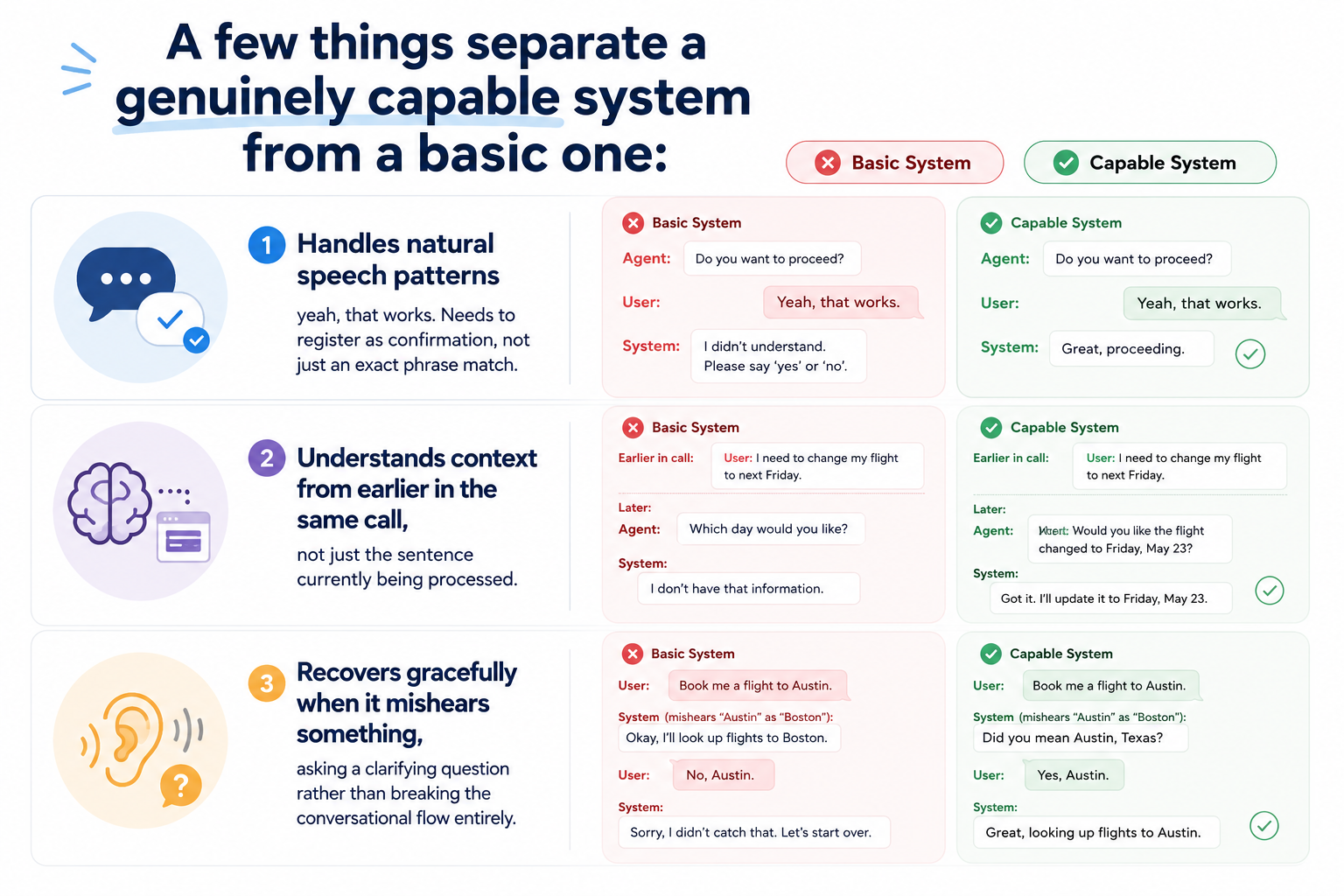
That last point matters more than it might seem. A human listener recovers from a mishearing instantly and without friction; a poorly built chatbot with voice recognition often derails the entire interaction over one misheard word. The best chatbot with voice recognition systems treat a mishearing as a minor detour, not a conversation-ending event.
How These Systems Handle 10+ Languages Without Losing the Human Feel
Genuine multilingual support requires native speech models at both the recognition and generation stages for each language. Not a single English-first pipeline with a translation layer bolted on top, which adds latency and loses nuance in both directions.
The practical test buyers should run directly: ask whether a platform’s non-English languages perform at the same latency and accuracy as English, or noticeably worse. That gap reveals whether multilingual support was designed in from the start or added later as an afterthought. A translation layer might technically support a language on a feature checklist while still producing the stilted, delayed responses that give away the machine immediately.
This is the same architecture principle behind AIveda’s Conversational Agent Platform, which handles natural conversation across multiple languages without relying on a translation layer stitched on top of an English-first system.
What to Look for in a Conversational AI Voice Bot Platform
A short list of questions separates genuine architecture from marketing claims:
- What’s the platform’s actual end-to-end latency, measured on real calls, not a curated demo?
- Does it stream responses, or wait for a complete reply before speaking?
- Are non-English languages built on native models, or a translation layer?
- Does dialogue management genuinely retain context across a multi-turn call?
- Where is voice and conversation data processed and stored?
AIveda’s Conversational Agent Platform, built on its private Lira LLM, is architected around these exact questions. Designed for low-latency, multilingual conversation handling rather than a single-language system with translation added later. For a broader look at how this plays out across real use cases.
AIveda’s guide on voice bots for call centers covers eight production examples. To see this in actual deployment rather than theory, AIveda’s case studies are worth a look.
Key Takeaways
- A conversational AI voice bot isn’t one piece of technology. It’s four layers working together in real time: speech-to-text, language understanding, dialogue management, and text-to-speech.
- The human-like quality people notice most isn’t accuracy, it’s speed: natural human conversation has an average 200-millisecond gap between speakers, and voice bots need to stay under roughly 800ms to feel acceptable.
- Many production voice AI systems still fall short of that target in practice, with real-world deployments often running 1,400-1,700ms. It is exactly why some voice bots still feel noticeably robotic.
- Supporting 10+ languages isn’t just a translation layer bolted on top; it requires native language models at both the speech-recognition and speech-generation stages, not a single English-first system with translation wrapped around it.
- The gap between a voice AI chatbot that feels natural and one that feels mechanical usually comes down to architecture choices most buyers never ask about. This layer is slowest, and whether the system streams responses or waits for a full reply before speaking.
Conclusion
The human-like quality of a conversational AI voice bot comes down to a measurable, physical constraint staying close to the roughly 200-millisecond rhythm of natural human conversation not just how smart the underlying language model happens to be. Many production systems still miss that target today, which is exactly why some voice bots feel noticeably robotic despite genuine technical progress across the industry. Anyone evaluating a conversational AI voice bot should ask about latency and architecture specifically. This layer is slowest, whether responses stream, whether non-English languages perform on par with English rather than taking human-like as a marketing claim at face value.
Frequently Asked Questions
Why does a conversational AI voice bot sometimes pause awkwardly mid-sentence even when it understood the question correctly?
That pause is usually a latency issue, not a comprehension. One of the four pipeline layers, often language model inference, is taking longer than the roughly 800-millisecond window that feels natural to callers.
Is a voice ai chatbot with a bigger, more powerful language model always more human-sounding?
Not necessarily. A more powerful model can actually increase latency, and if response time exceeds the natural conversational rhythm, the interaction feels less human regardless of answer quality.
How can a business tell if a vendor’s multilingual claim is genuine or just a translation layer?
Test the platform’s non-English languages directly for latency and accuracy compared to English. A noticeable gap usually means translation was added on top rather than built in natively.
What’s the actual difference between speech recognition accuracy and conversational understanding?
Speech recognition transcribes words correctly; conversational understanding interprets intent, including incomplete sentences and context from earlier in the call a harder, separate technical problem entirely.
Does streaming actually make a measurable difference in how human a voice bot sounds?
Yes. Streaming lets a system begin speaking before a full response is generated, cutting perceived latency significantly compared to waiting for a complete reply before any audio plays.
Why do some production voice AI systems still run well above the 800-millisecond target despite 2026 improvements?
Often because separate vendors handle each pipeline layer speech recognition, language model, speech generation and stitching them together adds delay that a single, integrated architecture avoids.