
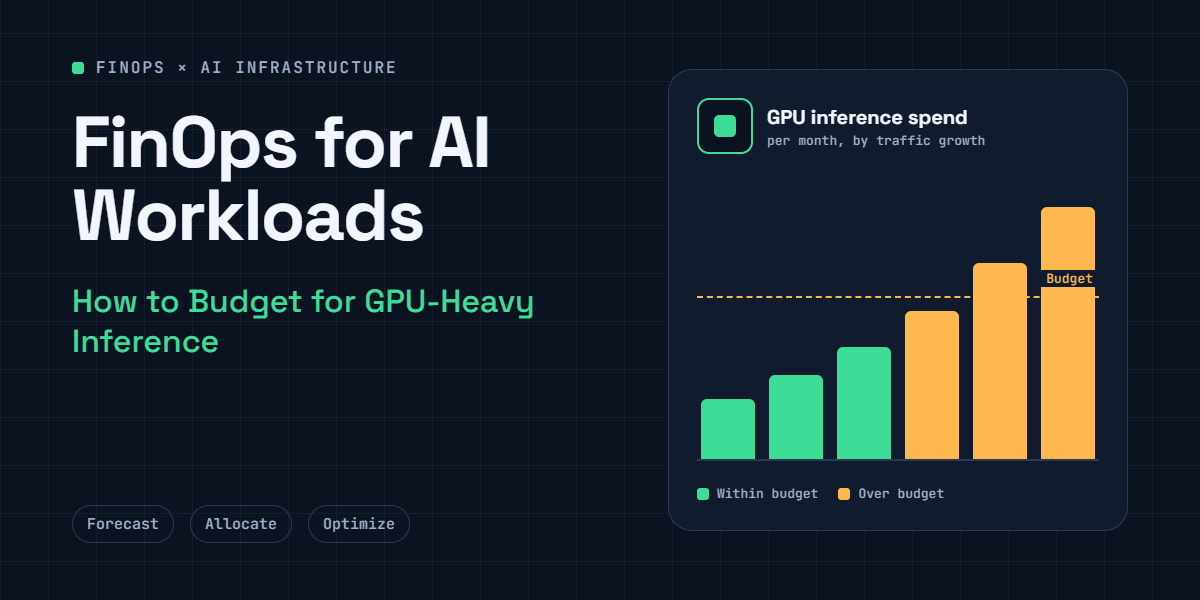
Artificial intelligence is transforming business operations, but running AI applications at scale introduces a growing financial challenge. As enterprises deploy large language models, intelligent assistants, and automated workflows, GPU infrastructure expenses can rise faster than expected.
Unlike traditional cloud applications, AI workloads often require specialized hardware, substantial memory, and continuous processing capacity. Growing request volumes, fluctuating demand, and inefficient resource allocation can make AI inference costs difficult to predict.
This is where FinOps for AI becomes essential. By combining financial accountability with infrastructure monitoring and workload optimization, organizations can gain better control over AI spending without compromising performance.
Understanding how GPU expenses accumulate is the first step toward building an AI infrastructure budget that supports sustainable growth.
Quick Answer
How Should Enterprises Budget for GPU-Heavy Inference?
FinOps for AI helps enterprises forecast, monitor, and optimize GPU spending by connecting infrastructure consumption with business outcomes. An effective budget should consider GPU instance pricing, workload demand, token consumption, utilization rates, and operational overhead. Organizations can improve cost predictability by benchmarking model performance, right-sizing resources, establishing spending limits, and regularly reviewing infrastructure efficiency.
Why FinOps for AI Matters for GPU-Heavy Workloads
Traditional cloud financial management focuses on predictable infrastructure expenses, storage consumption, and resource allocation. AI applications introduce additional variables that make budgeting more complicated.
Why GPU Inference Spending Is Difficult to Predict
Inference occurs whenever a trained AI model processes new input and generates an output. For applications serving thousands of requests, these operations create ongoing computing demands.
Several factors affect infrastructure spending:
- Unpredictable traffic: Sudden increases in user requests can require additional processing capacity.
- GPU availability: Enterprises may reserve more GPU resources than regularly needed to maintain performance during peak periods.
- Model complexity: Larger models generally require greater computing power and memory.
- Response time expectations: Applications requiring immediate responses may need dedicated infrastructure instead of shared processing resources.
These variables make static budgeting insufficient for growing AI deployment.
How AI Inference Cost Differs From Traditional Cloud Spending
Conventional applications can often scale through relatively straightforward CPU and memory adjustments. AI inference introduces additional constraints, including GPU memory capacity, model architecture, context length, and token generation speed.
An effective FinOps for AI strategy therefore needs to evaluate more than hourly infrastructure pricing. Organizations must understand how efficiently hardware processes requests and whether operating expenses align with delivered business value.
AWS also recommends selecting inference infrastructure according to workload requirements and monitoring utilization to identify optimization opportunities. See its inference cost optimization best practices.
Understanding the Real Costs Behind GPU Inference
Before creating a budget, enterprises need visibility into every component of their AI infrastructure.
GPU Compute, Memory, and Infrastructure Costs
GPU computing is often a major expense for organizations hosting AI models.
Costs depend on the GPU instance type, hardware configuration, deployment duration, and required memory capacity. Larger models may need GPUs with more video memory, increasing infrastructure requirements.
Organizations running dedicated endpoints may also pay for provisioned GPU capacity even when request volumes are low.
Token Consumption, Concurrency, and Model Complexity
For token-priced AI services, spending depends on input and output token volumes.
Longer prompts, larger context windows, and detailed responses can increase consumption. For self-hosted models, those same characteristics influence processing time, memory demands, and throughput.
Concurrency matters as well. An application handling hundreds of simultaneous users may require additional capacity to maintain acceptable response times.
Hidden Operational Expenses Enterprises Often Miss
Beyond GPU compute, AI deployments involve supporting expenses that should be included in the financial plan.
| Cost component | Primary cost driver | Optimization approach |
|---|---|---|
| GPU compute | Instance hours and hardware type | Right-size GPU resources |
| Token processing | Input and output volume | Optimize prompts and model selection |
| GPU memory | Model size and context length | Evaluate smaller models |
| Idle infrastructure | Unused provisioned capacity | Improve utilization |
| Storage and networking | Data storage and transfer | Monitor supporting services |
| Operations | Monitoring and maintenance | Automate routine processes |
Organizations that overlook these expenses may underestimate their total production costs.
For a deeper explanation of how model selection affects spending, explore AIVeda’s guide on reducing LLM inference cost with small language models.
How to Build a Practical FinOps for AI Budget
A reliable AI budget should reflect actual application demand rather than infrastructure estimates alone.
The following four-step approach provides a practical starting point.
Step 1: Forecast AI Workload Demand
Begin by estimating expected application usage.
Identify the number of daily requests, average tokens processed, concurrent users, and periods of increased traffic.
For example, a customer support assistant might experience predictable weekday demand, while an ecommerce AI assistant could encounter significant traffic spikes during promotional events.
Forecasting these patterns helps determine how much infrastructure capacity is required.
Step 2: Calculate GPU and Model Operating Costs
Suppose an enterprise operates two GPU instances at an illustrative rate of $3 per instance-hour for 720 hours per month.
Its estimated monthly GPU compute expense would be:
2 × 720 × $3 = $4,320
This calculation excludes storage, networking, monitoring, engineering expenses, and other supporting services.
A complete AI inference cost estimate should include these additional charges and distinguish dedicated GPU hosting from token-based API billing to avoid double-counting.
Step 3: Create Multiple Budget Scenarios
Rather than relying on one projection, develop low-demand, expected-demand, and peak-demand scenarios.
The following table shows hypothetical monthly planning figures.
| Expense category | Low demand | Expected demand | Peak demand |
|---|---|---|---|
| GPU compute | $2,400 | $4,800 | $9,600 |
| Storage and networking | $200 | $400 | $800 |
| Monitoring and operations | $400 | $600 | $1,000 |
| Estimated monthly total | $3,000 | $5,800 | $11,400 |
Note: These figures are illustrative examples, not current cloud-provider quotations.
Scenario planning allows finance teams to understand the potential impact of increased traffic before additional infrastructure is provisioned.
Step 4: Establish Spending Limits and Ownership
Every AI workload should have a clear budget owner, measurable spending targets, and defined reporting processes.
Organizations can introduce cost allocation tags, automated spending alerts, and regular budget reviews to identify unexpected increases.
Successful FinOps for AI budgeting also requires engineering and finance teams to review performance requirements together. Reducing spending should not come at the expense of reliability, output quality, or user experience.
Six Ways to Reduce GPU Inference Spending
Once baseline costs are established, the next priority is improving infrastructure efficiency.
1. Right-Size GPUs Based on Workload Demand
Choosing the most powerful available GPU does not necessarily deliver the best financial outcome.
Enterprises should compare hardware configurations against actual model requirements, processing speed, memory consumption, and expected traffic.
Benchmarking different instances can reveal whether a smaller configuration delivers sufficient performance at a lower cost.
2. Improve GPU Utilization Through Batching
Batching allows multiple inference requests to be processed together, potentially increasing throughput and improving hardware utilization.
However, aggressive batching can introduce response delays. Organizations should evaluate throughput gains alongside latency requirements before deployment.
3. Use Smaller Models for Simpler Tasks
Not every enterprise application requires a large, general-purpose language model.
Smaller language models may perform well for classification, information extraction, routing, and other clearly defined tasks.
Using appropriately sized models can reduce memory requirements and computing expenses while reserving larger models for complex reasoning.
AIVeda discusses related deployment considerations in its article on deploying small language models, inference, monitoring, and drift.
4. Apply Model Quantization and Optimization
Quantization reduces the numerical precision used to represent model parameters, potentially lowering memory consumption and improving inference efficiency.
Other optimization techniques include model compilation and specialized serving configurations.
AWS’s SageMaker inference optimization documentation describes several approaches and their performance considerations.
Every optimization should be evaluated for accuracy, latency, and operational compatibility.
5. Introduce Caching and Intelligent Request Routing
Caching can reduce repeated processing for identical or reusable requests.
Intelligent routing can direct straightforward tasks to less resource-intensive models while assigning complex requests to more capable systems.
These approaches may improve AI inference cost efficiency, especially for applications with repetitive workflows.
6. Match Deployment Models to Traffic Patterns
Dedicated infrastructure may suit predictable, high-volume applications. Serverless or usage-based options can be more appropriate for intermittent workloads, depending on model size, provider capabilities, and latency requirements.
Hybrid deployments may combine these approaches to balance flexibility and efficiency.
The objective is not simply to minimize hourly pricing. It is to achieve the required performance at the lowest sustainable total cost.
Which Metrics Should Enterprises Track to Control AI Costs?
Without meaningful performance metrics, even carefully designed budgets can become inaccurate.
Organizations should monitor infrastructure expenses alongside operational efficiency and application quality.
Essential GPU Cost and Performance Metrics
Important metrics include:
- Cost per successful inference: Total relevant inference spending divided by successful requests.
- Cost per million tokens: Useful for comparing token-based workloads.
- GPU utilization: Indicates how effectively provisioned computing capacity is being used.
- Throughput: Measures the number of requests or tokens processed over time.
- Response latency: Tracks how quickly applications deliver outputs.
- Budget variance: Identifies differences between forecast and actual spending.
These measurements help teams identify whether rising AI inference cost reflects growing business demand or inefficient infrastructure.
Connect Infrastructure Metrics to Business Value
Cost reduction should not be treated as the only measure of success.
An inexpensive model that produces inaccurate responses may create additional review work, customer dissatisfaction, or repeated requests.
FinOps for AI works best when financial metrics are evaluated alongside output quality, latency, reliability, and business value.
Organizations can use tools and benchmarking approaches such as Amazon SageMaker’s optimized inference recommendations to compare deployment configurations using real performance measurements.
Common GPU Budgeting Mistakes That Increase Enterprise AI Spending
Even experienced infrastructure teams can encounter avoidable budgeting challenges.
Common mistakes include:
- Overprovisioning GPUs: Reserving excessive capacity without verifying actual utilization.
- Ignoring demand patterns: Maintaining peak-level resources during periods of limited activity.
- Using oversized models: Assigning computationally expensive models to relatively simple tasks.
- Overlooking operational overhead: Failing to include monitoring, storage, networking, and maintenance.
- Prioritizing price over performance: Selecting cheaper infrastructure without evaluating reliability and response quality.
These mistakes are often symptoms of disconnected financial and engineering processes.
Regular benchmarking, accurate cost allocation, and clearly defined ownership help enterprises improve forecasting accuracy and make more informed infrastructure decisions.
How AIVeda Supports FinOps for AI and Smarter Infrastructure Planning
Managing AI infrastructure expenses requires visibility into existing resources, realistic workload planning, and a clear understanding of optimization opportunities.
AIVeda offers AI consulting and cloud optimization services that can support businesses evaluating infrastructure efficiency, deployment requirements, and operational performance.
Cloud Resource Optimization and Cost Visibility
Through its cloud optimization services, AIVeda focuses on cloud cost analysis, resource allocation, and performance improvements.
Its service offerings include right-sizing resources, resource tagging, workload balancing, monitoring, and other cloud efficiency practices.
These capabilities can support organizations seeking clearer insight into infrastructure spending and resource utilization.
AI Deployment Planning Around Cost and Performance
AI budgeting decisions often begin before infrastructure is deployed.
AIVeda’s AI consulting services address AI strategy, planning, industry-specific solutions, and scalable implementations.
For enterprises evaluating inference workloads, these considerations are relevant when comparing model requirements, deployment architectures, and long-term operating expenses.
Evaluating Scalable AI Infrastructure
As AI adoption expands, organizations may need to reassess whether existing infrastructure can support increasing workload demand.
Understanding the trade-offs between performance, flexibility, operational complexity, and cost allows businesses to make more informed technology investments.
AIVeda’s consulting and optimization capabilities provide a potential starting point for these evaluations.
Rather than treating infrastructure spending as an isolated technical issue, enterprises can use a coordinated approach that considers financial sustainability alongside deployment and performance requirements.
Key Takeaways
Effective GPU inference budgeting requires more than estimating hardware prices.
- Understand workload demand, token consumption, and concurrency before selecting infrastructure.
- Include GPU compute, supporting services, and operational overhead in financial forecasts.
- Improve efficiency through model right-sizing, batching, caching, and performance monitoring.
- Track cost per inference alongside quality, latency, and business outcomes.
- Use FinOps for AI as an ongoing financial management practice rather than a one-time budgeting exercise.
Organizations that regularly evaluate their infrastructure can make more informed scaling decisions while limiting unnecessary cloud expenditure.
Conclusion
As AI applications become more important to business operations, managing inference spending requires greater financial visibility and technical discipline.
Enterprises need accurate demand forecasts, appropriately sized infrastructure, performance benchmarks, and continuous cost monitoring to maintain sustainable AI operations.
Implementing FinOps for AI enables organizations to connect GPU spending with real application requirements rather than relying on reactive infrastructure decisions.
Businesses evaluating their existing deployments can explore AIVeda’s cloud optimization services to better understand resource efficiency, infrastructure performance, and opportunities for smarter cloud spending.
Ready to evaluate your AI infrastructure spending? Connect with AIVeda to discuss your cloud optimization and enterprise AI requirements.
Frequently Asked Questions
- What is FinOps for AI and how does it help enterprises?
It applies financial accountability to AI infrastructure, helping enterprises track GPU usage, forecast expenses, allocate spending, and optimize resources while maintaining application performance and business value.
- Why is GPU inference more expensive than traditional cloud computing?
GPU inference often requires specialized processors, substantial memory, and continuous availability. High concurrency, large models, and underutilized capacity can increase infrastructure spending significantly.
- How can businesses estimate AI inference cost before deployment?
Businesses can estimate expenses using expected request volumes, token consumption, GPU instance pricing, utilization assumptions, and operational overhead, then validate those forecasts through workload testing.
- Can smaller AI models reduce GPU infrastructure costs?
Yes. Smaller models often require less memory and processing power, potentially allowing enterprises to use cheaper infrastructure while maintaining acceptable accuracy for specific business tasks.
- Should enterprises use dedicated GPUs or serverless inference?
Dedicated GPUs generally suit sustained, predictable workloads, while serverless options may suit intermittent demand. The right choice depends on utilization, latency requirements, pricing, and availability.
- How often should organizations review their AI infrastructure budgets?
Organizations should monitor operational metrics continuously, review usage and spending trends weekly, and reassess budgets monthly or whenever workload demand, models, or infrastructure requirements change.