
Cloud adoption has become a strategic priority for businesses looking to improve scalability, strengthen security, and modernize their IT infrastructure. However, moving applications and data to the cloud involves more than choosing a platform and transferring workloads.
Without proper planning, organizations may face unexpected expenses, migration delays, security vulnerabilities, and operational inefficiencies.
This is where cloud consulting services become valuable. Experienced consultants help businesses evaluate their infrastructure, develop migration strategies, and make informed decisions about cloud investments.
Whether you’re planning your first migration or optimizing an existing environment, understanding the consulting process, pricing models, and partner selection criteria can help you avoid costly mistakes.
This guide explains what cloud consultants deliver, how much their services may cost in the US, and what to consider before choosing a provider.
Quick Answer:
What Are Cloud Consulting Services, and Are They Worth It?
Cloud consulting services help businesses plan, migrate, secure, and optimize their cloud infrastructure. Consultants evaluate existing systems, recommend suitable cloud platforms, develop migration roadmaps, and improve operational efficiency. Costs vary based on project complexity, technical requirements, and engagement duration. Professional consulting can be especially valuable for organizations lacking specialized cloud expertise or managing complex infrastructure transformations.
What Do Cloud Consulting Services Actually Include?
Cloud consulting services cover a range of activities designed to help organizations adopt and manage cloud technologies effectively.
The specific scope depends on business objectives, existing infrastructure, and the complexity of the planned transformation.
Cloud Strategy Consulting and Architecture Planning
Every successful cloud initiative begins with a clear strategy.
Cloud strategy consulting helps businesses evaluate their existing technology environment, identify infrastructure limitations, and establish realistic cloud adoption objectives.
Consultants assess whether public, private, hybrid, or multi-cloud architecture best meets organizational requirements.
They also consider application performance, security responsibilities, scalability, and long-term operational expenses.
Cloud Migration Consulting and Implementation
Moving applications, databases, and workloads requires careful coordination.
Cloud migration consulting focuses on developing migration plans, identifying dependencies, transferring workloads, and validating application performance after deployment.
A structured migration approach helps organizations reduce downtime, protect data integrity, and avoid unnecessary disruption.
Cloud Security, Governance, and Cost Optimization
Cloud adoption introduces new responsibilities for access management, security monitoring, regulatory compliance, and financial governance.
Consultants may help organizations establish security policies, configure identity controls, implement monitoring systems, and improve resource utilization.
The following table summarizes common consulting activities.
| Consulting area | What it includes | Business benefit |
|---|---|---|
| Cloud strategy | Planning and architecture | Clear technology direction |
| Readiness assessment | Infrastructure and risk evaluation | Better migration preparation |
| Cloud migration | Application and data migration | Controlled infrastructure transition |
| Cloud security | Access controls and governance | Reduced security exposure |
| Cost optimization | Resource analysis and right-sizing | Improved spending efficiency |
| Cloud operations | Monitoring and maintenance | Greater operational reliability |
Businesses evaluating these capabilities can explore AIVeda’s cloud consulting solutions to understand the different stages of cloud planning and implementation.
Learn more about Cloud Cost Optimization.
What to Expect When Working With a Cloud Consulting Company
A professional cloud consulting engagement typically follows a structured process, beginning with infrastructure evaluation and progressing through planning, implementation, and optimization.
Understanding these stages helps businesses establish clear expectations before signing a contract.
Step 1: Initial Consultation and Cloud Readiness Assessment
The engagement usually begins with an evaluation of current infrastructure, applications, data environments, and business requirements.
A cloud readiness assessment examines application dependencies, security requirements, technical limitations, and internal capabilities.
The objective is to identify potential migration challenges before they affect project budgets or timelines.
Step 2: Strategy Development and Migration Roadmap
After evaluating the existing environment, consultants develop a cloud adoption strategy.
Cloud strategy consulting typically includes platform selection, workload prioritization, architecture recommendations, and financial planning.
The roadmap should define migration phases, responsibilities, project milestones, and measurable success criteria.
Step 3: Migration, Testing, and Implementation
During implementation, consultants configure infrastructure, migrate selected workloads, and validate application functionality.
Cloud migration consulting should include performance testing, security validation, data integrity checks, and recovery procedures.
Organizations should also agree on rollback plans before making significant production changes.
Step 4: Knowledge Transfer and Ongoing Support
Once workloads are deployed, consultants may provide documentation, training, and operational recommendations.
Some businesses retain external support for monitoring, troubleshooting, and continuous optimization, while others transfer daily management responsibilities to internal teams.
The AWS Migration Readiness Assessment framework provides additional guidance on identifying organizational gaps and preparing for cloud migration.
How Much Do Cloud Consulting Services Cost in the US?
Cost is one of the most important considerations when hiring cloud consulting services. There is no universal consulting fee because pricing depends on project scope, infrastructure complexity, required expertise, and engagement duration. Businesses should understand how consulting fees are calculated before comparing proposals.
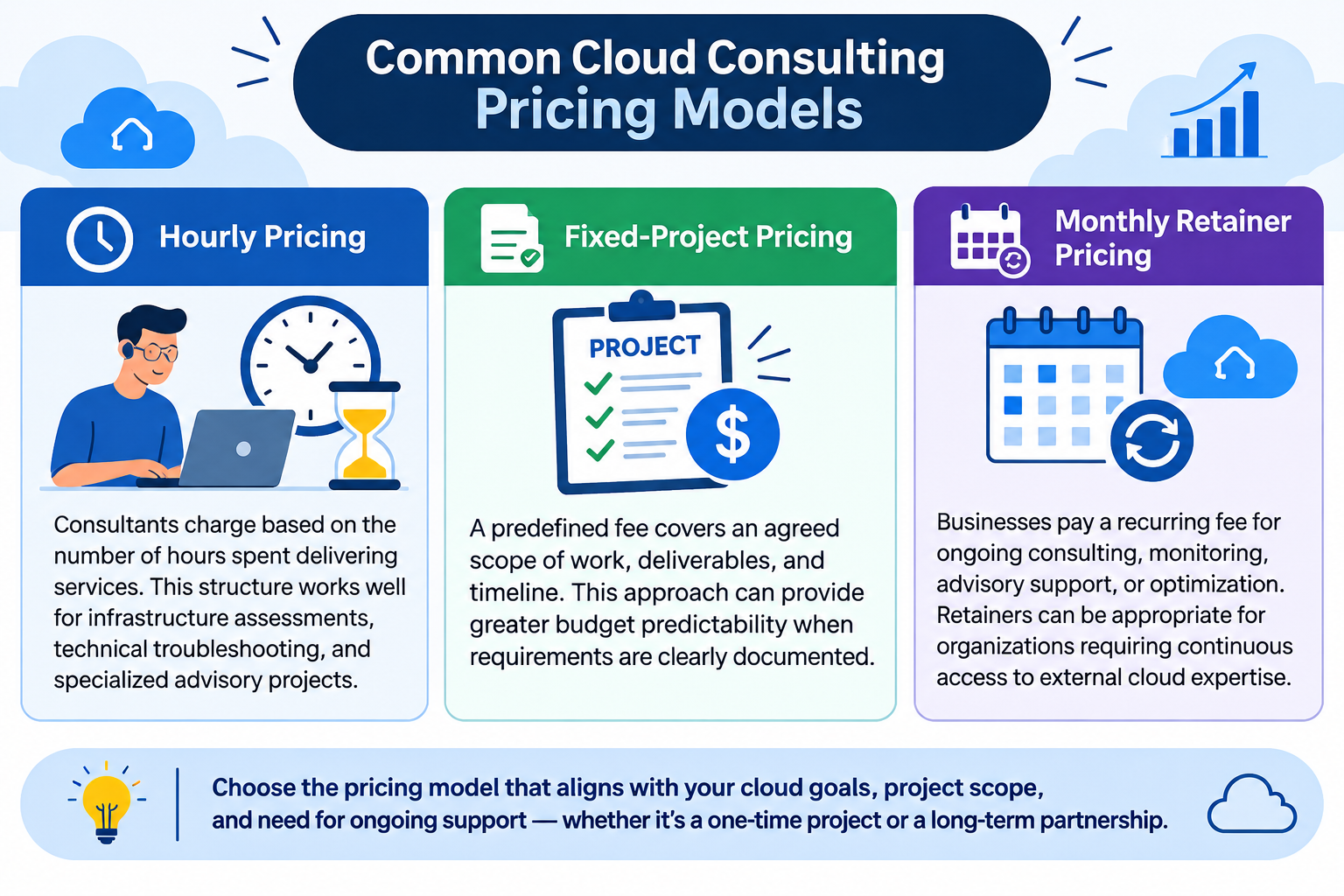
Illustrative Cloud Consulting Cost Estimates
The following scenarios demonstrate how consulting expenses might vary by project size.
| Project type | Estimated effort | Assumed hourly rate | Illustrative budget |
|---|---|---|---|
| Basic cloud assessment | 40-80 hours | $125 | $5,000-$10,000 |
| Cloud migration planning | 100-200 hours | $150 | $15,000-$30,000 |
| Mid-sized migration | 300-600 hours | $150 | $45,000-$90,000 |
| Complex enterprise project | 800-1,500 hours | $175 | $140,000-$262,500 |
These figures are hypothetical budgeting examples based on assumed effort and rates, not verified market averages or AIVeda quotations. Actual proposals may differ significantly.
These estimates exclude cloud infrastructure consumption, software licensing, third-party tools, and other external expenses.
What Influences the Final Consulting Cost?
Several factors affect the overall engagement price:
- Number and complexity of applications being migrated.
- Existing legacy systems and technical dependencies.
- Data migration volume and integration requirements.
- Security, compliance, and disaster recovery needs.
- Experience and specialization of the consulting team.
- Implementation timelines and ongoing support requirements.
A cloud consulting company should explain how these factors affect its proposal.
Instead of comparing hourly rates alone, businesses should evaluate the complete scope of work, expected deliverables, and potential ongoing expenses.
Why Cloud Readiness Assessment Matters Before Migration
Migrating to the cloud without understanding the existing IT environment can create unnecessary technical and financial risks.
A cloud readiness assessment helps businesses determine whether their applications, infrastructure, processes, and teams are prepared for migration.
What Should a Readiness Assessment Cover?
A comprehensive evaluation typically examines:
- Infrastructure inventory: Existing servers, databases, applications, and integrations.
- Application dependencies: Connections between workloads that could affect migration sequencing.
- Security requirements: Data protection, access controls, and relevant compliance obligations.
- Operational capabilities: Internal expertise, monitoring processes, and support responsibilities.
- Financial considerations: Migration expenses, projected cloud consumption, and operational costs.
How Assessment Results Improve Migration Decisions
Assessment findings help consultants identify workloads that can move with minimal changes and applications that may require modernization.
They also support realistic budgeting, risk prioritization, and migration scheduling.
Not every application needs to migrate immediately. Some workloads may benefit from remaining on-premises or using hybrid architecture.
Microsoft’s Cloud Adoption Framework offers guidance on aligning cloud adoption with business planning, governance, and operational requirements.
How to Choose the Right Cloud Consulting Company
Selecting a consulting partner is about more than technical certifications or competitive pricing. The right provider should understand your business requirements, communicate clearly, and demonstrate the ability to manage complex infrastructure projects.
Evaluate Cloud Platform and Industry Experience
Start by reviewing the provider’s experience with AWS, Microsoft Azure, Google Cloud, or other platforms relevant to your organization.
A cloud consulting company should demonstrate familiarity with similar workloads, infrastructure challenges, and industry-specific requirements.
Ask for relevant project examples, references, and information about the consultants who will directly manage your engagement.
Review Technical Expertise and Delivery Processes
Technical knowledge matters, but a structured delivery process is equally important.
Look for providers that follow documented assessment procedures, define migration milestones, establish testing requirements, and prepare disaster recovery plans.
Cloud strategy consulting should connect technical recommendations with measurable business objectives rather than focus exclusively on infrastructure configuration.
Compare Pricing Transparency and Long-Term Support
Request detailed proposals that specify deliverables, timelines, responsibilities, and additional charges.
Determine whether post-migration monitoring, troubleshooting, and optimization are included or billed separately.
Before choosing a partner, ask these questions:
- What deliverables are included in the proposed engagement?
- How will you evaluate our existing infrastructure?
- What migration risks should we anticipate?
- How will security and compliance requirements be addressed?
- Who will manage the project and communicate progress?
- What happens if implementation exceeds the planned budget?
- What support will be available after deployment?
Reliable cloud consulting services should provide transparent answers that help businesses compare providers confidently.
Cloud Consulting Services vs In-House Cloud Teams: Which Is Better?
Businesses often need to decide whether to hire external specialists or build internal cloud capabilities.
Both approaches offer advantages, depending on the organization’s infrastructure requirements, budget, and long-term objectives.
| Consideration | External cloud consultants | In-house cloud team |
|---|---|---|
| Expertise | Access to specialized skills | Depends on hiring and training |
| Initial investment | Project-based consulting fees | Recruitment and employment expenses |
| Scalability | Engagement scope can be adjusted | Limited by available team capacity |
| Business knowledge | Requires onboarding and collaboration | Develops through ongoing involvement |
| Daily operations | May need a separate support agreement | Direct internal ownership |
External consultants can be particularly helpful for complex migrations, architecture planning, and specialized technical projects.
Internal teams may be more appropriate for businesses requiring constant infrastructure management and direct operational control.
A hybrid model can also work effectively. Consultants can guide architecture and implementation while internal teams retain responsibility for ongoing operations.
Mistakes Businesses Make When Hiring Cloud Consultants
Even well-funded cloud initiatives can encounter challenges when businesses overlook important planning decisions.
- Choosing the lowest-priced provider: A cheaper proposal may exclude essential testing, documentation, or support.
- Skipping a cloud readiness assessment: Undetected dependencies can create delays and unexpected expenses.
- Accepting unclear deliverables: Vague agreements make it difficult to measure progress and accountability.
- Ignoring security responsibilities: Misunderstanding ownership of cloud security controls can create serious risks.
- Overlooking ongoing operational costs: Consulting fees are only one component of total cloud expenditure.
Avoiding these mistakes requires clear project objectives, realistic budgets, and well-defined responsibilities.
Businesses should treat consulting as a strategic investment rather than a one-time technical purchase.
How AIVeda Supports Cloud Strategy, Migration, and Optimization
Building a reliable cloud environment requires coordinated planning, technical expertise, and ongoing infrastructure evaluation.
AIVeda provides cloud consulting services designed to help organizations evaluate infrastructure requirements, plan adoption strategies, and improve cloud performance. Its published offerings include architecture design, readiness assessment, security, hybrid cloud planning, and cost management.
Cloud Strategy and Infrastructure Assessment
AIVeda’s cloud advisory services help organizations evaluate cloud adoption opportunities and develop strategies aligned with business requirements.
Early planning can help businesses understand migration priorities, technical limitations, and potential infrastructure investments.
Cloud Migration and Implementation
Through its cloud migration services, AIVeda supports organizations evaluating how to transition existing applications and data to cloud environments.
This approach connects cloud migration consulting with infrastructure planning, implementation considerations, and operational requirements.
Businesses considering different deployment architectures can also explore AIVeda’s article on migrating to serverless architecture, which discusses scalability, operational overhead, and cloud-native design.
Cloud Cost and Performance Optimization
Migration is not the final stage of cloud transformation. Organizations must continue evaluating infrastructure utilization, performance, and spending as requirements evolve.
AIVeda’s cloud optimization services address resource efficiency and infrastructure improvement. For businesses comparing potential partners, AIVeda offers an option for connecting cloud planning with migration and ongoing optimization.
Key Takeaways
Choosing the right cloud partner requires a clear understanding of business requirements, project costs, and expected outcomes.
- Define infrastructure objectives before evaluating providers.
- Understand what cloud consulting services include and how engagements are priced.
- Complete a readiness assessment before major migrations.
- Evaluate technical experience, delivery processes, and pricing transparency.
- Consider both immediate migration expenses and long-term operating costs.
- Choose a partner capable of supporting your future infrastructure requirements.
A structured evaluation process can help businesses make more confident cloud investment decisions.
Frequently Asked Questions
- What does a cloud consulting company actually do?
A cloud consulting company evaluates existing infrastructure, recommends suitable cloud solutions, plans migrations, addresses security requirements, and helps businesses manage performance, scalability, and ongoing infrastructure expenses.
- How much should a small business budget for cloud consulting?
Small businesses should budget according to infrastructure complexity, required expertise, project duration, and support needs. Request detailed proposals to distinguish consulting fees from ongoing cloud charges.
- What is the difference between cloud strategy consulting and cloud migration consulting?
Cloud strategy consulting defines business objectives, architecture choices, and investment priorities, while cloud migration consulting focuses on planning and executing the movement of applications and data.
- Is a cloud readiness assessment necessary for every migration?
A formal assessment is especially valuable for complex migrations, but even smaller projects benefit from reviewing dependencies, security requirements, costs, and potential operational risks before deployment.
- How long does a typical cloud consulting engagement take?
Engagement timelines vary considerably. A focused assessment may take days or weeks, while complex enterprise migrations can require several months of planning, execution, and validation.
- Can cloud consultants help reduce existing cloud infrastructure costs?
Yes. Consultants can evaluate resource utilization, identify idle capacity, recommend right-sizing, improve monitoring, and introduce cost governance practices to help organizations manage cloud spending effectively.