Enterprise AI is moving beyond chatbots that simply answer questions. Today, businesses are exploring intelligent agents that can interpret requests, retrieve information, coordinate tasks, and execute workflows across multiple applications.
Imagine a customer service request that requires checking an order in a CRM, verifying inventory in an ERP, reviewing company policies, and preparing a resolution. Instead of employees manually switching between systems, an AI agent could coordinate these steps and request human approval when necessary.
However, choosing the best agentic AI platform is not straightforward. Some solutions prioritize low-code automation, while others offer advanced customization, multi-agent orchestration, or private deployment.
For enterprises planning their AI investments in 2027, the right decision depends on business requirements, existing infrastructure, security expectations, and long-term operating costs.
This guide compares leading platforms, explains their strengths and limitations, and explores how businesses can choose an enterprise-ready solution.
What Is an Agentic AI Platform and Why Does It Matter?
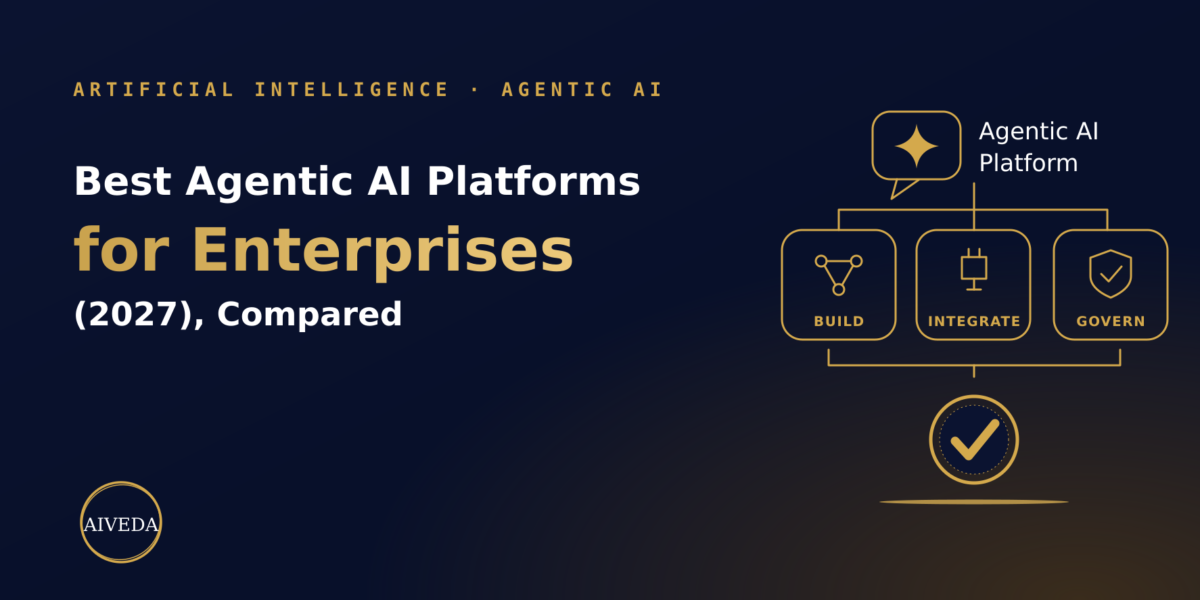
An agentic AI platform provides the infrastructure to build, deploy, manage, and monitor AI agents that perform tasks toward defined goals.
Unlike traditional chatbots that primarily generate responses, AI agents can interact with approved tools, retrieve information, make bounded decisions, and initiate actions within business systems.
For example, a traditional chatbot might explain how to process an invoice. An AI agent could extract invoice details, compare them with purchase orders, identify discrepancies, and route exceptions for approval.
Key Capabilities of Enterprise Agentic AI
A capable enterprise agentic AI platform should offer more than conversational intelligence. Important capabilities include:
- Autonomous task execution: Completing multi-step processes within defined operational boundaries.
- Multi-agent orchestration: Coordinating specialized agents responsible for different tasks.
- Enterprise integrations: Connecting with CRM, ERP, databases, and internal applications.
- Human-in-the-loop controls: Requiring employee approval before sensitive actions.
- Security and governance: Managing permissions, audit trails, and operational policies.
- Monitoring and evaluation: Tracking accuracy, reliability, failures, and workflow outcomes.
These capabilities make agentic AI useful in customer service, finance, manufacturing, healthcare administration, IT operations, and other enterprise functions.
However, agentic systems do not eliminate the need for conventional automation. As discussed in AIVeda’s guide to RPA vs Agentic AI, predictable tasks may still be better handled through traditional automation, while AI agents can address complex decisions and exceptions.
Best Agentic AI Platform Options for Enterprises in 2027: Top Providers Compared
The market offers several enterprise AI solutions, each designed around different infrastructure and workflow requirements.
The best agentic AI platform for an organization already using Microsoft technologies may differ from the right solution for an AWS-based development team or a business with extensive Salesforce workflows.
The following comparison covers seven leading options based on publicly documented capabilities available through November 2026.
Enterprise AI Platform Comparison Table
| Platform | Best For | Key Strength | Main Consideration |
|---|---|---|---|
| Microsoft Copilot Studio | Microsoft 365 users | Low-code agent development | Microsoft ecosystem dependencies |
| Salesforce Agentforce | Sales and customer service | CRM-connected AI agents | Salesforce-centered workflows |
| Google Gemini Enterprise Agent Platform | Cloud development teams | Flexible agent development and governance | Technical configuration requirements |
| Amazon Bedrock AgentCore | AWS-based enterprises | Scalable agent infrastructure | Developer expertise |
| IBM watsonx Orchestrate | Complex enterprise operations | Agent orchestration and governance | Integration planning |
| ServiceNow AI Agents | IT and service operations | Service workflow automation | ServiceNow platform alignment |
| UiPath Agent Builder | Automation-heavy enterprises | Combining AI agents and RPA | Automation lifecycle complexity |
1. Microsoft Copilot Studio
Microsoft Copilot Studio is a low-code development environment for creating AI agents connected to enterprise knowledge, applications, and workflows. It is particularly relevant to organizations already using Microsoft 365, Teams, Dynamics 365, or Power Platform.
Key strengths:
- Visual agent creation and workflow configuration
- Prebuilt connectors and API integrations
- Integration with Microsoft enterprise applications
- Support for agent handoffs and multi-step processes
Best suited for: Enterprises looking to introduce AI automation within an established Microsoft environment.
Consideration: Licensing, consumption-based usage, and the requirements of individual agent configurations should be evaluated before deployment.
2. Salesforce Agentforce
Salesforce Agentforce focuses on AI agents connected to customer relationship management and business processes. It can support customer service inquiries, lead qualification, sales assistance, and other activities that depend on Salesforce data.
Key strengths:
- CRM-grounded agent workflows
- Sales and service automation
- Customer context and business data integration
- Configurable actions and workflow orchestration
Best suited for: Organizations with substantial customer-facing operations built around Salesforce.
Consideration: Enterprises should assess the effort required to connect workflows and data sources outside the Salesforce ecosystem.
3. Google Gemini Enterprise Agent Platform
Google Gemini Enterprise Agent Platform offers infrastructure for building, deploying, governing, and optimizing enterprise AI agents. It supports low-code development through Agent Studio and custom development using Google’s Agent Development Kit.
Key strengths:
- Multiple model options
- Low-code and developer-focused tools
- Managed agent runtime and orchestration
- Integrated governance, evaluation, and observability
Best suited for: Enterprises seeking flexible AI agent development within Google Cloud.
Consideration: Advanced implementations may require experienced cloud engineers and additional integration work.
4. Amazon Bedrock AgentCore
Amazon Bedrock AgentCore provides infrastructure for deploying and operating AI agents within AWS environments. Rather than functioning primarily as a visual business workflow builder, AgentCore emphasizes runtime infrastructure and operational services for custom agents.
Key strengths:
- Managed agent execution
- Integration with AWS infrastructure
- Security and identity controls
- Support for scalable agent workloads
Best suited for: Engineering teams building customized AI applications on AWS.
Consideration: Development, testing, and operational expertise remain essential.
5. IBM watsonx Orchestrate
IBM watsonx Orchestrate focuses on creating, managing, and coordinating AI agents across enterprise environments. Its capabilities include agent discovery, orchestration, governance, and visibility into agent behavior.
Best suited for: Large organizations operating multiple agents across different business systems.
Consideration: Integration complexity and enterprise governance requirements can influence implementation timelines.
6. ServiceNow AI Agents
ServiceNow offers AI agent capabilities for workflows spanning IT service management, employee services, and customer support. Its principal advantage is the ability to connect intelligent automation with processes already managed through the Now Platform.
Best suited for: Enterprises with established ServiceNow environments and high volumes of service requests.
Consideration: Organizations should evaluate cross-platform integrations for workflows extending beyond ServiceNow.
7. UiPath Agent Builder
UiPath’s agentic automation platform combines AI-driven decisions with software robots, enterprise workflows, and human involvement. This approach can be valuable for companies that have invested heavily in robotic process automation.
Best suited for: Enterprises modernizing existing automation systems without replacing every established workflow.
Consideration: Coordinating agents, bots, and human approvals requires well-designed governance.
Ultimately, the best agentic AI platform is the one that integrates with existing operations while providing the necessary flexibility, security, and measurable business value.
How to Choose the Best Agentic AI Platform for Your Enterprise
Choosing an enterprise agentic AI platform requires more than comparing product features. Decision-makers should evaluate how effectively a solution operates within their existing technology and compliance environments.
1. Security, Compliance, and Governance
AI agents may access customer records, financial information, proprietary documents, and sensitive internal systems.
Organizations should prioritize platforms offering role-based access, encryption, audit logs, approval workflows, and clear data-handling policies.
For US businesses, relevant requirements may include HIPAA for applicable healthcare data or financial-sector regulations.
The NIST AI Risk Management Framework provides a useful reference for evaluating and managing AI-related risks.
2. Enterprise Integration and Scalability
A powerful agent becomes significantly more valuable when connected to the applications employees already use.
Assess the platform’s compatibility with CRM systems, ERP software, cloud infrastructure, internal APIs, and data repositories.
Also determine whether agents can operate across multiple departments without creating disconnected automation environments.
3. Deployment Flexibility and Control
Businesses should compare managed cloud services, private cloud environments, hybrid architectures, and on-premises deployment options.
For organizations handling sensitive data, infrastructure ownership and control over information flows may influence the selection.
4. Total Cost of Ownership
Licensing is only one component of enterprise AI costs.
A realistic evaluation should consider:
- Platform subscriptions and usage fees
- Model inference and computing resources
- Integration and development expenses
- Security reviews and compliance requirements
- Monitoring, maintenance, and human oversight
Rather than focusing exclusively on subscription costs, measure the cost per successfully completed workflow.
The best agentic AI platform should demonstrate improvements in accuracy, processing time, operational efficiency, or service quality that justify its ongoing costs.
No-Code vs Custom AI Agent Platforms: Which Approach Works Best?
A no code agentic AI platform allows teams to design agents using visual interfaces, workflow builders, and preconfigured integrations.
This approach can reduce development effort for straightforward internal tasks such as information retrieval, ticket routing, or employee support.
However, enterprises with specialized workflows may require more flexibility than a no code agentic AI platform provides.
When No-Code Solutions Are Suitable
A no code agentic AI platform can be useful when organizations need rapid prototyping, standardized integrations, and simpler business-process automation. It is particularly attractive to teams with limited software development resources.
When Custom Agent Development Makes Sense
Custom development becomes relevant when enterprises require specialized models, complex integrations, private infrastructure, or sophisticated multi-agent coordination.
| Evaluation Area | No-Code Solutions | Custom Development |
|---|---|---|
| Development speed | Faster for standard use cases | More initial engineering |
| Technical requirements | Lower | Higher |
| Customization | Platform-dependent | Greater architectural flexibility |
| Integration depth | Often connector-based | Custom APIs and services |
| Deployment control | Vendor-dependent | Potentially broader |
| Best application | Standard workflows | Complex enterprise operations |
A no code agentic AI platform may offer a practical starting point, while custom development can address requirements that exceed predefined capabilities.
For organizations considering this approach, AI agent development services provide an option for building solutions around specific operational requirements.
Where AIVeda Fits Into Enterprise Agentic AI Implementation
While established technology vendors provide broad agent development ecosystems, businesses may still need specialized engineering support to implement AI securely.
AIVeda focuses on developing private enterprise AI systems, customized agents, and intelligent automation solutions.
Its agentic workflow automation services support organizations seeking to coordinate complex business processes across existing applications.
Custom AI Agents for Enterprise Workflows
AIVeda’s capabilities include:
- Custom AI agent development
- Private LLM and small language model integration
- Multi-agent workflow orchestration
- CRM and ERP connectivity
- Secure enterprise deployment
- Monitoring, governance, and approval controls
An enterprise agentic AI platform is only effective when it reflects actual business processes, data access requirements, and organizational policies.
AIVeda’s implementation approach emphasizes these operational considerations rather than deploying AI as an isolated tool.
Businesses can also explore its article on multi-agent systems in the enterprise to understand how specialized agents coordinate complex workflows.
From AI Experimentation to Production
An effective AI implementation should begin with a clearly defined problem and measurable success criteria.
AIVeda offers a four-week pilot approach designed to evaluate a use case using enterprise data before making a broader deployment decision.
This creates an opportunity to assess technical feasibility, integration needs, security considerations, and expected business value before scaling.
AIVeda Case Study: AI-Powered Lead Qualification for Manufacturing
A practical example of enterprise AI implementation comes from AIVeda’s published manufacturing lead qualification case study.
The Business Challenge
A manufacturing enterprise received inquiries involving complex product specifications, custom requirements, and lengthy B2B buying processes.
Its sales teams relied on manual lead qualification, making it difficult to consistently identify prospects demonstrating serious purchasing intent.
The AI-Powered Solution
AIVeda developed an intelligent lead qualification assistant using a domain-adapted language model trained on proprietary manufacturing information.
The solution incorporated intent classification, adaptive conversations, hybrid lead scoring, and CRM integration.
An on-premises deployment helped address the organization’s data confidentiality and intellectual property requirements.
Business Outcomes
According to AIVeda’s published case study, the implementation delivered several operational improvements:
- Reduced time spent engaging unqualified leads
- Faster identification of high-intent prospects
- More consistent lead scoring
- Better contextual information for sales conversations
- Improved lead-to-opportunity conversion
The case study does not publish numerical improvement percentages, and its results should not be interpreted as evidence of fully autonomous end-to-end sales operations.
Nevertheless, it demonstrates how customized enterprise AI can connect language understanding, business rules, and existing systems to improve workflow efficiency.
Which Is the Best Agentic AI Platform for Your Enterprise in 2027?
There is no universal solution for every enterprise.
Microsoft Copilot Studio may suit Microsoft-centered organizations, Salesforce Agentforce aligns with CRM-heavy workflows, and Google or AWS solutions offer substantial opportunities for custom development.
IBM, ServiceNow, and UiPath provide alternatives for organizations prioritizing orchestration, service operations, or existing automation investments.
Choosing the best agentic AI platform requires balancing integration readiness, security, customization, cost, and long-term business value.
For enterprises with complex requirements, technology selection should be accompanied by a practical implementation strategy.
Discover how our enterprise AI development services can help assess your workflow requirements, develop customized agents, and plan a controlled deployment.
Frequently Asked Questions
1. What is the best agentic AI platform for large enterprises?
The best choice depends on infrastructure, governance, integration requirements, and operational goals. Compare scalability, security, workflow reliability, and long-term ownership costs before making a decision.
2. Can enterprises deploy AI agents without coding?
Yes. No-code and low-code platforms enable visual agent development and workflow automation. Advanced integrations, security controls, and complex business requirements may still need engineering support.
3. How much does an enterprise AI agent platform cost?
Pricing depends on subscriptions, model usage, infrastructure, development, and integration complexity. Businesses should also budget for monitoring, human oversight, security assessments, maintenance, and ongoing optimization.
4. Are agentic AI platforms suitable for regulated industries?
Yes, when appropriate security controls, audit trails, access restrictions, and human approvals are implemented. Organizations must validate deployments against their specific regulatory and operational obligations.
5. Can multiple AI agents work together on enterprise tasks?
Yes. Multi-agent orchestration allows specialized agents to coordinate tasks, exchange relevant information, and execute workflows while maintaining defined permissions, operational boundaries, and necessary human oversight.
6. Will agentic AI replace traditional RPA?
Not entirely. RPA remains valuable for predictable, rule-based processes, while AI agents handle contextual decisions and exceptions. Combining both can improve automation without abandoning existing investments.