Every collections leader eventually hits the same fork in the road: hire more agents, or go digital. Leadership wants higher recovery rates without a bigger payroll. Compliance wants fewer risky calls, not more of them. And finance wants a real number before approving either path.
The trouble is, most comparisons stop at agent salaries vs software subscription, which barely scratches the surface. The real cost math involves hiring cycles, compliance exposure, after-hours coverage, and how fast each model can actually scale.
This piece breaks down what a bigger calling floor really costs against a digital debt collection platform, walks through an ROI comparison, and looks at where automation.
This includes AI-assisted conversations fits into the decision without replacing the parts of collections that still need a human touch.
What Is a Digital Debt Collection Platform?
A digital debt collection platform is software built to manage outreach, payments, and compliance across multiple channels like SMS, email, voice, and chat instead of routing nearly every interaction through a live agent on a phone line. It centralizes account data, automates routine workflows like payment reminders and balance updates, and logs every touchpoint for compliance review.
Core Components of a Modern Platform
Most platforms in this category share a similar backbone:
- Omnichannel outreach (SMS, email, voice, in-app chat)
- Automated payment workflows and self-service portals
- Real-time account synchronization across channels
- Built-in compliance logging and consent tracking
- Reporting dashboards for recovery and contact-rate metrics
How It Differs From a Traditional Calling Floor
A calling floor scales the way most labor-based operations do: more accounts worked means more seats, more supervisors, and more payroll. A debt collection platform shifts that equation.
Instead of cost rising in a straight line with volume, much of the cost is fixed in the software and infrastructure. So additional volume doesn’t require a proportional increase in headcount.
That difference sounds simple on paper. To see why it matters financially, it helps to look at what a calling floor actually costs once you go beyond the payroll line.
The Hidden Costs of a Bigger Calling Floor
Calling floors are not just agents plus phones. Three cost categories tend to get underestimated when leadership models out the expense of scaling one.
Headcount, Hiring & Attrition
Collections is a high-turnover role. Every departure means a new hiring cycle, weeks of training before an agent is fully productive, and a temporary dip in recovery performance while new hires ramp up. Multiply that across a growing floor, and the cost of an agent is never just their hourly wage, it’s the recruiting pipeline behind them.
Compliance Risk Exposure
Every call placed by a human agent carries some variability tone, timing, scripting, and judgment calls in the moment. That variability is exactly what TCPA and FDCPA enforcement looks for. Most calling floors rely on manual call sampling for quality assurance, which means only a fraction of total calls ever get reviewed. The rest is risk sitting unmonitored.
Scaling Limitations
Adding capacity on a calling floor means adding seats, supervisors, dialer licenses, and often physical floor space. None of that happens overnight. It’s a hiring and onboarding cycle measured in weeks, not days.
Stack these costs against a debt collection platform built for this kind of volume, and the math starts to shift in a different direction.
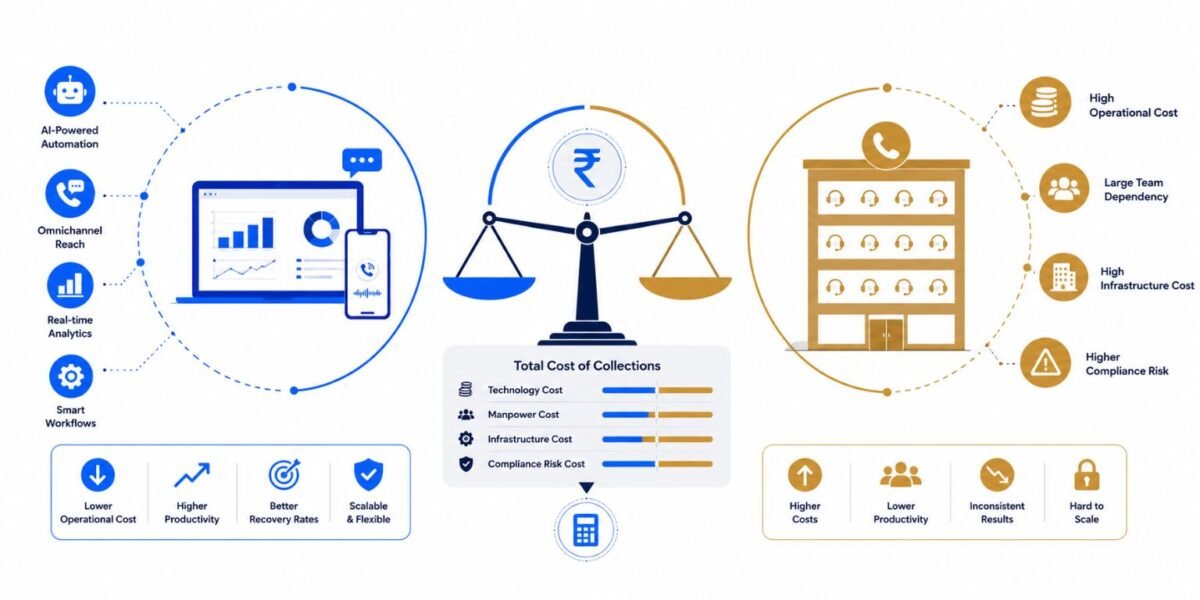
Digital Debt Collection Platform vs Calling Floor: The Cost Math
Here’s how the two models compare across the factors that actually move the needle on cost and recovery performance.
| Cost Driver | Traditional Calling Floor | Debt Collection Platform |
|---|---|---|
| Cost per 1,000 accounts worked | Scales linearly with headcount | Largely fixed/software-based; scales with volume, not staffing |
| Compliance monitoring | Manual call sampling (partial coverage) | Automated logging across most or all interactions |
| Time to scale capacity | Weeks (hiring, training, ramp-up) | Days (configuration, channel activation) |
| Recovery rate consistency | Varies by agent skill, shift, and mood | Consistent scripting and channel-optimized timing |
| After-hours coverage | Limited, often costly overtime | Native 24/7 capability |
| Technology overhead | Dialer licenses, seats, and floor infrastructure | Centralized platform plus integrations |
Where the Real Savings Come From
The savings here aren’t just fewer salaries. They come from three places: reduced compliance exposure from near-complete interaction logging, faster scaling when account volume spikes, and more consistent recovery performance across shifts, time zones, and languages.
That said, it’s worth being fair about the limits. Complex, high-balance, or relationship-sensitive accounts often still need an experienced human collector who can read context and negotiate flexibly. The realistic goal isn’t replacing every agent, it’s right-channeling volume so people handle what people are best at, and software handles the rest.
None of this works, though, without the system underneath it holding everything together which is where the core CRM layer comes in.
Why a Debt Collection CRM Is the Backbone of Any Digital Strategy
A debt collection CRM is the data layer that makes everything else in this comparison possible. Without it, even the best automation tools end up working off fragmented account records.
Centralized Account Data & Audit Trails
A solid collections CRM ties every interaction with a call, a text, a payment promise, a dispute, and a back to a single account record. That single source of truth is what makes compliance audits manageable and recovery forecasting accurate, instead of guesswork pieced together from separate systems.
Integration With Communication Channels
That CRM layer rarely works well as a standalone tool. It needs to plug directly into dialers, SMS gateways, payment processors, and increasingly conversational AI layers that handle live interactions on the platform’s behalf.
Reporting & Forecasting
Real-time dashboards for recovery rate, right-party contact rate, and compliance exceptions are difficult to produce with a calling-floor-only setup, where much of that data lives in call logs and spreadsheets rather than one connected system. A connected CRM turns that into a live view that leadership can actually act on.
The next evolution of that system isn’t just about storing better data. It’s having software that can hold a conversation with a debtor directly, inside the rules that collections teams already operate under.
Where Conversational AI Fits Into a Modern Digital Debt Collection Platform
This is the layer most agencies are still figuring out how to use well. Done right, it doesn’t replace the calling floor, it absorbs the volume that doesn’t need a human on the line.
Automating Routine, High-Volume Conversations
First-notice contact, balance inquiries, and payment reminders are repetitive by nature. They’re well-suited to an AI-handled conversation rather than tying up a live agent’s time for something a debtor could resolve in thirty seconds over text or chat.
Intent Recognition for Payment Negotiations
A well-built AI layer can recognize when a debtor’s intent shifts toward setting up a payment plan, disputing a balance, or asking to speak with a live agent and route the conversation accordingly, without losing the context that came before it.
24/7, Multilingual Reach
After-hours contact and non-English-speaking debtor segments are historically underserved on a calling floor, simply because staffing every shift in every language isn’t practical. An AI layer doesn’t have that constraint.
This is the exact layer AIVeda’s conversational AI platform, Lira, is built to operate in handling intent recognition, real-time account lookups, and adaptive context management. So a payment-plan conversation feels continuous rather than scripted and robotic. For a digital debt collection platform, that means routine inquiries get resolved without waiting for the calling floor capacity to free up.
The question collections leaders are really asking, though, isn’t whether AI can hold a conversation. It’s how much of the workload it can responsibly own, and whether it stays compliant while doing it.
How AIVeda’s Lira Strengthens Platform ROI
Lira is built on AIVeda’s private LLM foundation, which means account and payment data stays inside the enterprise’s own environment rather than passing through a third-party public model. A meaningful distinction for FDCPA and PCI-sensitive collections workflows.
A few capabilities worth noting:
- Real-time data access for live account and payment status during a conversation, rather than a stale snapshot.
- Adaptive context management that keeps multi-turn negotiation conversations coherent instead of restarting context with every message.
- Multilingual support that extends reach to debtor segments calling floors often underserve.
- Integration with existing systems, including a collections CRM and dialer stack, rather than requiring a rip-and-replace.
None of this means AI should run unsupervised. It means a debt collection platform can hand off the repetitive, high-volume work to a layer built for it, while human collectors stay focused on the conversations that actually need judgment.
Whether or not AI is part of the rollout on day one, choosing the right platform still comes down to a handful of non-negotiables.
Choosing the Right Digital Debt Collection Platform
Before signing with any vendor, it’s worth confirming the platform covers these basics:
- Built-in TCPA/FDCPA compliance logging, not bolted-on reporting
- Native integration with your existing debt collection CRM
- Omnichannel support across voice, SMS, email, and chat
- Real-time reporting and audit trails, not weekly exports
- Room to add AI-assisted conversation handling later without a system overhaul
A platform that checks these boxes now will scale a lot more cleanly than one that needs a rebuild the moment volume doubles.
Conclusion
A bigger calling floor scales cost in a straight line with volume. A digital debt collection platform scales capacity without scaling compliance risk and headcount cost at the same rate and that gap widens the more volume grows.
The smartest path for most agencies isn’t choosing all AI or all human. It’s right-channeling volume: software handles the repetitive contact at scale, and people handle the conversations that need real judgment. If you’re evaluating where a conversational AI layer like Lira might fit into your existing stack, AIVeda’s team is worth a conversation before your next hiring cycle, not after it.
Frequently Asked Questions
What is a digital debt collection platform?
It’s a digital debt collection platform built around software-driven outreach. Therefore, managing payments and compliance across SMS, email, and voice instead of routing every contact through a live agent.
How does a debt collection CRM reduce compliance risk?
A debt collection CRM logs every interaction against an account record, creating audit-ready trails for regulators while reducing reliance on manual call sampling for compliance checks.
Can AI fully replace human debt collectors?
Not entirely. AI handles routine, high-volume conversations well, but complex disputes and sensitive negotiations still benefit from experienced human collectors working alongside the platform.
Is conversational AI compliant with TCPA for debt collection?
Compliance depends on configuration, not the AI itself. The platforms need built-in consent tracking, call-time restrictions, and audit logging to operate within TCPA and FDCPA rules.
How much can switching from a calling floor to a digital platform save?
Savings vary by volume and current staffing costs, but typically come from reduced headcount scaling, lower compliance risk, and more consistent recovery rates across shifts.
How does AIVeda’s Lira fit into an existing debt collection platform?
Lira adds a conversational AI layer for intent recognition and real-time account lookups, integrating with existing collections CRM and dialer systems rather than replacing them.