
RPA repeats fixed steps on screens and systems exactly the same way every time. Agentic AI reads unstructured inputs, decides what to do and calls tools to do it, with people approving the risky steps. Most enterprises should not choose one: keep bots for stable, rule-bound steps and put agents in charge of the judgement around them.
Both technologies have a record that should make buyers careful. Ernst & Young reported that 30 to 50 percent of RPA projects initially fail, a figure UiPath itself cites. Gartner now predicts that over 40% of agentic AI projects will be cancelled by the end of 2027, due to escalating costs, unclear business value or inadequate risk controls, and estimates that only about 130 of the thousands of vendors claiming agentic AI offer the real thing.
The useful question is not which technology wins. It is which steps of a process each one should own, and how to move work from one to the other without breaking operations that run today.
RPA vs Agentic AI: The Difference In One Table
| Dimension | RPA | Agentic AI |
|---|---|---|
| Input | Structured and predictable: forms, fields, fixed screens | Also unstructured: emails, PDFs, call transcripts, chat |
| How it decides | Rules written in advance | Reasons over the input and context, within limits you set |
| When something changes | Breaks when a screen or format changes | Adapts to new formats, but can still misjudge |
| How it fails | Stops with an error | Can take a confident wrong action |
| Audit | The same steps every run | Needs logged inputs, reasoning, actions and approvals |
| Main cost | Bot licences and maintenance | Model compute per task, plus evaluation |
| Best for | Stable, high-volume, rule-bound steps | Exceptions, judgement and work across several systems |
The row that matters most is how each one fails. A bot that meets an unexpected screen stops and raises an error, which is annoying but safe. An agent that meets an unexpected situation may carry on and do something plausible but wrong. Every design decision for agentic automation follows from that difference: what the agent may touch, which actions need a person’s approval, and what gets logged. Get those three right and an agent’s mistakes become cases for review, not incidents.
Where RPA Still Earns Its Keep
RPA is the right tool for steps that are deterministic, high-volume and stable: copying approved values from one system to another, generating the same report every morning, filing documents into the same folders, running a fixed sequence that a regulator expects to see performed identically each time. For that work a bot is predictable, cheap per transaction and easy to audit, and the mature platforms, including UiPath, Automation Anywhere, Microsoft Power Automate and SS&C Blue Prism, are well understood by IT teams.
The weaknesses are just as well known. Bots that work through screens break when the screen changes, so a vendor’s interface update can stop a process overnight. Every bot needs maintenance, and large estates accumulate a maintenance burden that grows with each new automation. Most importantly, RPA cannot handle what it was not programmed for: the invoice with a mismatched amount, the KYC pack with a missing page, the customer email that asks two questions at once. Those exceptions go to a queue for people, and in many processes the exception queue is where most of the cost and delay sits.
That last point is why agents are interesting. They are not a better bot; they are a way to work the exception queue.
Where Agents Do Better
Agentic AI earns its place where a process needs reading, judgement or coordination. An agent can read an email or a scanned document and extract what matters; look up the customer in the CRM, the order in the ERP and the contract in the document store; decide which of several next steps applies; and draft or take the action, with a person approving where the risk warrants it.
Typical candidates in Indian enterprises include invoice and payment mismatches in finance, incomplete or inconsistent KYC packs in lending and insurance, customer requests that arrive by email or chat and need a lookup across systems, and order changes that touch inventory, billing and logistics at once.
Analysts expect this to become routine. Gartner predicts that by 2028 at least 15% of day-to-day work decisions will be made autonomously through agentic AI, up from none in 2024, and that a third of enterprise software applications will include agentic AI, up from less than 1%. Even if those forecasts prove optimistic, the direction is clear enough to plan for, and the enterprises that learn to run agents safely on small processes now will be the ones ready to scale them.
What Agents Still Get Wrong
The research on agent reliability is sobering, and it should shape every design. Salesforce AI Research’s CRMArena-Pro benchmark found that leading LLM agents achieved only around 58% success on single-turn business tasks, dropping to about 35% in multi-turn settings, and showed near-zero inherent awareness of confidentiality. Carnegie Mellon’s TheAgentCompany benchmark, which simulates a small software company, found that the most capable agent tested completed 30% of tasks autonomously.
Those results do not mean agents are useless. They mean an agent given broad goals, broad permissions and no supervision will fail often and sometimes leak data. The working pattern looks different:
- Bounded tasks: One job with a clear outcome, not “handle accounts payable”.
- Tools, not free rein: The agent acts through a defined set of actions, each with its own permissions.
- Data access by permission: The agent sees only what the person it acts for is allowed to see.
- Approvals by risk: Low-risk actions run automatically; payments, customer commitments and record changes wait for a person.
- Evaluation before go-live: on real cases with known answers.
- A full log: of inputs, reasoning, actions and approvals.
The Hybrid Pattern: Agents In Charge, Bots As Tools
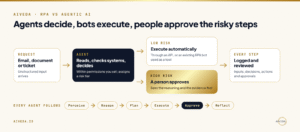
The pattern that works in practice puts an agent in front of the process and keeps bots behind it. A request arrives as an email, a document or a ticket. The agent reads it, checks the relevant systems and decides what should happen. Low-risk steps go straight to execution, through an API where one exists or through an existing RPA bot where one does not. High-risk steps wait for a person, who sees the agent’s reasoning and the evidence before approving. Every step is logged.
This is how we designed LIRA Unity, our platform for agentic workflows. Every agent follows the same loop: perceive, reason, plan, execute, approve and reflect. Approvals are risk-based, access is role-based, credentials are encrypted and every decision leaves an audit trail. Its Migration Hub is built to bring existing RPA bots in as governed agents, so the automation you already run keeps working while agents take over the judgement around it. Models can be switched without rebuilding the workflow.
The advantage of the hybrid pattern is that it is incremental. Nothing that works today has to be switched off on day one.
How To Move From Bots To Agents Without Breaking Operations
| Step | What you do | What you measure |
|---|---|---|
| 1. Inventory the bots | List each bot with its volume, stability and exception rate | Breakages per month; share of cases sent to people |
| 2. Wrap stable bots as tools | Expose reliable bots as actions an agent can call | Success rate per call |
| 3. Start the agent on exceptions | Let the agent triage the exception queue and prepare each case; a person decides | Handling time; agreement with the person’s decision |
| 4. Add approvals by risk tier | Automate low-risk outcomes; keep people on high-risk ones | Share completed without a person; errors caught at approval |
| 5. Replace screen bots with APIs | Where a system offers an API, call it instead of driving the screen | Breakages and maintenance hours |
| 6. Retire bots last | Retire a bot only when the agent path is cheaper and at least as reliable | Cost per case; error rate |
Step three is where most of the early value appears, because the exception queue is usually the slowest and most expensive part of an automated process. It is also the safest place to start: the agent prepares, a person decides, and you build a record of how often the agent’s recommendation matches the person’s before giving it any authority of its own.
See how agentic workflows run
Multi-agent workflows that read, check, decide, act and log, with your people approving the steps that matter and your existing bots kept in service.
Explore agentic workflow automation →
What It Costs: Licences Versus Compute
The economics of the two approaches are different in kind. RPA costs are mostly licences per bot or per runtime, plus the people who build and maintain the bots. Agent costs are mostly compute: every time an agent reads a document or decides a step, it calls a model, and a multi-step task may call it many times.
Compute is getting cheaper quickly. Stanford’s 2025 AI Index found that the inference cost for a system performing at the level of GPT-3.5 dropped over 280-fold between November 2022 and October 2024. Cheaper does not mean free, though, and the number to watch is cost per completed case, measured on real work, not the price per token on a rate card.
How the model is hosted changes the picture too. Paying a model provider per call makes costs track volume and the provider’s pricing decisions. Running models on infrastructure you control, inside your own environment, turns the same work into a capacity cost you can budget for a year ahead. For high-volume processes, that difference often decides the business case. Whichever model you choose, measure the cost of the human review that remains, because it is part of the cost per case.
Which Processes To Start With
Good first candidates share five traits: a large exception queue, documents or emails in the loop, a clear and checkable outcome, actions that can be reversed if wrong, and a named owner who will judge the results. Invoice exception handling, KYC exception review, customer request triage and order changes usually qualify.
Avoid starting where actions are irreversible, where no one can say what a correct outcome looks like, or where the process itself is still changing. And design the data side from the beginning: an agent that reads customer records is processing personal data, so its access, logging and retention need the same care as any other system. Our DPDP compliance checklist for AI systems covers what that means in practice.
For the connection work underneath, see our guide to AI integration services. For background on the concepts, our explainers on what agentic AI is and multi-agent systems in the enterprise go deeper. The ready-to-use agents on our platform each do one job end to end: answer, check, call, write or watch. To test one process before committing, our four-week proof of concept playbook shows how to scope it.
Frequently Asked Questions
Is agentic AI replacing RPA?
Not in the near term. Agentic AI handles the reading, judgement and exceptions that RPA cannot, while RPA remains cheaper and more predictable for stable, rule-bound steps. Most enterprises will run both, with agents deciding and bots or APIs executing.
What is agentic process automation?
Agentic process automation uses AI agents to run a business process from request to outcome: reading the input, checking systems, deciding the next step and acting through tools, with people approving high-risk actions. It extends rule-based automation to work that needs judgement.
Can AI agents use our existing RPA bots?
Yes. Stable bots can be exposed as tools that an agent calls, so the agent decides what should happen and the bot performs the steps it already performs reliably. This lets you add agents without rewriting automation that works.
Which is cheaper, RPA or AI agents?
It depends on the work. For a stable, high-volume step, a bot is usually cheaper per transaction. For exceptions and judgement, an agent can be cheaper than the people who handle them today. Compare cost per completed case on real work, including licences, compute and human review.
How do you stop an AI agent from taking a wrong action?
Limit what it can do and check what matters. Give the agent a defined set of tools with narrow permissions, require a person’s approval for high-risk actions, evaluate it on real cases before go-live, and log every input, decision and action so errors can be traced and corrected.
Which RPA processes should move to agents first?
Start with the exception queues of processes you have already automated, such as invoice mismatches or incomplete KYC packs. Let the agent prepare each case while a person decides, and expand its authority only as its recommendations prove reliable.
Put an agent on one exception queue
Four weeks, one process, your real cases and a written go / no-go. Your existing bots stay in service throughout.