The majority of enterprise AI projects struggle due to an overly rigorous methodology rather than poor models. Relying on a single model often creates bottlenecks, whether it’s rising costs, slow responses, or inconsistent accuracy.
A Multi-Model AI Strategy for Enterprises is therefore rapidly emerging as the more sensible course of action. Businesses are integrating many models to play to their strengths rather than making one system do everything.
According to Gartner, over 70% of enterprises will use multiple AI models in production by 2027, indicating a distinct move toward more adaptable architectures. This is a change in perspective rather than merely a technological improvement.
Businesses can create systems that are both strong and useful by combining LLMs for complicated reasoning, SLMs for speed, and RAG for accuracy. We’ll explain how to use that combination in actual business situations in this guide.
Understanding the Core Components of a Multi-Model AI Strategy for Enterprises
It’s critical to comprehend the differences between LLMs, SLMs, and RAG in both technical and real-world commercial applications to develop an efficient Multi-Model AI Strategy for Enterprises.
Large Language Models (LLMs) are strong systems intended for content creation, natural language comprehension, and deep reasoning. For jobs like creating reports, summarizing records, and managing intricate workflows, they are great. But when utilized alone, they can hinder scalability because they often have slower reaction times and higher prices.
Small Language Models (SLMs) are made to be quick and effective. They are more affordable, lighter, and quicker to deploy. SLMs are usually employed in a hybrid AI model strategy for high-volume, repetitive operations like classification workflows or chat responses.
Retrieval-Augmented Generation (RAG) offers an additional level of intelligence by linking models to external data sources. To increase accuracy, RAG retrieves pertinent information in real time rather than depending just on training data. This is particularly crucial in business settings where accurate and current solutions are essential.
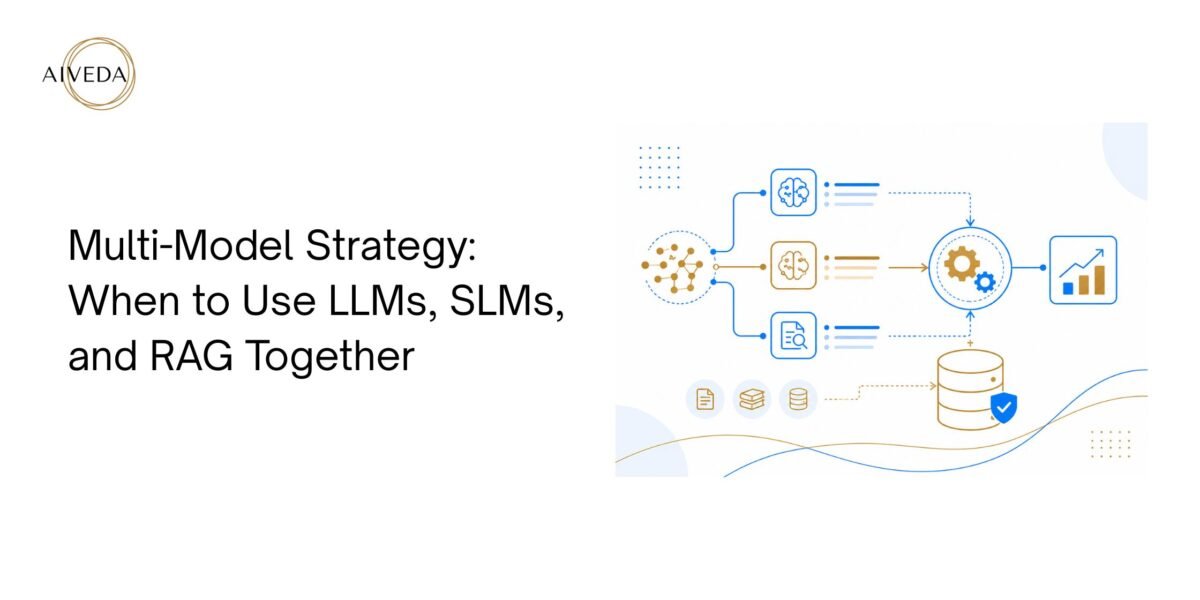
The LLM vs SLM vs RAG Strategy isn’t really about picking one over the other. Rather, the goal is to combine all three into a unified Enterprise Multi-Model AI Architecture that can accommodate a range of business requirements.
The Security Layer/Guardrail
The Guardrail layer, which sits above data integration, enforces safety, compliance, and quality controls throughout the hybrid RAG pipeline. This is where the mistakes have serious repercussions for business deployment.
Content Safety Filters: This layer looks for sensitive information, financial data, PII, and PHI before content is added to the knowledge base. According to protocol, a scanned contract document containing social security numbers is prohibited, sanitized, or flagged.
Multimodal Moderation: Safety checks are performed on image and video content to identify protected individuals, identify inappropriate imagery, and highlight compliance issues. A training DVD that contains confidential competitor data is placed in quarantine.
Framework for Output Validation: The Guardrail layer verifies replies produced by the LLM using many criteria:
- Factual Grounding: Identifies possible hallucinations by confirming that LLM outputs match retrieved source material.
- Citation Standards: Ensure responses cite original texts, pictures, or videos.
- Tone and Style: Verifies that answers adhere to brand standards and suitable degrees of formality
- Regulatory Compliance: Verifies results against industry-specific laws (SOX for finance, HIPAA for healthcare).
Budgetary Controls and Cost Governance: Inference costs are tracked in real time and automatically throttled when thresholds are reached. The system can immediately switch to SLM-only operation for routine queries in the event of an unexpected rise in LLM usage.
Audit Trail and Explainability: Each query, retrieval, and generation is recorded with full lineage, including the sources that were retrieved. The reasons the query was sent to LLM rather than SLM, the confidence ratings that were assigned, and the final response’s construction. System debugging and compliance audits are made possible by this.
Bias Detection: Identifies answers that can reinforce stereotypes or inaccurate representations by monitoring model outputs for demographic, cultural, or perspective biases.
LLM vs SLM vs RAG Strategy: Key Differences Explained
Implementing a successful AI Strategy for Enterprises requires an understanding of the distinctions between these models.
| Factor | LLMs | SLMs | RAG |
|---|---|---|---|
| Core Strength | Deep reasoning and language generation | Speed and efficiency | Accurate, data-backed responses |
| Primary Role | Complex decision-making and content creation | Handling high-volume, simple tasks | Enhancing outputs with real-time data |
| Cost | High (compute-intensive) | Low (resource-efficient) | Moderate (depends on retrieval system) |
| Latency | Moderate to slow | Very fast | Moderate |
| Accuracy | High but may hallucinate | Limited by training | High due to external data grounding |
| Scalability | Expensive to scale widely | Highly scalable | Scalable with proper data pipelines |
| Best Use Cases | Reports, analytics, conversations | Chatbots, automation, classification | Knowledge search, compliance, document QA |
| Dependency of Data | Pre-trained knowledge | Pre-trained knowledge | Real-time external data sources |
| Infrastructure Needs | GPUs / high compute | Lightweight / edge-friendly | Requires vector databases + pipelines |
| Flexibility | Highly flexible but costly | Limited but efficient | Flexible with strong data integration |
| Risk Factors | Hallucination, cost overruns | Limited capability | Data quality dependency |
| Role in System | Final reasoning and generation layer | First layer (filtering, routing) | Middle layer (data retrieval) |
Important Takeaways
- LLMs are best for creativity and deep reasoning but are expensive
- SLMs offer efficiency and speed for repetitive jobs
- RAG guarantees accuracy by basing answers on facts
These models support one another instead of competing with one another.
When to Use LLMs in a Multi-Model AI Strategy for Enterprises
Any Multi-Model AI Strategy for Enterprises must include LLMs, particularly when tasks call for sophisticated intelligence.
Ideal Use Cases for LLMs
- Workflows for complex decision-making
- Content creation (blogs, reports, emails)
- Multiple-step reasoning exercises
- Conversational AI that needs complexity
For instance, LLMs can analyse big datasets and produce insights in a financial or legal system.
Nevertheless, it is ineffective to use LLMs everywhere. They are therefore best applied sparingly in a hybrid AI model strategy.
Best Practice
- LLMs should only be used for important duties
- To increase accuracy, combine with RAG
- Don’t use them for recurring questions
Only the most complicated activities are handled by LLMs at the top layer of a well-designed Enterprise Multi-Model AI Architecture.
This focused application guarantees that your brand maintains good performance at a reasonable cost.
When to Use SLMs in a Hybrid AI Model Strategy
SLMs are essential to increasing productivity in a Multi-Model AI Strategy for Businesses. They are perfect for front-line operations because they are made to quickly tackle high-volume activities.
SLMs are lighter and require fewer resources than LLMs. They are therefore ideal for real-time applications where speed is essential. SLMs serve as the initial point of contact in many corporate systems.
Chatbots, classification systems, and automated workflows are examples of common use cases. They greatly lessen the need for costly LLM processing due to their efficiency.
SLMs can be used as a filtering layer in the LLM vs SLM vs RAG Strategy. They are able to respond to straightforward inquiries and, if needed, forward more complicated ones to LLMs.
Among the main benefits of SLMs are:
- Quicker reaction times
- Reduced operating expenses
- Scalability for large-scale jobs
Businesses may create an AI Architecture that is more responsive and economical by including SLMs in a Hybrid AI Model Strategy.
When to Use RAG in an Enterprise Multi-Model AI Architecture
In a Multi-Model AI Strategy for Enterprises, RAG is crucial for increasing accuracy, particularly when handling knowledge-intensive activities. RAG guarantees that responses are based on actual data, in contrast to solo models.
This is especially crucial in sectors where accuracy cannot be compromised, such as finance, healthcare, and legal services. RAG lowers the possibility of hallucinations by obtaining pertinent data from reliable sources and feeding it into the model.
RAG serves as the link between intelligence and data. By offering contextually right information, it improves both LLMs and SLMs.
Common use scenarios consist of:
- Systems for managing internal knowledge
- Searching and summarizing documents
- Regulatory and compliance inquiries
Organizations can greatly increase the dependability of their AI systems by including RAG into an Enterprise Multi-Model AI Architecture.
How to Combine LLMs, SLMs, and RAG Together
How well these models are integrated determines the actual worth of a multi-model AI strategy for businesses. A well-designed system intelligently orchestrates the employment of several models.
A layered architecture with distinct roles for each model is a popular method. For instance, RAG can retrieve pertinent data, SLMs can process initial queries, and LLMs can produce final responses.
Usually, this process includes:
- Query classification and routing
- RAG-based data retrieval
- Using LLMs or SLMs to generate responses
By offering safe, scalable platforms that facilitate multi-model orchestration, organizations such as AIVeda are helping businesses adopt such designs.
Additionally, it enables companies to modify their Hybrid AI Model Strategy in response to changing needs. Developing a system that is not just clever but also effective and scalable is the ultimate objective.
Conclusion
AI in businesses is progressing beyond single-model solutions. Businesses can maximize the advantages of many models while reducing their drawbacks with a well-thought-out Multi-Model AI Strategy for Enterprises.
Organizations can create scalable and dependable systems by utilizing RAG for accuracy, SLMs for efficiency, and LLMs for complicated reasoning. Adopting several models is important, but so is skillfully combining them.
This balanced approach will become crucial for developing systems that consistently produce excellent results as AI develops.
FAQs
1 . What is a Multi-Model AI Strategy for Enterprises?
It’s a strategy where companies combine several AI models to manage different jobs effectively, increasing scalability, lowering cost, and providing improved performance across a range of use cases.
2 . How does LLM vs SLM vs RAG Strategy work?
It operates by allocating duties according to strengths: retrieval systems guarantee that outputs are precise and based on actual facts, lightweight models handle fast answers, and advanced models handle complex reasoning.
3 . Why is a Hybrid AI Model Strategy important?
Using the right model for each activity helps businesses balance cost and performance, improving system adaptability, efficiency, and suitability for real corporate applications.
4 . When should RAG be used?
When accuracy is crucial, like in document retrieval, knowledge systems, or compliance settings where solutions must be founded on accurate and current data, RAG is the best option.
5 . What are the benefits of Enterprise Multi-Model AI Architecture?
It improves efficiency, reduces costs, enhances accuracy, and enables businesses to scale AI systems effectively while adapting to different operational needs and use cases.