
Azure OpenAI gives businesses access to powerful generative AI models through Microsoft’s cloud infrastructure. However, understanding the actual cost of running these models is more complicated than comparing a few token rates.
For companies deploying customer support assistants, document automation systems, or internal AI copilots, expenses depend on model selection, processing volume, deployment type, and infrastructure requirements.
Understanding Azure OpenAI pricing is particularly important for organizations operating in India, where exchange rates, applicable GST, and data processing requirements can influence the final cost.
This guide explains token-based billing, Provisioned Throughput Units (PTUs), monthly cost scenarios, and how privately deployed large language models compare over three years.
Quick Answer
How much does Azure OpenAI cost?
Azure OpenAI Standard deployments charge separately for input and output tokens, with rates typically expressed per one million tokens. Pricing varies by model and deployment type, including Global Standard, Data Zone Standard, and regional Standard.
Eligible Batch processing offers approximately 50% lower inference pricing, while PTUs provide reserved processing capacity through hourly billing or discounted one-month and one-year reservations. Indian invoices may include applicable GST.
For predictable, high-volume workloads, PTUs or private LLM infrastructure may offer better long-term economics than pay-as-you-go APIs.
Refer to the pricing calculator and comparison tables below to estimate costs for your workload
Key Takeaways
- Azure OpenAI charges for input and output tokens, with separate cached-input rates for supported models.
- Global, Data Zone, and regional deployments differ in processing geography, pricing, and availability.
- Batch processing can reduce costs for tasks that do not require immediate responses.
- PTUs make budgeting more predictable when demand is consistent.
- Private AI infrastructure may become economical at scale, but GPU expenses, maintenance, staffing, and utilization must be considered.
How Azure OpenAI Pricing Works: Tokens, Deployment Types and PTUs
Understanding Azure OpenAI pricing starts with three components: token consumption, deployment geography, and processing capacity.
Input, Output, and Cached Tokens
A token represents a unit of text processed by an AI model. Both the information submitted to a model and its generated response contribute to billing.
Azure distinguishes between:
- Input tokens: Instructions, questions, and documents sent to the model.
- Output tokens: Content generated in response.
- Cached input tokens: Previously processed prompt content that qualifies for discounted reuse.
For example, an application sending 2,000 input tokens and receiving 500 output tokens incurs charges for both categories.
The basic calculation is:
Monthly cost = (Input tokens ÷ 1,000,000 × Input rate) + (Output tokens ÷ 1,000,000 × Output rate)
Cached tokens should be calculated separately where supported.
Global, Data Zone, and Regional Deployments
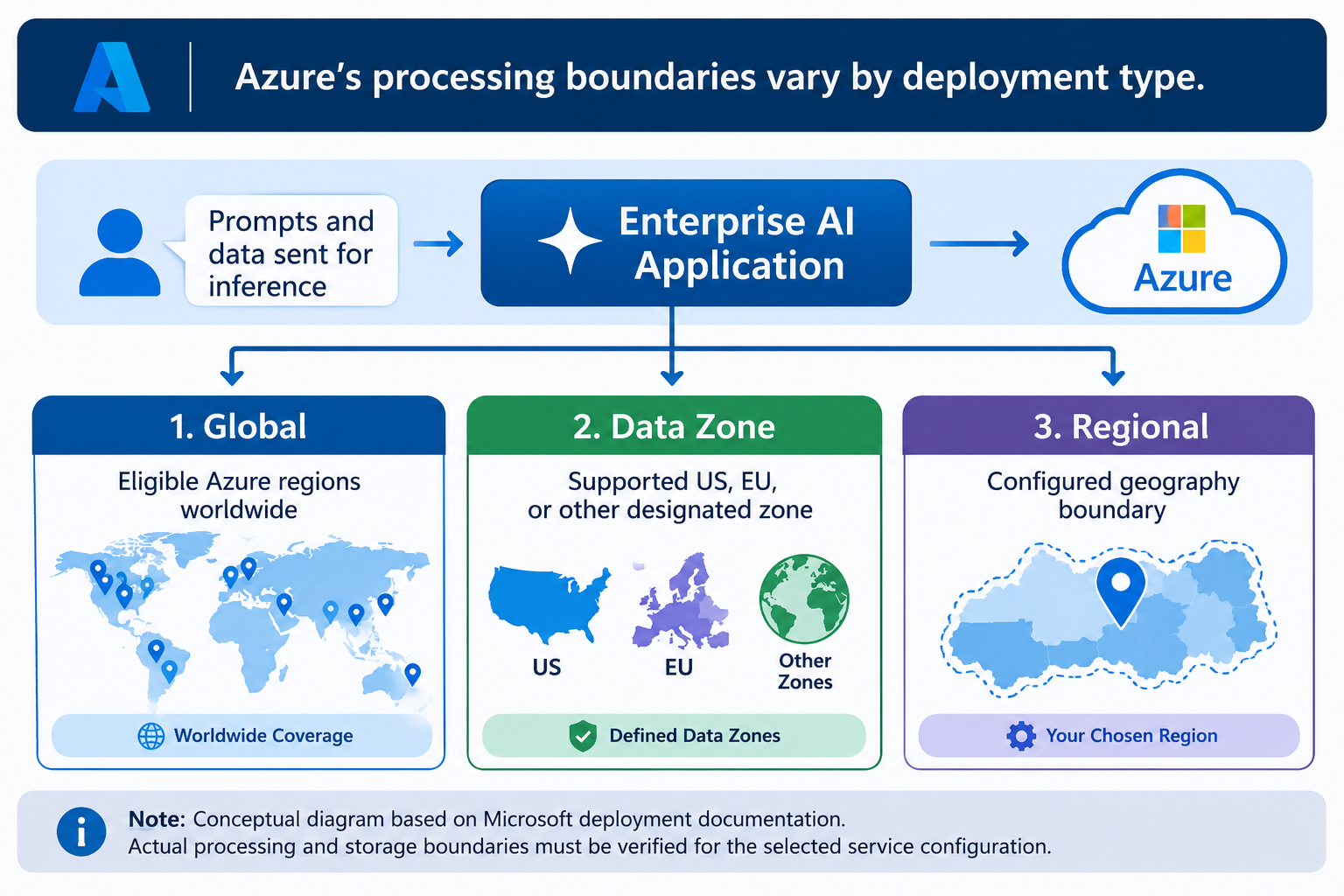
Azure offers deployment options with different processing boundaries.
Global deployments can process inference requests across eligible Azure regions. Data Zone deployments keep processing within a supported zone, such as the US or EU. Regional deployments follow the geography boundaries associated with their configuration.
These distinctions matter when balancing infrastructure flexibility against data residency requirements.
What Are Provisioned Throughput Units?
Provisioned Throughput Units reserve model-processing capacity.
Unlike token-based billing, PTUs are charged according to allocated capacity, regardless of whether it is fully utilized.
Microsoft supports hourly charges and discounted reservations for sustained deployments, making PTUs worth evaluating when workloads require consistent throughput.
Azure OpenAI Pricing by Model: USD and INR Comparison
Model selection substantially influences inference spending. Smaller models are generally less expensive, while larger models may offer stronger performance for complex workloads.
The following table summarizes published Global Standard token rates.
| Model | Input / 1M USD | Output / 1M USD | Input / 1M INR | Output / 1M INR |
|---|---|---|---|---|
| GPT-4.1 | $2.00 | $8.00 | ₹190.74 | ₹762.95 |
| GPT-4.1 mini | $0.40 | $1.60 | ₹38.15 | ₹152.59 |
| GPT-4.1 nano | $0.10 | $0.40 | ₹9.54 | ₹38.15 |
| GPT-5 mini | $0.25 | $2.00 | ₹23.84 | ₹190.74 |
Price reference checked October 30, 2026. Global Standard USD rates are supported by Azure retail-price aggregators; Microsoft’s public pricing page did not expose numerical rates in its accessible rendering. INR amounts are calculated at ₹95.3688/USD, the October 29, 2026 reference rate, before taxes. Verify model version, SKU, and contracted rates using the Azure pricing calculator before purchasing.
Why INR Estimates May Differ From Actual Bills
Microsoft’s currency conversion methodology may differ from the RBI reference rate used for comparison.
Contract terms, billing currency, regional pricing, and applicable Indian taxes can also affect the invoice.
Businesses should therefore treat published INR conversions as planning estimates rather than guaranteed billing amounts.
Azure OpenAI Pricing: Pay-as-You-Go vs Batch vs PTUs
Choosing the right billing method is just as important as selecting the model.
Pay-as-You-Go for Variable Demand
Standard token billing works well for applications with unpredictable traffic.
A developing chatbot or experimental AI assistant can operate without reserving dedicated processing capacity. Expenses increase with usage, making the approach flexible for early deployments.
Batch Processing for Non-Urgent Tasks
Batch processing is suitable for document classification, data enrichment, and large-scale content analysis.
Eligible Azure Batch workloads offer a 50% discount compared with corresponding Standard rates, provided applications can accommodate asynchronous processing.
PTUs for Predictable Enterprise Workloads
Organizations requiring consistent throughput can consider provisioned capacity.
PTUs are billed hourly, with discounted one-month or one-year reservations. However, unused capacity still incurs charges, and reservations must match eligible deployments.
| Billing Model | Best For | Primary Advantage |
|---|---|---|
| Pay-as-you-go | Variable workloads | Flexible spending |
| Batch | Asynchronous processing | Lower token costs |
| PTUs | Sustained production demand | Reserved throughput |
The most economical choice depends on utilization and response-time requirements, not simply monthly token totals.
Hidden Costs Beyond Azure OpenAI Token Pricing
The total Azure OpenAI pricing calculation should extend beyond inference.
Embeddings and Vector Databases
Retrieval-augmented generation applications often require embeddings, vector storage, document indexing, and retrieval services.
These services may be billed separately from model inference.
Fine-Tuning, Monitoring, and Support
Fine-tuning may introduce training, hosting, or specialized inference charges depending on the model and configuration.
Logging, networking, security controls, and support plans also contribute to operational expenditure. Content filtering is integrated into Azure’s model-serving workflow, but additional safety products or customized configurations may carry separate costs.
GST and Currency Conversion
For Indian customers, applicable GST can increase the final payable amount.
Where an 18% GST rate applies, a ₹10,000 taxable service charge would become ₹11,800. Actual tax treatment depends on the purchasing entity and invoice structure.
These additional expenses should be included before approving an enterprise AI budget.
Azure OpenAI Data Residency: What Indian Companies Need to Know
Pricing is only one consideration when enterprise applications process confidential information.
Where Is Enterprise Data Processed?
DPDP Act and Enterprise Compliance
India’s Digital Personal Data Protection Act, 2023 and DPDP Rules, 2025 establish requirements for handling digital personal data, with phased commencement provisions.
Organizations should assess lawful processing, security safeguards, vendor obligations, and applicable cross-border transfer restrictions.
The framework does not automatically require every AI workload to run entirely inside India. Businesses should evaluate their specific obligations before selecting a deployment architecture.
For additional background, see the Ministry of Electronics and Information Technology.
Azure OpenAI vs AWS Bedrock vs Private LLM: Three-Year TCO
The long-term cost comparison changes when businesses evaluate infrastructure ownership rather than individual API requests.
Azure OpenAI and OpenAI API provide managed access to proprietary models. AWS Bedrock and Google Vertex AI offer managed model-serving options with varying pricing structures.
Private alternatives commonly use open-weight models such as Llama, Qwen, or Mistral on customer-controlled GPUs.
When evaluating AWS Bedrock pricing, businesses should compare equivalent model capabilities, input-output token consumption, and provisioned capacity charges.
A realistic private LLM cost assessment must also include hardware, engineering, security, and support.
When Does a Private LLM Become Cheaper?
The private LLM cost becomes more attractive when sustained workloads utilize available infrastructure efficiently.
Unlike API billing, private deployment typically involves a fixed infrastructure commitment plus ongoing operational expenses.
The private LLM deployment cost should therefore be evaluated against both monthly inference expenses and expected utilization.
Monthly Cost vs Token Volume
Illustrative Monthly AI Cost by Token Volume
Hypothetical USD costs, not live vendor rates. Assumes a consistent workload mix and sufficient model capacity.
For a simplified comparison, break-even token volume can be estimated as:
Break-even volume = (Private fixed monthly cost − API fixed monthly cost) ÷ (API marginal cost per million tokens − Private marginal cost per million tokens)
The formula applies when the API has a higher marginal cost and the private deployment has higher fixed costs.
Importantly, private LLM deployment cost should not be judged using GPU rental alone. The calculation must also reflect model evaluations, uptime requirements, failover capacity, staffing, and optimization.
Many organizations discover that a hybrid approach offers a practical compromise: managed APIs for complex or unpredictable tasks and private models for repeatable, high-volume workflows.
How AIVeda Helps Enterprises Deploy Private LLMs
When organizations begin comparing Azure OpenAI pricing with infrastructure ownership, the central question becomes whether a privately operated model can deliver comparable results at an acceptable long-term cost.
AIVeda helps enterprises design, develop, and deploy private large language models within customer-controlled infrastructure, including on-premises, VPC, and hybrid environments.
From Cost Assessment to Deployment
Our private LLM development support helps organizations evaluate greater control over their AI infrastructure.
A typical assessment includes:
- Evaluating model requirements, usage volumes, and data sensitivity.
- Selecting suitable models and available computing resources.
- Estimating infrastructure, integration, and operational expenses.
- Validating performance, security, and deployment feasibility.
This approach helps organizations assess whether the private llm cost supports their financial and technical objectives.
Businesses can also explore AIVeda’s AI proof-of-concept services before committing to a full deployment.
Rather than assuming private infrastructure is always more economical, an initial pilot can establish whether its performance and operating characteristics justify the investment.
Conclusion
Understanding azure openai pricing helps organizations make informed decisions about AI infrastructure and operating expenditure.
Pay-as-you-go services provide flexibility, Batch processing can reduce asynchronous workload costs, and PTUs offer reserved capacity for sustained demand.
However, businesses planning substantial, predictable AI usage should also evaluate private infrastructure. Its economic value depends on model performance, utilization, operational capabilities, and the full ownership period.
For enterprises considering this transition, our private LLM development services provide a starting point for assessing deployment feasibility and long-term economics.
Frequently Asked Questions
1. Is Azure OpenAI cheaper than the OpenAI API?
Not always. Costs depend on the selected model, deployment region, token rates, and reserved capacity. Compare equivalent configurations and enterprise requirements before choosing either platform.
2. Which Azure OpenAI models are available in Indian regions?
Availability changes by Azure region, model version, and deployment type. Check Microsoft’s regional availability matrix for supported Indian regions before planning production infrastructure.
3. What is a PTU, and how is it billed?
A Provisioned Throughput Unit represents reserved model-processing capacity. Azure charges for allocated PTUs hourly, with discounted monthly or annual reservations available for qualifying sustained deployments.
4. Does Microsoft use Azure OpenAI prompts to train models?
Microsoft states that customer prompts and completions are not used to train its foundation models. Review current service documentation for applicable privacy, monitoring, and retention details.
5. How do I estimate my monthly token usage?
Multiply expected monthly requests by average input and output tokens, then apply their respective rates. Include prompt history, retrieval, retries, and growth when forecasting.