
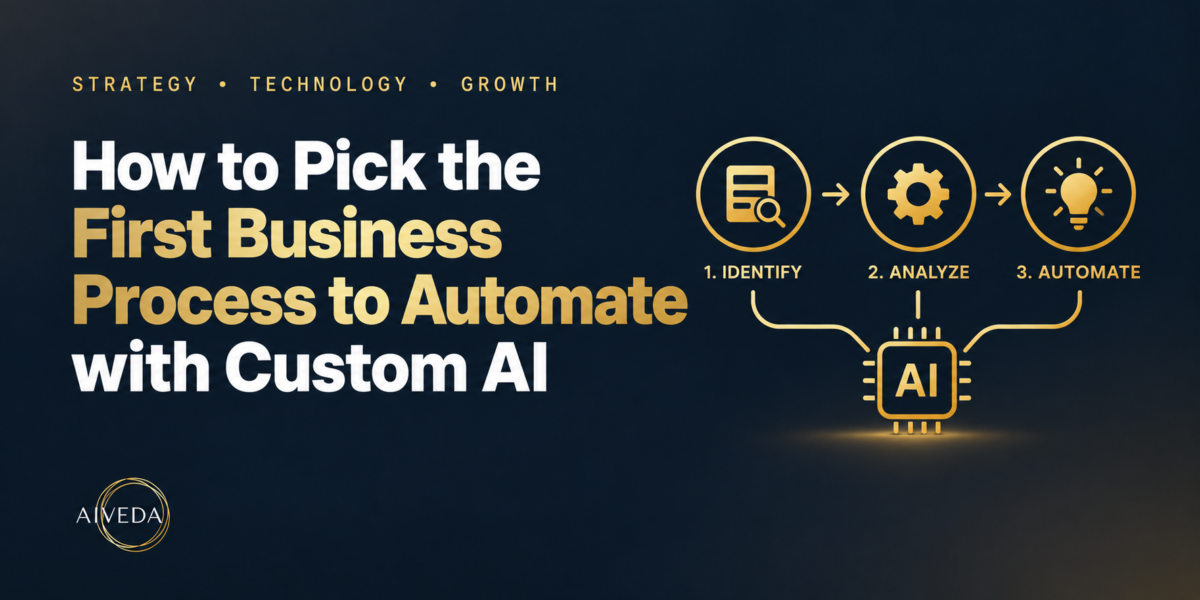
Every enterprise leader eventually asks the same question: We know AI can transform our operations, but where do we actually begin?
It sounds simple, but it is where many automation programs quietly fail. Teams get excited, list thirty possible use cases, try to tackle several at once, and end up with scattered pilots that never reach production. A better enterprise AI strategy starts with a narrower question.
This guide walks through a practical, business-focused way to answer it. You will learn how to spot good candidates, measure their value, check whether your data and systems are ready, weigh the risks, and run a pilot that proves the case for wider adoption. Whether you plan to build in-house or work with a custom AI development company, the same framework applies.
1. Why Start with One Business Process?
The temptation to automate the whole business is understandable. Leadership sees what AI can do and wants results across finance, HR, sales, support and operations at once. In practice, starting broad creates more problems than it solves.
Focus makes learning faster. Your first AI project teaches your organization how to prepare data, manage change, handle exceptions and measure results. Learning these lessons on one process is far cheaper than learning them across ten.
Early wins build trust. Employees are often cautious about automation. A single successful project that visibly removes tedious work does more to win support than any internal presentation.
Resources stay manageable. A narrow scope needs fewer integrations, fewer stakeholders and a smaller review cycle, so you reach a working result sooner.
Risk stays contained. If something goes wrong, the impact is limited to one workflow, not the entire operation.
You create a repeatable playbook. Once the first process is live, you have a template for assessment, development, testing and rollout that later projects can reuse. This is how intelligent process automation scales: one proven process at a time, each building on the last.
Starting with one process is not a lack of ambition. It is the most reliable path to a program that actually ships.
2. Identify Repetitive Tasks
The best automation candidates are usually hiding in plain sight. Look for work that is high in volume, follows recognizable patterns and consumes skilled people’s time on low-judgment steps.
Invoice processing. Staff receive invoices in different formats, extract the vendor, amount and line items, match them against purchase orders, and key the data into an ERP. AI can read varied layouts, extract fields, flag mismatches and route clean invoices straight through.
Document verification. Onboarding, KYC, insurance claims and loan applications all involve checking IDs, certificates, statements and forms. AI can classify documents, extract details, cross-check them for consistency and flag anomalies for human review.
Customer follow-ups. Sales teams and support desks spend hours sending reminders, status updates, renewal notices and feedback requests. AI can draft and send context-aware messages, prioritize which leads need attention and escalate when a customer’s tone suggests a problem.
Data entry and reconciliation. Copying information between emails, spreadsheets, PDFs and business systems is slow and error-prone. It is also one of the clearest places where automation pays off quickly.
Ticket triage and routing. Reading incoming requests, categorizing them and sending them to the right team is repetitive but requires some understanding of language. This is a natural fit for AI.
How to find them in your own business
You do not need a consultant to start the search. Try these approaches:
- Ask the people doing the work. Frontline employees know exactly which tasks they dread and which steps they repeat dozens of times a day.
- Review ticket and email volumes. High-volume inboxes and queues point to repetitive demand.
- Look for handoffs. Processes that bounce between teams, with data re-entered at each step, usually hide delays and errors.
- Check for workarounds. If your team maintains shadow spreadsheets or manual checklists to compensate for system gaps, that process is a strong candidate.
At this stage, build a long list. Do not judge yet. The goal is to collect every plausible candidate so you can evaluate them objectively in the next steps.
3. Evaluate Business Impact
Once you have a list, the next question is: which of these actually matters? A process can be repetitive and still not worth automating if the payoff is small.
Time. How many hours per week or month does the process consume across the team? Include waiting time and rework, not just active effort. A task that takes ten minutes but is performed four hundred times a month represents a lot of capacity.
Cost. What is the fully loaded cost of the process, including labor, errors, delays, late-payment penalties, lost deals or customer churn? Sometimes the most expensive part of a process is not the work itself but the mistakes it produces.
Manual effort and quality. How often do errors occur? How many people touch each item? How frequently does the process create bottlenecks for other teams?
Look beyond efficiency
Impact is not only about saving money. Consider also:
- Speed to customer. Faster onboarding or quicker claim settlement directly improves satisfaction and retention.
- Revenue effect. Does the process delay sales, renewals or collections?
- Compliance exposure. Does manual handling create audit risk?
- Employee experience. Does the work cause burnout or turnover?
A simple scoring approach
For each candidate, assign a score from 1 to 5 for time consumed, cost, error rate and strategic importance. You do not need exact figures at this stage. A rough, honest estimate from process owners is enough to separate the high-value candidates from the nice-to-haves.
The goal is to find processes where automation would be noticed: by finance, by customers, or by the teams doing the work.
4. Check Data and Integration Readiness
A high-impact process is only a good first choice if AI can actually work with it. This is where many promising ideas stall, and where honest assessment saves months of frustration.
Data readiness
Custom AI learns from, and acts on, your data. Ask:
- Is the data available? Can you access past invoices, tickets, contracts or customer records in a usable form?
- Is it sufficient? Does enough historical data exist to train, test and validate a model?
- Is it clean and consistent? Are fields filled in reliably, or does quality vary between teams?
- Is it labeled or easy to label? For many tasks, you need examples of correct outcomes. If experts can quickly label a sample, that may be enough to start.
- Is it governed? Do you have the right to use this data, and are privacy, security and retention rules clear?
If the data is messy, that does not automatically rule the process out. But it does shift your timeline and budget, and it should affect your priority ranking.
Integration readiness
An AI model that lives in isolation delivers little value. It needs to read from and write to the systems your teams already use.
- Can it connect to your CRM, ERP or other core systems? Check whether those platforms offer APIs, webhooks or database access.
- Where does the process start and end? Map the inputs (emails, uploads, forms) and outputs (updated records, notifications, approvals).
- Who owns each system? Integration often depends on IT teams and vendors, so involve them early.
- How will security and access control work? Authentication, audit trails and permissions must fit your enterprise standards.
A process that touches one or two well-documented systems is far easier to automate than one scattered across legacy tools with no interfaces. Be realistic here. Integration complexity is one of the most common reasons first projects run late.
5. Assess Risk and Complexity
Not every process is equally forgiving. Before choosing, think about what happens when the AI gets something wrong, because eventually it will in some cases.
Ask about the cost of a mistake
- What is the worst realistic outcome? A wrongly categorized support ticket is an inconvenience. A wrongly approved loan or a misapplied payment is a serious problem.
- Is the error reversible? Can it be caught and fixed before it affects a customer, a regulator or a financial statement?
- Is the process regulated? Finance, healthcare, insurance and legal workflows carry compliance requirements that shape how automation must be designed and audited.
Decide where humans stay involved
Good automation does not mean removing people. It means placing them where their judgment matters most. Common patterns include:
- Human-in-the-loop approval. The AI prepares a recommendation or draft, and a person approves before anything is executed.
- Confidence thresholds. High-confidence items flow through automatically, while uncertain ones are routed to a reviewer.
- Exception handling. Unusual or high-value cases always go to a human.
- Sampling and audits. A portion of automated decisions are reviewed regularly to catch drift or errors.
Consider complexity
Complexity comes from the number of steps, the variety of inputs, the number of exceptions and the number of stakeholders. A process with a clear start, a clear end and a limited set of rules is simpler than one where every case is different.
For a first project, a medium-impact, lower-risk process with well-defined rules is often smarter than the highest-impact one that carries serious consequences. You can tackle the harder ones after you have proven your approach.
6. Choose the First AI Automation Use Case
Now you can bring everything together. You have a long list of candidates and a picture of each one’s impact, readiness and risk. The final step is to prioritize.
Use a simple prioritization matrix
Score each candidate on four dimensions:
| Dimension | Question to ask |
|---|---|
| Business impact | How much time, cost or revenue is at stake? |
| Feasibility | Are data and integrations ready? Is the process well-defined? |
| Risk | How serious is a mistake, and how easy is human oversight? |
| Implementation cost | What will development, integration and change management require? |
Rank candidates by high impact and high feasibility, balanced against manageable risk and reasonable cost. The best first use case usually sits in the sweet spot: clearly valuable, technically achievable and safe enough to learn from.
Characteristics of a strong first use case
- A clear owner who cares about the outcome and can make decisions.
- A measurable baseline, such as current processing time, error rate or cost per item.
- Sufficient volume to show meaningful results.
- Accessible data and a manageable number of integrations.
- Visible benefit that stakeholders will recognize and appreciate.
- Limited downside if early results are imperfect.
Warning signs
Be cautious if the process has no clear owner, depends on undocumented tribal knowledge, relies on data nobody can access, or is so strategically sensitive that any error would trigger a crisis. Those can be excellent second or third projects, but they make difficult starting points.
A thoughtful enterprise AI strategy treats the first project as both a deliverable and an experiment. You are solving a real problem while also building organizational confidence and capability.
7. Run a Small Pilot
Selecting the process is only half the work. A pilot turns your assumptions into evidence.
Define success before you start
Decide, in advance and in numbers, what good looks like. Examples include:
- Reduce invoice processing time from five days to two.
- Achieve 95% accuracy on field extraction.
- Cut manual data entry hours by 60%.
- Respond to customer follow-ups within one hour instead of one day.
Without a measurable target, it is impossible to tell whether the pilot worked, and stakeholders will each judge it by their own standard.
Test on real data
Demos with clean, hand-picked examples are misleading. Use real documents, real tickets and real edge cases, including the messy ones. This is the only way to learn how the system behaves under actual conditions.
Keep the scope tight
Limit the pilot to one team, one region, one document type or one product line. Run it for a fixed period, often four to eight weeks, and compare results against your baseline.
Keep humans in the loop
During the pilot, have people review outputs, correct errors and provide feedback. This improves the model and also builds trust among the employees who will eventually work alongside it.
Track more than accuracy
Monitor processing time, exception rates, user satisfaction, cost per transaction and any operational problems. Capture what the system handles well and where it struggles.
Decide what happens next
At the end of the pilot, you should be able to answer three questions: Did it meet the success metric? What needs improvement? Is it ready to scale? If the results are strong, expand to more volume and more teams. If they are mixed, refine the model or adjust the scope. If the case is weak, you have learned that cheaply and can move on to the next candidate.
8. How AIVeda Helps
Choosing and delivering your first automation is easier with an experienced partner. As a custom AI development company, AIVeda supports organizations at every stage of this journey.
Workflow assessment. AIVeda works with your teams to map current processes, identify automation opportunities and score them on impact, feasibility and risk, so you start with the right use case rather than the most obvious one.
Custom AI development. Instead of forcing your process into a generic tool, AIVeda builds models and agents tailored to your documents, data, rules and terminology. This matters because the real value of custom AI development lies in fitting how your business actually operates.
Integrations. AIVeda connects AI solutions to your existing CRM, ERP and other enterprise systems, so automated work flows into the places your teams already use, with the right security and access controls.
Production deployment. Many AI projects never get past the prototype. AIVeda supports testing, monitoring, governance and rollout so your pilot becomes a dependable production system, with human-approval steps designed where they matter.
A foundation for growth. Once your first process succeeds, AIVeda helps you extend the approach to other workflows as part of a broader intelligent process automation roadmap.
If you are weighing where to begin, a short assessment can turn a long list of ideas into a clear, prioritized plan. Visit aiveda.io to start the conversation.
Conclusion
Picking the first business process to automate is less about finding the most exciting use of AI and more about finding the most sensible one. Start with a single process. Look for repetitive, high-volume work. Measure the real impact on time, cost and effort. Check honestly whether your data and systems are ready. Weigh the risks and decide where humans should stay in control. Then prioritize on impact, feasibility, risk and cost, and prove the idea with a small, measurable pilot on real data.
Organizations that follow this path tend to avoid the common traps of scattered experiments, stalled prototypes and unclear results. Instead, they build momentum: one successful automation, one trusted playbook and one confident team at a time. That steady approach is the foundation of any lasting enterprise AI strategy.
If you are ready to identify your best first use case, a partner with experience in custom AI development can help you move from idea to production faster and with fewer surprises.
Frequently Asked Questions (FAQs)
- Why should we automate one process first instead of several at once?
A single process keeps scope, cost and risk under control. It lets your team learn how to prepare data, integrate systems and manage change, and it produces a visible win that builds support for further automation. - What types of processes are best suited for custom AI automation?
Processes that are high in volume, repetitive and based on documents, text or structured data work well. Common examples include invoice processing, document verification, customer follow-ups, data entry and ticket triage. - How do I know if a process is worth automating?
Estimate the time, cost and manual effort it consumes, along with its error rate and effect on customers or revenue. If automation would produce a noticeable, measurable improvement, it is worth considering. - What data do we need before starting an AI automation project?
You need accessible, reasonably clean data that represents the process, such as past documents, records or tickets, plus examples of correct outcomes. The data should also be governed, meaning you have the right to use it and appropriate security controls are in place. - Can custom AI integrate with our existing CRM and ERP systems?
In most cases, yes. Integration usually depends on whether your systems offer APIs or other access methods, so an early technical assessment is important. - How do we manage risk when automating business processes?
Evaluate the impact of potential errors, then design human-approval steps, confidence thresholds and exception handling around them. Start with lower-risk processes and audit outputs regularly. - Will AI automation replace our employees?
Well-designed automation typically removes repetitive tasks so employees can focus on judgment, exceptions and customer relationships. Human oversight remains important, especially for high-stakes decisions. - How long should an AI pilot run?
Many pilots run for roughly four to eight weeks, depending on volume and complexity. The key is to define success metrics in advance and test on real data within a limited scope. - What is the difference between intelligent process automation and traditional automation?
Traditional automation follows fixed rules and struggles with variation. Intelligent process automation adds AI capabilities such as language understanding, document reading and prediction, so it can handle unstructured inputs and more complex decisions. - When should we work with a custom AI development company?
A partner is especially useful when you lack in-house AI expertise, need to integrate with complex systems, or want to move quickly from assessment to production. They can also help you prioritize use cases and avoid common implementation mistakes.