Why the Build vs Buy Decision Matters
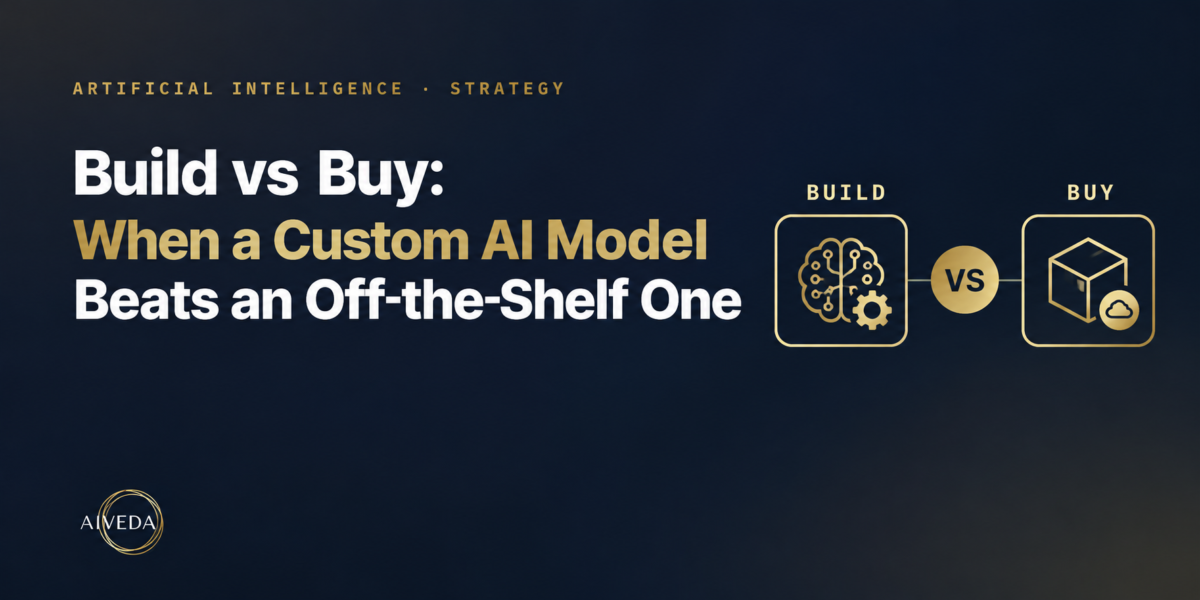
Every enterprise leader exploring artificial intelligence eventually faces the same question: do we buy a ready-made AI product, or do we build something tailored to our business?
It sounds like a simple procurement choice. It is not. The decision shapes your budget for years, determines how well AI fits your workflows, decides who controls your data, and influences whether AI becomes a real competitive advantage or just another subscription on the expense sheet.
The market makes this harder, not easier. Off-the-shelf AI tools are polished, fast to adopt and increasingly capable. At the same time, open-source models, private deployment options and fine-tuning techniques have made custom AI solutions more accessible than they were even a few years ago. Businesses no longer have to choose between “generic but easy” and “tailored but impossible.”
That is why a clear enterprise AI strategy starts with an honest build-vs-buy analysis. Choose wrong in one direction and you overspend on a custom model you did not need. Choose wrong in the other and you end up locked into a generic tool that cannot handle your data, your compliance rules or your unique processes.
This guide walks through both options, compares them across the factors that matter, and explains when a custom AI model genuinely beats an off-the-shelf one. We also cover a practical third path that many organizations overlook, and how a custom AI development company can help you decide.
What Is Off-the-Shelf AI?
Off-the-shelf AI refers to pre-built models, platforms and applications that are developed by a vendor and sold or licensed to many customers. Think of general-purpose chat assistants, AI-powered CRM features, document summarization tools, transcription services, chatbots with built-in templates, and API access to large foundation models.
You do not train these systems. You configure them, connect them to your tools and start using them.
Benefits of Off-the-Shelf AI
Speed to value. You can often be up and running in days or weeks. There is no data collection phase, no model training and no lengthy development cycle.
Lower upfront cost. Subscription or usage-based pricing means you avoid a large initial investment. This is attractive for teams that want to test AI before committing serious budget.
Proven reliability. Vendors have already tested their products across many customers. Bugs are fixed centrally, and updates arrive automatically.
Minimal technical burden. You do not need a dedicated machine learning team to maintain the tool. The vendor handles infrastructure, scaling and model improvements.
Broad capability. Modern general-purpose models handle a wide range of tasks reasonably well, from drafting emails to summarizing reports to answering common questions.
Limitations of Off-the-Shelf AI
Generic by design. A model built for everyone is optimized for no one in particular. It may not understand your industry terminology, internal processes or the nuances of your customers.
Limited control over data. Depending on the vendor and plan, your prompts and documents may travel to third-party infrastructure. For regulated industries, that can be a deal-breaker.
Customization ceilings. You can usually adjust settings and prompts, but you cannot change how the underlying model behaves or what it was trained on.
Vendor dependency. Pricing, features, usage limits and even the model itself can change on the vendor’s schedule, not yours. Switching later can be costly.
Costs that scale unpredictably. Per-seat or per-token pricing looks cheap at pilot scale. At enterprise volume, the bill can grow much faster than expected.
Shallow integration. Connectors exist for popular tools, but deep integration with legacy systems, proprietary databases or complex internal workflows is often limited.
What Is Custom AI?
Custom AI means building or adapting a model specifically for your organization’s data, tasks and constraints. Rather than adopting a one-size-fits-all product, you create a system designed around how your business actually operates.
“Custom” is a spectrum, not a single approach. It can include:
- Training a model from scratch on proprietary data for a highly specialized task, such as a defect-detection system for a specific manufacturing line or a risk model built on years of internal transaction data.
- Fine-tuning an existing foundation model so it learns your domain language, tone, formats and decision patterns.
- Retrieval-augmented generation (RAG), where a model is connected to your private knowledge base so its answers are grounded in your own documents.
- Private LLM deployment, where a large language model runs inside your own cloud or on-premises environment so sensitive data never leaves your control.
- Custom pipelines and agents that combine models, business rules, APIs and human review into workflows built around your processes.
The unifying idea is ownership and fit. A well-designed custom model reflects your data, your requirements and your risk tolerance, and it improves as your business generates more of both.
Why Private AI Plays a Growing Role
Many enterprises are not just asking “can AI do this?” but “can AI do this without exposing our data?” Private AI, including privately hosted large language models, answers that question. It lets organizations use the power of modern AI while keeping sensitive information inside a controlled environment, with clear governance over access, logging and retention.
For companies handling financial records, patient information, legal documents, intellectual property or customer data under strict regulation, private deployment is increasingly a baseline expectation rather than a luxury.
Build vs Buy: A Side-by-Side Comparison
Comparing the two options across the same dimensions makes the trade-offs clearer.
1. Cost
Low upfront cost, predictable at small scale, but recurring fees can compound. Heavy usage, many seats or high token volumes can push total spend well beyond early estimates.
Higher initial investment in discovery, data preparation, engineering, infrastructure and testing. However, once a model is in production, the marginal cost per task can be significantly lower, especially at high volume. The right comparison is total cost of ownership over several years, not the first invoice.
2. Accuracy and Performance
Strong general performance, but accuracy on niche tasks can be inconsistent. The model may produce plausible-sounding answers that miss domain-specific details.
Because the model learns from your data and is evaluated against your own benchmarks, accuracy on your specific tasks can be markedly higher. You can measure and improve performance against the metrics that matter to your business.
3. Security and Compliance
Reputable vendors invest heavily in security, but your data is still processed in their environment. Data residency, retention policies and audit requirements may not fit every regulatory framework.
You decide where the model runs, who can access it and how data is handled. This makes it easier to align with industry regulations, internal policies and regional data laws.
4. Scalability
Vendors handle infrastructure scaling, which is convenient. But you are bound by their rate limits, pricing tiers and capacity.
You own the scaling strategy. That means more responsibility, but also the freedom to optimize for your own traffic patterns, latency needs and cost targets.
5. Integration
Quick to connect to mainstream SaaS tools, harder to embed deeply into proprietary or legacy systems.
Designed from day one to fit your architecture, data sources and workflows. Integration can be as deep as your use case demands.
6. Differentiation
Your competitors can buy the same tool. It improves efficiency but rarely creates a lasting advantage.
A model trained on your unique data and workflows is hard for others to replicate. It can become a genuine strategic asset.
7. Time to Market
Clear winner. Deployment is fast.
Slower to launch, though a focused scope and the right partner can shorten timelines considerably.
| Factor | Off-the-Shelf AI | Custom AI |
|---|---|---|
| Upfront cost | Low | Higher |
| Long-term cost at scale | Can grow quickly | Often more efficient |
| Domain accuracy | Moderate | High |
| Data control | Limited | Full |
| Integration depth | Surface-level | Deep |
| Differentiation | Low | High |
| Speed to launch | Fast | Slower |
When Should You Build Custom AI?
A custom model is not always the answer, but in several situations it clearly beats an off-the-shelf alternative.
1. You Work With Sensitive or Regulated Data
If your workflows involve financial records, health information, legal files, proprietary research or personal customer data, sending that information to a shared external service may create unacceptable risk. A privately deployed or custom-built model keeps data under your control and simplifies compliance conversations with auditors and regulators.
2. Your Workflows Are Highly Specialized
Generic models struggle with niche vocabulary, unusual document formats and domain-specific reasoning. If your team works with specialized contracts, technical manuals, clinical notes, engineering drawings or industry-specific codes, a model trained or fine-tuned on that material will outperform a general-purpose tool.
3. Compliance and Auditability Are Non-Negotiable
Some industries require you to explain how an automated decision was made, log every interaction and prove where data was processed. Custom AI gives you the transparency and control needed to meet those obligations.
4. You Run High-Volume Workloads
When thousands or millions of requests flow through an AI system every month, per-call pricing can become a major line item. At that scale, an optimized, self-hosted model can deliver meaningful cost savings over time.
5. AI Is Central to Your Competitive Advantage
If the capability itself is what sets you apart, such as a proprietary recommendation engine, pricing model or diagnostic tool, you should own it. Renting your core differentiator from a vendor that serves your competitors is a strategic risk.
6. You Need Deep Integration With Existing Systems
When AI must read from legacy databases, trigger actions in internal platforms and follow complex business rules, a purpose-built solution is usually more reliable than stitching together generic connectors.
7. You Want Control Over Model Behavior
Custom development lets you shape tone, guardrails, refusal behavior, output structure and escalation logic. For customer-facing or high-stakes use cases, that control is critical.
If several of these points describe your situation, investing in custom AI solutions is likely to pay off.
When Is Buying Better?
Building is not automatically the smarter choice. Off-the-shelf AI is the right call in many cases.
1. The Use Case Is Simple and Common
Tasks such as meeting transcription, basic email drafting, general customer FAQs or standard document summarization are well served by existing tools. There is little value in reinventing something that already works well.
2. Your Budget Is Limited
Startups and smaller teams often need results quickly without a large upfront commitment. A subscription product lets you capture value immediately and preserve capital for other priorities.
3. You Need Fast Implementation
If a business need is urgent, such as supporting a seasonal surge or testing a new channel, buying gets you live in days, not months.
4. You Lack the Data or Expertise to Build
Custom AI depends on quality data and skilled people. If you do not yet have clean, relevant data or an engineering team to support a model, starting with a bought solution can be more realistic.
5. You Are Still Validating the Idea
Not sure whether AI will help a particular process? Buy a tool, run a pilot and measure impact before investing in something bespoke. The lessons you learn will make any later custom build better targeted.
6. The Task Is Not Strategic
If the function is a commodity capability that does not differentiate your business, there is rarely a good reason to own it.
A Third Option: Customize an Existing Model
Framing the choice as “build from scratch or buy a finished product” misses the approach that works best for many enterprises: start with a strong existing model and adapt it to your needs.
Not every business needs to train a model from the ground up. Training a large model from scratch demands enormous data, compute and expertise, and for most use cases it is simply unnecessary. Instead, organizations can take a capable foundation model, open-source or commercial, and customize it in several ways.
Fine-tuning. Adjust a pre-trained model on your own examples so it learns your terminology, formats and preferred responses.
RAG (retrieval-augmented generation). Connect the model to your internal documents, wikis and databases so its answers are grounded in current, company-specific information without retraining.
Prompt and workflow engineering. Design structured prompts, tools and multi-step flows that guide the model toward consistent, reliable outputs.
Private deployment. Host the model in your own environment to protect sensitive data while still benefiting from state-of-the-art capabilities.
Guardrails and evaluation. Add safety layers, monitoring and testing so the system behaves predictably in production.
This hybrid approach offers much of the accuracy, control and security of a fully custom build at a fraction of the time and cost. It is also flexible. You can begin with light customization, measure results and deepen the investment where the returns justify it.
For many organizations, the best enterprise AI strategy is not “build” or “buy” but a portfolio: buy for commodity tasks, customize for specialized workflows and build from scratch only where the model itself is a strategic asset.
A Practical Framework for Deciding
If you are weighing your options, work through these questions with your stakeholders:
- How sensitive is the data involved? The more sensitive, the stronger the case for private or custom deployment.
- How specialized is the task? Niche domains favor fine-tuning or custom models.
- How strategic is the capability? Differentiating capabilities deserve ownership.
- What is the expected volume? High volume changes the cost equation.
- What are the compliance requirements? Regulatory pressure raises the bar for control and auditability.
- What is your timeline and budget? Be realistic about what you can invest now and later.
- Do you have the data and talent? If not, consider a partner.
There is no universal right answer. The point is to make the decision deliberately, with evidence, rather than defaulting to whichever option is easiest to approve.
How AIVeda Helps
Choosing between build and buy is much easier with an experienced partner who has seen both approaches succeed and fail. As a custom AI development company, AIVeda helps enterprises move from uncertainty to a clear, practical plan.
AI consulting and strategy. AIVeda works with your team to identify high-value use cases, assess data readiness and map each opportunity to the right approach: buy, customize or build. The result is a roadmap grounded in business outcomes, not hype.
Custom AI solutions. From fine-tuned models to purpose-built AI applications and agents, AIVeda designs and develops solutions around your workflows, data and goals.
Private LLM engineering. For organizations that cannot compromise on data privacy, AIVeda builds and deploys private large language models that run within your controlled environment, so you gain the power of generative AI without exposing sensitive information.
Secure deployment. Security, governance and compliance are built into the architecture from the start, including access controls, monitoring and deployment aligned with your regulatory requirements.
Integration and scale. AIVeda connects AI to your existing systems and prepares it to grow with your usage, so pilots turn into production-grade solutions rather than stalled experiments.
Whether you are just beginning to shape your enterprise AI strategy or ready to commission a custom model, the right starting point is a conversation about your goals, constraints and data.
Conclusion
The build-vs-buy question does not have a single correct answer, but it does have a correct process. Buy when the need is common, the stakes are low and speed matters. Build when your data is sensitive, your workflows are specialized, compliance is strict or the AI capability is central to your competitive edge. And in the large middle ground, customize an existing model so you get tailored performance without the cost and delay of starting from zero.
The organizations that get the most from AI are not the ones that build everything or buy everything. They are the ones that match the approach to the problem, revisit the decision as their needs evolve and treat AI as a long-term capability rather than a one-time purchase.
If you are weighing your options, start by mapping your use cases, your data and your risks. Then work with a team that can help you choose, and deliver, the right path. With the right custom AI solutions and a clear enterprise AI strategy, your AI investment can move from experiment to measurable business impact.
Frequently Asked Questions (FAQ)
- What is the difference between custom AI and off-the-shelf AI?
Off-the-shelf AI is a pre-built product offered to many customers with limited customization. Custom AI is built or adapted specifically for your organization’s data, workflows and requirements, giving you greater accuracy, control and differentiation. - When does a custom AI model outperform an off-the-shelf one?
Custom models tend to win when you handle sensitive or regulated data, work in a specialized domain, need deep integration with internal systems, run high-volume workloads or rely on AI as a core competitive advantage. - Is custom AI always more expensive than buying?
Upfront, usually yes. Over the long term, the picture can reverse. At high usage volumes, recurring subscription and per-token fees can exceed the cost of running an optimized custom or privately hosted model. Always compare total cost of ownership across several years. - Do I need to train a model from scratch to get custom AI?
No. Most enterprises do not need to. Fine-tuning an existing model, using retrieval-augmented generation with your own documents and deploying a private LLM can deliver strong results at much lower cost and complexity. - What is a private LLM, and why does it matter?
A private LLM is a large language model deployed in an environment you control, such as your own cloud or on-premises infrastructure. It matters because it keeps sensitive data from leaving your boundary, supports compliance and gives you control over access and logging. - How long does it take to build a custom AI solution?
Timelines vary with scope, data readiness and integration needs. A focused solution built on an existing model can reach production in a matter of weeks to a few months, while larger, from-scratch builds take longer. A discovery phase helps set realistic expectations. - What data do I need for custom AI development?
You need relevant, representative and reasonably clean data tied to the task, such as documents, transaction records, support conversations or labeled examples. A good partner will assess your data readiness early and recommend ways to close any gaps. - Can I start with an off-the-shelf tool and move to custom AI later?
Yes, and it is often a smart approach. Using a bought tool to validate a use case and learn what matters helps you define requirements for a later custom build. Plan for data portability so you can transition smoothly. - How do I choose a custom AI development company?
Look for proven experience with both fine-tuning and private deployment, a clear approach to security and compliance, strong integration capabilities, transparent communication and a focus on business outcomes rather than technology for its own sake. - How should I build an enterprise AI strategy around build vs buy?
Start with your business goals, then evaluate each use case on data sensitivity, specialization, strategic value, volume, compliance and budget. Buy for commodity tasks, customize for specialized workflows and build where the capability differentiates you. Revisit the plan regularly as your needs and the technology evolve.