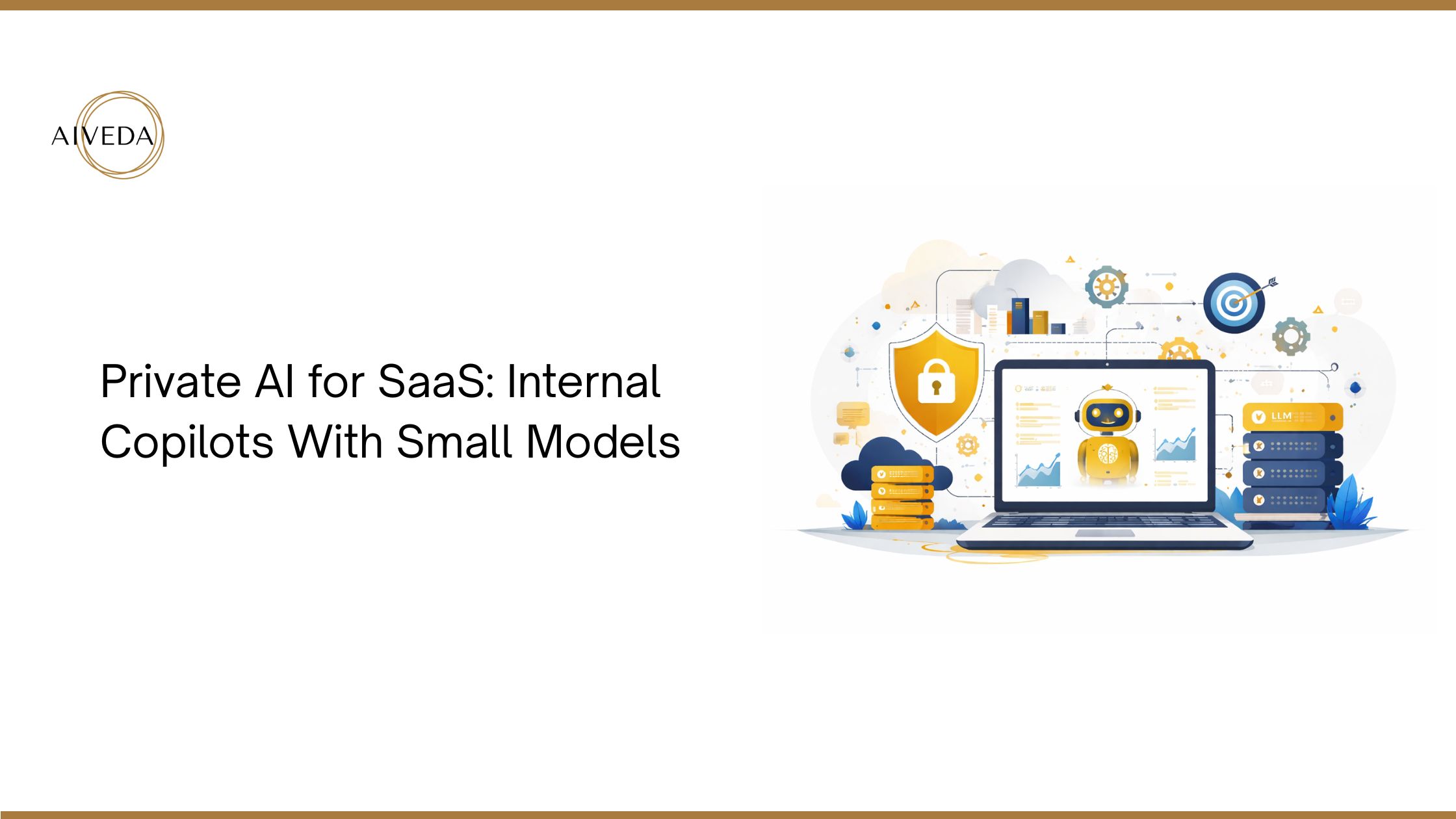
AI’s quick uptake in SaaS platforms has completely changed how companies run, automate, and grow. But this innovation also raises an increasing number of concerns about data control and privacy. Private AI for SaaS becomes crucial in this situation. Organisations are now moving toward safe, internally deployed solutions rather than depending on public AI APIs that can reveal private information.
The emergence of the Internal AI Copilot for SaaS, driven by Small Language Models for SaaS, is a significant innovation propelling this change. These copilots ensure that data stays within organisational bounds while assisting teams in automating operations, supporting decision-making, and increasing productivity.
To protect proprietary data and leverage AI-driven efficiency, modern businesses are increasingly implementing Private AI for SaaS. Organisations are implementing safe AI systems that are customised to meet their specific requirements with the aid of platforms like AIVeda.
What is Private AI for SaaS?
For SaaS, “private AI” refers to AI systems that are installed in an organisation’s infrastructure, either on-site or in a private cloud, guaranteeing complete control over data, models, and operations. Private AI solutions keep all processing internal, in contrast to public AI tools that handle data publicly.
This approach becomes even more critical when compared to public AI systems, especially in terms of security, cost, and control, as explored in Private LLM vs Public LLM
The adoption of a Private LLM for SaaS Applications, which enables businesses to modify models based on their own datasets, is a crucial part of this strategy. These models are made to adhere to stringent data governance while matching business-specific operations.
Furthermore, sensitive business data is never removed from the organisation’s environment thanks to On-Prem AI for SaaS Platforms. This is especially crucial for sectors like finance, healthcare, and corporate SaaS that handle sensitive data.
Private AI for SaaS is a key component of contemporary SaaS design since it allows businesses to strike a compromise between innovation and security.
How to Build Internal AI Copilots for SaaS
There are several straightforward, methodical stages involved in creating internal AI copilots for SaaS:
- Define clear use cases: To guarantee better outcomes, start with particular demands like customer service, developer support, or AI interview solutions for recruiters.
- Choose the right model: Use a Private LLM for SaaS Applications for more complex, customised work, or Small Language Models for SaaS for speed and cost effectiveness.
- Ensure data security: To protect sensitive data, implement On-Prem AI for SaaS platforms. Adopting private AI for SaaS requires this.
- Build a strong data layer: For accurate results, link the copilot to internal data sources such as knowledge bases, CRM systems, and papers.
- Use RAG (Retrieval-Augmented Generation): To help the copilot in retrieving pertinent data in real time and producing context-aware answers.
- Design a simple interface: To improve user experience, incorporate the copilot as an inline assistant or chat assistant into your SaaS platform.
- Monitor and Improve: Keep tabs on performance, get input, and make constant improvements to the system.
Businesses may create safe, effective, and scalable internal copilots with Private AI for SaaS by following these steps.
Why SaaS Companies Need Internal AI Copilots
An Internal AI Copilot for SaaS helps teams complete work more quickly and effectively by functioning as a virtual assistant integrated within SaaS platforms. These copilots are extremely context-aware because they are built to comprehend internal procedures.
For instance, SaaS firms are increasingly utilising copilots for AI interview solutions for recruiters, where AI helps with the evaluation, scheduling, and screening of candidates.
Additionally, Private AI for SaaS guarantees that these copilots function safely without disclosing private client or company information. Internal copilots are being prioritised by organisations due to the combination of automation and privacy.
Also read: Private AI for Enterprises
The Role of Small Language Models in SaaS
Compact, effective AI models created for certain tasks are known as Small Language Models for SaaS. They are perfect for internal deployment because they demand fewer resources than large models.
The speed and cost-effectiveness of Small Language Models for SaaS are two of their main benefits. Compared to large-scale models, they provide quicker reactions and cheaper operating costs. They are therefore ideal for powering copilots in real time.
Improved control is another advantage. Small Language Models for SaaS allow businesses to customise models to fit their own needs. In domain-specific tasks, this guarantees improved accuracy.
Furthermore, these models offer unparalleled security and compliance when used with On-Prem AI for SaaS Platforms. For this reason, smaller, more effective models are becoming more and more important in private AI for SaaS plans.
Architecture of Private AI for SaaS Copilots
Several layers must cooperate harmoniously to build a strong Private AI for SaaS system.
- Data Layer
Internal SaaS data, including customer interactions, operational logs, and company papers, are included in this tier. Within the company, data is kept safe.
- Model Layer
Depending on the use case, the model layer uses either Small Language Models for SaaS or Private LLM for SaaS Applications. These models undergo internal training and refinement.
- Deployment Layer
For SaaS platforms, On-Prem AI is usually used for deployment, guaranteeing complete control over infrastructure and security.
- Security Layer
Private AI for SaaS applications is kept safe and compliant by security methods including encryption, access restriction, and monitoring.
Organisations may implement secure, scalable AI copilots using this architecture without sacrificing data privacy.
Key Use Cases of Private AI for SaaS
Customer Support Automation
Customer satisfaction can be increased by using an internal AI copilot for SaaS to handle customer enquiries, resolve tickets, and deliver prompt responses.
Developers Productivity
Copilots, which use Small Language Models for SaaS, help developers with code recommendations, debugging, and documentation.
Marketing and Sales Perspectives
AI copilots evaluate data to produce useful insights that assist teams in making more informed decisions.
HR and Recripment
In order to expedite hiring procedures, SaaS platforms are including AI interview solutions for recruiters. These systems increase hiring efficiency by automating the evaluation of candidates.
Internal AI Copilot for SaaS is essential to the transformation of operations in all of these use cases.
Benefits of Small Language Models in SaaS
Using private AI for SaaS has a number of benefits.
- Improved Data Privacy: By keeping sensitive information inside the company, breaches are less likely to occur.
- Customisation: Businesses can customise AI models to meet their own requirements with a Private LLM for SaaS Applications.
- Cost Efficiency: SaaS platforms that use On-Prem AI are less dependent on pricey external APIs.
- Expandability: Businesses can expand their AI systems without sacrificing security or performance.
Private AI for SaaS is a wise investment for long-term growth because of these advantages.
Small vs Large Models in SaaS AI Applications
| Aspect | Small Models | Large Models |
|---|---|---|
| Speed | Fast, low latency | Slower responces |
| Cost | Low cost | High cost |
| Use Case | Task-specific (copilots, automation) | General, complex tasks |
| Customisation | Easy to fine-tune | Harder to customise |
| Deployment | On-prem or private setup | Mostly cloud-based |
| Data Privacy | High (supports Private AI for SaaS) | Lower with external APIs |
Summary: Small models are best for efficient, secure SaaS workflows, while large models are suited for broader, more complex AI tasks.
Challenges and How to Overcome Them
While Private AI for SaaS offers significant advantages, it also comes with challenges.
- Fine-Tuning Model : Customizing Small Language Models for SaaS requires expertise and resources.
- Infrastructure Setup: Implementing On-Prem AI for SaaS Platforms can be complex.
- Combination: It takes careful planning to incorporate AI into current SaaS workflows.
Organisations can collaborate with platforms like AIVeda, which specialise in secure AI deployment and customisation, to overcome these obstacles.
Why AIVeda for Private AI for SaaS
AIVeda is made to make it simple and effective for businesses to use private AI for SaaS. It provides:
- Safe On-Prem AI Implementation for SaaS Platforms
- Personalised Private LLM for SaaS Applications
- Scalable infrastructure for business requirements
Organisations may create strong AI copilots while keeping total control over their data by utilising AIVeda.
Contact us to build secure, scalable Private AI for SaaS with powerful internal copilots tailored to your business needs.
In conclusion
Private AI is now important for SaaS companies that prioritise data protection and operational effectiveness. Businesses may fully utilise AI without sacrificing privacy by implementing internal copilots and utilising Small Language Models for SaaS.
Implementing safe and scalable AI systems is now easier than ever thanks to programs like AIVeda. Using private AI will be essential to maintaining an advantage in a cutthroat market as the SaaS landscape changes.
FAQs
1 What makes small models suitable for SaaS AI applications?
Small models are perfect for SaaS workflows since they are quick, economical, and efficient. They don’t require a lot of infrastructure and are easily customisable and safely installed within internal contexts..
2 When should SaaS companies use large language models instead?
When jobs call for sophisticated content creation, multi-domain knowledge, or complex reasoning, large models are helpful. They are perfect for applications that require intelligence that goes beyond certain SaaS procedures.
3 How does Private AI for SaaS improve data security?
By ensuring that all data processing takes place within internal systems or private clouds, private AI for SaaS helps businesses preserve data control and compliance while lowering exposure to third-party threats.
4 Can internal AI copilots integrate with existing SaaS platforms?
Yes, internal AI copilots can be integrated into dashboards, workflows, and tools using APIs. They enhance existing systems by automating tasks and providing real-time insights without disrupting operations.
5 What role does data play in SaaS AI performance?
High-quality, structured data is essential for accurate AI outputs. Internal data sources help models understand context better, improving response quality, personalization, and overall performance in SaaS applications.
About the Author

Avinash Chander
Marketing Head at AIVeda, a master of impactful marketing strategies. Avinash's expertise in digital marketing and brand positioning ensures AIVeda's innovative AI solutions reach the right audience, driving engagement and business growth.