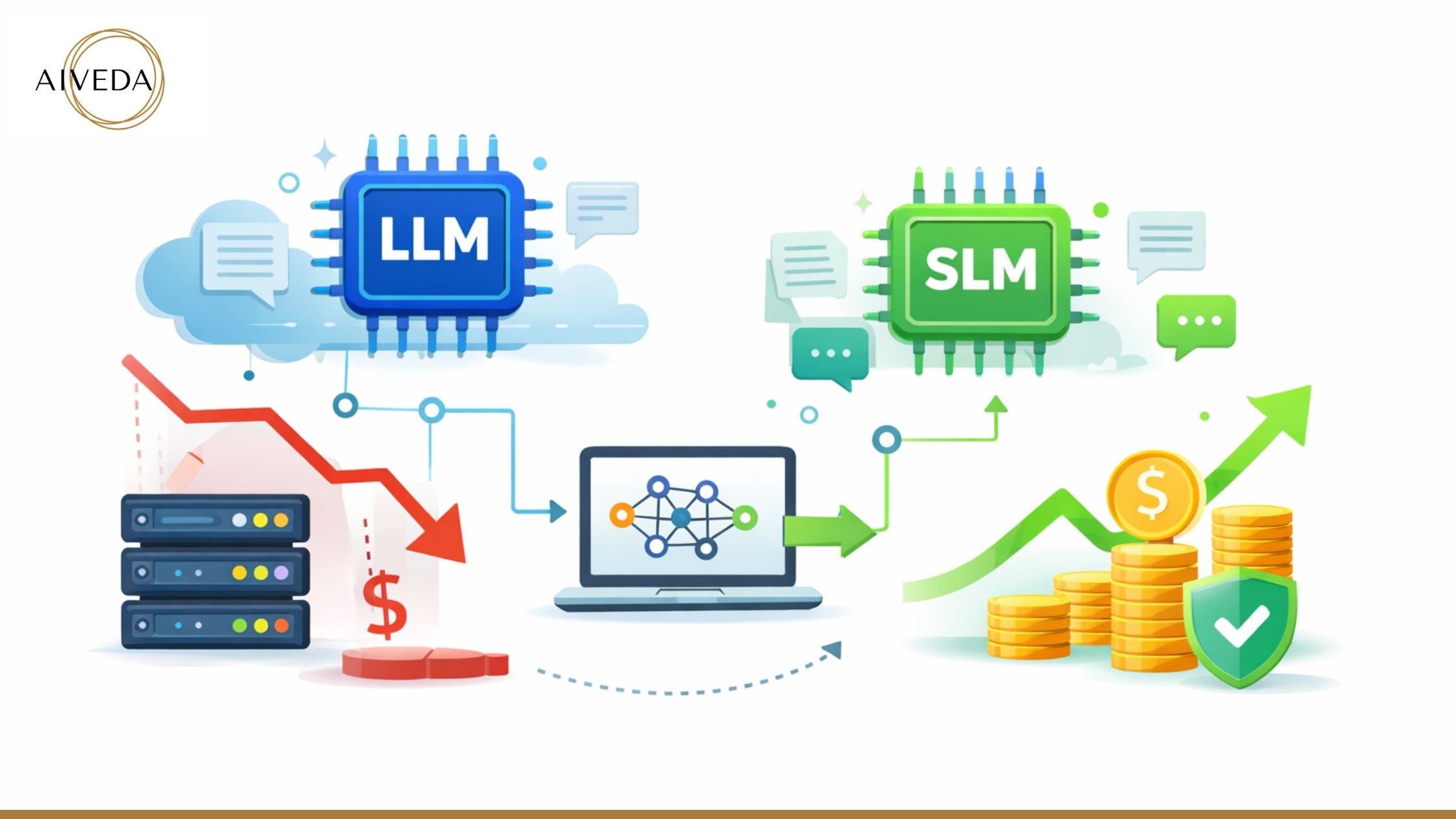
Over the past two years, enterprise AI usage has increased dramatically. However, many businesses are finding that implementing large language models in production presents a major operational challenge: cost. Large models have tremendous capabilities, but the main obstacle to long-term AI adoption is frequently the continuous costs of operating them at scale. LLM inference cost reduction becomes a strategic focus as businesses transition from experimentation to full deployment.
As AI workloads expand across departments, workflows, and customer-facing applications, inference costs mount rapidly for many organisations. Compute resources are used for each prompt, response, and interaction. This utilisation eventually results in rising cloud costs and infrastructure requirements. Infrastructure teams and executives are looking more and more for ways to reduce LLM compute cost without sacrificing performance.
A workable answer to this problem is the use of small language models (SLMs). Businesses can attain small language model cost optimisation while preserving high performance for specific workflows by employing smaller, task-optimized models. Organisations are implementing sustainable techniques for LLM inference cost reduction thanks to this transition toward efficient AI frameworks.
Why Inference Cost Is the Biggest Bottleneck in Enterprise LLM Adoption
Many businesses first test AI using cloud APIs that charge by the token. Although this model is easy to evaluate, when it is used at scale, it rapidly becomes costly. Forecasting is challenging with recurring token-based pricing, and consumption spikes may lead to unforeseen costs.
The scarcity and high price of GPUs present another difficulty. Infrastructure inflation is being driven by the growing demand for GPUs as AI becomes more widely used. Organisations utilizing large language models frequently need many GPUs for each deployment, which raises operating expenses even further.
Production AI workloads also introduce scaling issues. Businesses must manage high concurrency, varying traffic, and stringent latency requirements. Maintaining this performance with large models can significantly increase operational spending, making LLM inference cost reduction a critical goal.
Financial executives are currently carefully assessing AI projects using a return-on-investment perspective. CFOs are pressuring companies to implement designs that reduce LLM compute cost while producing quantifiable business benefit because they want explicit cost governance for AI deployments.
How Small Language Models Deliver Cost and Efficiency Advantages
Small language models provide a fundamentally different approach to AI deployment. SLMs prioritise efficiency and task specialisation above large models with billions of parameters.
They have significantly lower computing requirements due to their smaller parameter footprints. This implies that inference can frequently be performed on less costly hardware, such as CPUs or simple GPU setups. Businesses can thus significantly reduce the cost of small language models.
Infrastructure planning is also made easier by lower memory needs. Organisations can use more workloads on their current hardware with lower VRAM requirements. Effective LLM inference cost reduction is directly impacted by these efficiencies.
Faster inference cycles are a further benefit. Generally speaking, smaller models produce responses faster, enabling businesses to manage higher request volumes with less resources. SLMs are a desirable choice for teams looking to lower LLM computing costs across production systems because of their speed and predictability.
Economic and Operational Drivers for Shifting to SLMs
The transition to SLM-first AI techniques is being accelerated by a number of global developments. The requirement for consistent operating costs is a significant contributing factor. Deploying models internally enables businesses to better plan infrastructure investments and stabilise budgets, in contrast to unpredictable cloud API pricing.
Regulated industries are also prioritizing private AI deployments. Strict control over data processing settings is frequently necessary in the banking, healthcare, and government industries. In these cases, on-prem SLM inference cost strategies provide both compliance benefits and significant LLM inference cost reduction.
Another issue that is becoming more and more important is energy consumption. Large models need a lot of processing power, which raises data center expenses and electricity consumption. Small language model cost optimisation is both economically and environmentally advantageous because smaller models use less energy.
In the end, businesses are increasingly focusing on performance per dollar when optimising AI investments. This shift is driving deeper analysis through SLM vs LLM cost comparison, helping organizations identify the most efficient model architecture for their needs.
Understanding LLM Inference Costs in Production Environments
Core Components of Inference Cost
Examining the elements that lead to inference costs is crucial to understanding how to reduce LLM compute costs.
Compute time is the most important factor. Processing resources, usually GPUs or CPUs, are needed for each AI request. During inference, these resources use computation cycles. The cost per request increases with the length of time the model takes to produce results.
Another important factor is the memory footprint. To store parameters and intermediate activations, large models require VRAM. Memory efficiency is crucial for small language model cost optimisation since hardware that can meet these criteria is costly.
Throughput and latency trade-offs further affect cost. Dedicated hardware resources are frequently allocated by low-latency systems, which can lower utilisation efficiency. Organisations trying to reduce LLM compute costs must strike a balance between performance and resource efficiency.
Lastly, operating expenses are influenced by network and storage overhead. Bandwidth consumption rises with large prompt payloads and answer streams, which becomes important at scale.
Token Generation and Cost Implications
Token creation is a significant contributor to inference costs. Every token processed by a model demands computational resources, making token efficiency critical for LLM inference cost reduction.
In enterprise AI applications, prompt length inflation is a frequent problem. Large context windows and intricate prompts are frequently included by developers, which raises token consumption and expense.
Models that provide verbose outputs may also experience response token amplification. Over time, token buildup can dramatically raise expenses in multi-turn interactions.
This issue is made worse by expanding context windows. Larger context enhances reasoning skills, but it also raises processing demands. To preserve cost effectiveness, businesses must strike a compromise between functionality and small language model cost optimisation.
Scaling Challenges With Large Language Model
Scaling large models is quite difficult. Organisations frequently use GPU clusters, which divide inference requests among several processors, to manage production workloads.
Although this strategy boosts performance, it also raises infrastructure costs and operational complexity. Another problem is idle GPU capacity. Underutilised resources arise from the need for systems to preserve spare capacity for traffic spikes.
Various departments or apps may vie for scarce GPU resources in multi-tenant situations. LLM inference cost reduction may become more challenging as a result of this dispute, which may raise latency and operational expenses.
SLM vs LLM Cost Comparison
Parameter Count and Compute Efficiency
The number of parameters is a crucial consideration when doing an SLM vs LLM cost comparison. To process each request, larger models need exponentially more processing power.
The number of inference-time operations, expressed in floating point operations (FLOPs), rises dramatically as the size of the model increases. Hardware needs also increase significantly as parameter counts reach hundreds of billions.
Another limitation is memory bandwidth. During inference, large models necessitate fast memory transfers, which raises the complexity of the infrastructure. Smaller models are far more efficient, enabling meaningful small language model cost optimisation.
Real-World Cost Benchmarks and Reduction Scenarios
Detailed cost modelling is frequently carried out by businesses assessing LLM inference cost reduction. The per-request costs of privately hosted models and API-based inference are contrasted in these assessments.
SLMs provide significant savings in numerous high-frequency automation settings. Large models’ full reasoning power is rarely used for tasks like document summarisation, categorisation, and process automation.
Organisations can reduce LLM compute cost without sacrificing performance by implementing smaller models for certain workloads.
This is where the SLM vs LLM cost comparison is useful. It makes it possible for infrastructure teams to create architectures that put efficiency first without compromising functionality.
Infrastructure and Energy Impact
Infrastructure efficiency is also an important component in LLM inference cost reduction. Dedicated GPUs, which use a lot of energy, are usually needed for large models.
On the other hand, lightweight accelerators or CPUs can frequently power small models. This reduces hardware dependence and energy consumption, and improves the small language model cost optimisation.
Data center cooling needs are also decreased by lower power use. These efficiencies result in large operational savings over time.
Proven Strategies for LLM Inference Cost Reduction
Quantization and Model Compression
Quantisation is a highly efficient method for LLM inference cost reduction. Memory needs are greatly reduced by translating model weights from high precision forms to 8-bit or 4-bit representations.
This reduction allows models to run on smaller hardware configurations, helping enterprises reduce LLM compute cost.
Pruning, Distillation, and Architectural Optimisation
Smaller models can learn from larger models thanks to knowledge distillation. Small language model cost optimisation is made possible by this technique, which yields compact models with robust performance.
Neural networks are made more efficient by structured pruning, which eliminates superfluous parameters.
Efficient Batching and Intelligent Request Routing
Multiple requests can be processed at once thanks to dynamic batching. This LLM inference cost reduction boosts GPU utilisation.
Additionally, routing systems can assign jobs to the right models. Organisations can lower the cost of LLM computation by using smaller models to accomplish simpler tasks.
Deploying Lightweight Models for High-Frequency Tasks
Large models are not necessary for many repetitive processes in enterprise workflows. FAQ automation, document summarisation, and structured data extraction are a few examples.
Significantly small language model cost optimisation while preserving speed is made possible by deploying small models for certain jobs.
In order to achieve scalable LLM inference cost reduction, companies like AIVeda are assisting businesses in designing these systems.
How Small Language Models Enable Cost-Efficient Inference
Low-Latency Inference for Real-Time Enterprise Workflows
Small models are perfect for real-time enterprise workflows since they provide quicker response times.
The reduced latency of SLM-based systems is advantageous for applications like AI copilots, compliance inspections, and customer service automation. These features help reduce LLM compute cost.
Throughput Gains on CPUs and Edge Hardware
CPU compatibility is one of SLMs’ main advantages. The cost of on-premise SLM inference can be greatly reduced by using many small models that function well on common server hardware.
By reducing GPU dependency, this enables businesses to lower LLM computational costs.
Reducing GPU Dependency With Optimized SLMs
Organisations can achieve strong small language model cost optimisation by using SLMs for normal workloads and allocating GPUs for difficult reasoning tasks.
When to Use SLMs Alone vs Paired With Larger LLMs
Large models and SLMs are combined in hybrid designs. While larger models offer backup reasoning skills, smaller models manage regular activities.
This cascade architecture lowers the cost of LLM inference while increasing efficiency.
Businesses can deploy these hybrid architectures at scale thanks to platforms created by AIVeda.
Resource-Efficient Inference Architectures
The goal of contemporary inference architectures is to minimise operating costs while optimising use. LLM inference cost reduction is facilitated by techniques like serverless deployments, autoscaling infrastructure, and intelligent routing frameworks.
Systems can scale dynamically in response to traffic demand thanks to serverless inference. By doing this, overprovisioning is avoided while peak load performance is maintained. In a similar vein, batch-heavy workloads can operate effectively without resource stalling thanks to asynchronous pipelines.
By dispersing workloads among edge devices, on-premise servers, and cloud settings, hybrid inference techniques also enhance small language model cost optimisation.
On-Prem SLM Deployment as a Cost Control Strategy
One of the most effective strategies to manage AI costs is to implement small models internally. Organisations can avoid ongoing token-based cloud fees by hosting models locally.
This offers reliable budgeting models and significantly lowers the cost of on-premises SLM inference.
By combining CPU-heavy deployments with targeted GPU allocation, businesses can further optimise infrastructure. These methods enable lowering the cost of LLM inference while increasing hardware utilisation.
AIVeda’s solutions assist businesses in deploying safe on-premises AI systems intended for long-term small language model cost optimisation.
MLOps and Monitoring for Continuous Cost Optimisation
Sustained LLM inference cost reduction necessitates ongoing optimisation and monitoring. Metrics like latency per request, computing utilisation, and cost per inference are monitored using cost observability tools.
Teams can more effectively reallocate resources by identifying underutilised hardware or idle GPUs.
Over time, continuous optimisation methods like model repacking and re-quantization enhance small language model cost optimisation even more.
By enforcing use limitations and giving priority to key workloads, automated scaling policies and governance frameworks also assist organisations in reducing LLM compute costs.
Best Practices for Designing Cost-Efficient AI Systems
Choosing the appropriate model for each work should be the primary emphasis of organisations looking to reduce LLM compute cost in a sustainable manner.
Large models are not necessary for many procedures, and using large models results in wasteful spending. Teams can find the most effective architecture by regularly conducting SLM vs LLM cost comparison.
Model utilisation can also be decreased by combining SLMs with retrieval systems. Retrieval-augmented generation lowers costly inference calls while increasing accuracy.
Lastly, businesses may continuously lower LLM computing costs without sacrificing performance thanks to assessment systems that calculate the cost per successful output.
Conclusion: The Economics of SLM-First Enterprise AI
Cost effectiveness becomes as crucial as model capacity as businesses expand their use of AI. Though their operational costs might rapidly increase in production settings, large models offer strong reasoning capabilities.
A more sustainable route ahead is provided by small language models. Organisations may create AI systems with robust performance and predictable infrastructure through small language model cost optimisation.
Businesses can achieve long-term LLM inference cost reduction by implementing hybrid architectures, streamlining inference pipelines, and funding ongoing monitoring. SLM-first architectures are starting to provide the basis for scalable and economical AI deployments as platforms like AIVeda continue to develop enterprise AI infrastructure.
FAQ
- Why are inference costs a major challenge in enterprise AI?
Because each AI request uses computational resources, inference costs increase quickly with scale. To achieve sustainable LLM inference cost reduction in commercial deployments, organisations require smaller models and efficient infrastructures.
- How do small language models help reduce compute costs?
Businesses can handle AI workloads more effectively while achieving considerable small language model cost optimisation and lower infrastructure expenses since small language models require fewer parameters and less hardware capacity.
- What is the advantage of on-premise SLM deployment?
On-premises deployments make on-prem SLM inference costs far more predictable and controllable by removing recurrent token-based API fees and giving businesses control over infrastructure utilisation.
- When should enterprises use SLMs instead of large models?
Organisations can lower LLM computing costs without compromising job performance by using SLMs for repetitive or domain-specific operations like summarisation, classification, and automation workflows.
- What role does monitoring play in AI cost optimization?
Monitoring tools track utilization, latency, and cost metrics, enabling teams to identify inefficiencies and continuously implement improvements that support long-term LLM inference cost reduction.
About the Author

Avinash Chander
Marketing Head at AIVeda, a master of impactful marketing strategies. Avinash's expertise in digital marketing and brand positioning ensures AIVeda's innovative AI solutions reach the right audience, driving engagement and business growth.