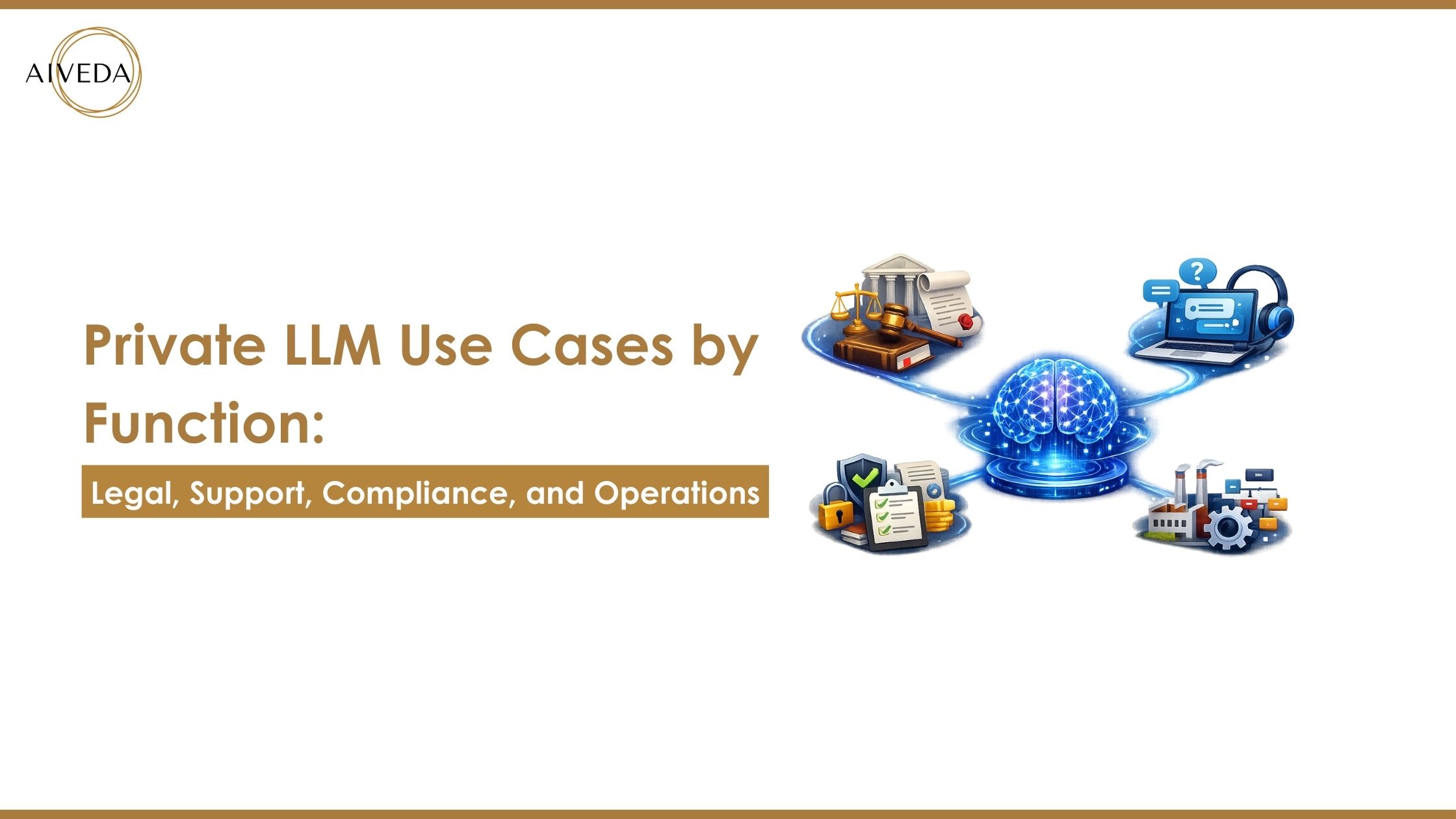
Enterprises no longer experiment with generic AI tools. They now demand precision, control, and measurable outcomes. This shift explains the growing focus on private LLM use cases built for specific business functions. Instead of deploying a single horizontal model across the organization, companies design private LLMs for enterprises that align with legal, support, compliance, and operations needs.
An enterprise private LLM gives teams secure access to AI trained on internal data, policies, and workflows. These systems unlock high-impact private AI use cases without risking data exposure or compliance violations. Platforms like AIVeda help enterprises design and deploy function-specific private LLMs that deliver real business value while maintaining full governance.
Why Enterprises Are Adopting Private LLMs Functionally (Not Generically)
Generic AI tools struggle in enterprise environments. They lack business context, ignore data sensitivity, and offer limited control. Enterprises now adopt private LLM for enterprises that support individual functions rather than the entire organization at once.
Each function works with different data. Legal teams handle confidential contracts. Compliance teams manage regulatory records. Operations teams rely on internal systems. These differences drive demand for private LLM use cases that operate within functional boundaries.
An enterprise private LLM works as a domain-specific intelligence layer. It aligns with security policies, governance frameworks, and ROI expectations. This functional approach turns AI into a reliable business system instead of an experiment.
What Makes Private LLMs Suitable for Function-Level Deployment
A strong enterprise private LLM architecture supports secure, scalable, and role-aware AI. Unlike public models, private LLM deployments give enterprises full control over data and outputs.
Key enablers include private AI infrastructure, secure LLM deployment models, and policy enforcement. These elements allow private LLM use cases to operate safely across sensitive functions.
Learn more about Private LLM Architecture for enterprises
Data Ownership and Isolation
Private LLM data ownership remains the foundation of enterprise adoption.
- Training and inference happen on proprietary datasets
- No data leaks to third-party or public models
- Support for on-prem LLM and VPC LLM deployment
This setup strengthens enterprise data security. Private LLM for enterprises ensures confidential data stays within organizational boundaries, enabling regulated private AI use cases without compromise.
Role-Based Access and Policy Enforcement
Private LLM governance ensures the right people access the right data.
- Role-based AI access by function
- Guardrails based on enterprise AI security policies
- Full audit logs for compliance
An enterprise private LLM enforces permissions at scale. This structure makes AI safe for legal, compliance, and operations teams that need accountability.
Domain Adaptation and Fine-Tuning
A domain-trained LLM outperforms generic models in enterprise settings.
- Fine-tuned private LLMs understand legal language
- Models learn regulatory terminology and workflows
- Higher accuracy than general-purpose LLMs
These capabilities power advanced private LLM use cases where precision matters. Enterprise language models reduce hallucinations and improve decision confidence.
Private LLM Use Cases in Legal Functions
Legal teams manage sensitive, high-risk information daily. Private LLM use cases allow them to automate safely while maintaining confidentiality.
A private LLM for legal teams operates within enterprise boundaries, unlike public legal AI tools.
Contract Review and Risk Analysis
AI contract reviews private LLM solutions support:
- Clause extraction and obligation mapping
- Detection of non-standard or risky language
- Comparison against approved templates
Legal document automation improves speed without sacrificing accuracy. An enterprise private LLM ensures contract data never leaves the organization.
Legal Research and Case Summarization
With legal research, private LLM teams can:
- Query internal case histories and memos
- Securely summarize lengthy documents
- Build an AI legal knowledge base
These private AI use cases reduce research time and improve legal consistency.
Compliance with Data Residency and Confidentiality
Legal data confidentiality AI addresses strict privacy needs.
- Handles privileged information securely
- Aligns with the attorney-client privilege
- Supports secure legal LLM deployments
A private LLM for enterprises ensures compliance without limiting AI capabilities.
Internal Legal Advisory Automation
An internal legal AI assistant delivers:
- First-level responses to routine queries
- Policy-aligned legal guidance
- Reduced reliance on external counsel
This enterprise private LLM boosts efficiency while controlling risk.
Private LLM Use Cases in Customer Support Functions
Support teams handle large volumes of sensitive customer data. Private LLM use cases allow automation without exposure.
A private LLM for customer support operates as an internal system, not a public chatbot.
Secure AI Assistants for Support Agents
A secure artificial intelligence support assistant uses internal standard operating procedures to deliver real-time, context-aware counsel. Private AI copilots, as opposed to public copilots, do not share consumer data with others.
This is a high-impact private LLM use case for corporations looking to scale their support operations.
Knowledge Base Search and Resolution Acceleration
Semantic search private LLMs enable agents to quickly find answers across tickets and documents. Faster resolution decreases escalations while increasing customer satisfaction.
Multilingual Enterprise Support
A multilingual private LLM provides consistent and compliant responses across languages. Enterprises provide consistency in tone, accuracy, and policy adherence around the globe.
Post-interaction Analysis and Quality Monitoring
AI-supported analytics private LLMs summarise tickets and detect recurring issues. These insights contribute to the improvement of products and processes without the need for manual analysis.
Private LLM Use Cases in Compliance and Risk Management
Compliance teams operate under constant regulatory pressure. Private LLM use cases reduce manual workload while improving accuracy. A private LLM for compliance supports regulated AI systems.
Regulatory Document Interpretation
Regulatory AI private LLMs process updates and map them to internal controls. This decreases compliance gaps and response times.
Policy Monitoring and Enforcement
AI policy monitoring analyses internal communications to identify danger indicators. These private AI use cases promote proactive risk management.
Audit Preparation and Evidence Collection
AI audit automation retrieves evidence automatically, hence minimising audit cycles and manual effort.
Explainable AI for Compliance Teams
Explainable private LLMs generate traceable outputs with source references. Transparency is crucial in regulated contexts.
Private LLM Use Cases in Operations and Internal Processes
Operations teams benefit from private LLM use cases that connect systems and data. A private LLM for operations drives internal process automation.
Process Documentation and SOP Intelligence
SOP automation private LLMs provide natural language access to operational playbooks.
Enterprise Search Across Operational Data
Enterprise AI search integrates ERP, CRM, and internal technologies into a single searchable interface.
Workflow Optimisation and Bottleneck Analysis
AI workflow optimisation examines logs and reports to pinpoint inefficiencies.
Internal Reporting and Executive Summaries
AI executive reporting generates organised summaries for leaders to ensure consistent findings.
Cross-Functional Benefits of Private LLM Adoption
Adoption of private LLM use cases provides value that goes beyond particular departments. Enterprises realise lower operational risk in areas such as legal, support, compliance, and operations because sensitive data is kept secure. A private LLM for enterprises improves data governance by requiring consistent policies, access controls, and audit trails across functions.
Another significant advantage is faster time-to-insight. Teams can swiftly retrieve, analyse, and summarise information without requiring manual intervention. Over time, an enterprise private LLM increases AI-business alignment by personalising outputs to specific processes rather than generic applications. These private AI use cases enable organisations to scale AI responsibly while maintaining trust, compliance, and measurable ROI.
Check out our complete guide on Private LLM for more information.
Implementation Considerations for Function-Specific Private LLMs
Model Selection: LLM vs SLM by Function
Small language models enterprise teams use:
- Lower cost
- Faster inference
- Better performance for narrow tasks
SLM vs LLM decisions impact ROI
- Integration with existing enterprise systems
Private LLM integration must support:
- ERP and CRM AI integration
- DMS and compliance tools
- Enterprise AI pipelines
Governance, Monitoring, and Continuous Improvement
AI governance enterprise strategies include:
- Human-in-the-loop review
- Continuous evaluation
- Model monitoring
Future Outlook: From Functional AI to Enterprise AI Fabric
Private LLMs are increasingly becoming the foundational components of a corporate AI fabric. Federated AI solutions allow function-specific models for legal, support, compliance, and operations to collaborate rather than operate independently. This enables organisations to keep data separate while also allowing for shared intelligence across teams.
Over time, insights generated by one function can help others without revealing sensitive information. A private LLM for enterprises progresses from a one-time tool to a coordinated intelligence layer that enables enterprise-wide decision-making. These private LLM use cases are the next step towards scaled, controlled, and connected AI use.
FAQs:
Why are private LLMs preferred for legal and compliance teams?
Private LLMs provide stronger security, data isolation, and governance. They protect sensitive legal and compliance data while ensuring outputs align with regulatory requirements and internal policies.
Can private LLMs be deployed separately for each function?
Yes. Enterprises often deploy function-specific private LLMs trained on distinct datasets. This approach improves accuracy, control, and relevance for each business unit.
How do private LLMs differ from secure SaaS AI tools?
Private LLMs offer full data ownership, customization, and on-prem or VPC deployment. On the other hand, secure SaaS AI tools still involve third-party data ownership.
What data is required to build function-specific private LLMs?
Enterprises use internal documents, policies, historical records, and workflows. Clean, well-labeled enterprise AI training data improves model performance.
How do enterprises measure ROI from functional private LLM deployments?
ROI comes from reduced manual work, faster decisions, lower risk, and improved efficiency. Metrics include time savings, cost reduction, and compliance improvements.
About the Author

Avinash Chander
Marketing Head at AIVeda, a master of impactful marketing strategies. Avinash's expertise in digital marketing and brand positioning ensures AIVeda's innovative AI solutions reach the right audience, driving engagement and business growth.